Fort Dodge debt tops $210M
Revenue bonds for infrastructure work account for $147M; City gets ‘very solid and strong’ rating from investor firm
-
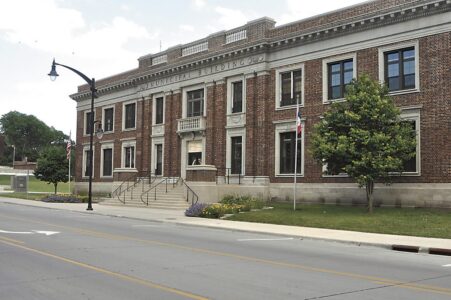
- -Messenger file photo The Muncipal Building, 819 First Ave. S., is shown. The city of Fort Dodge has a variety of debt totaling around $210 million.
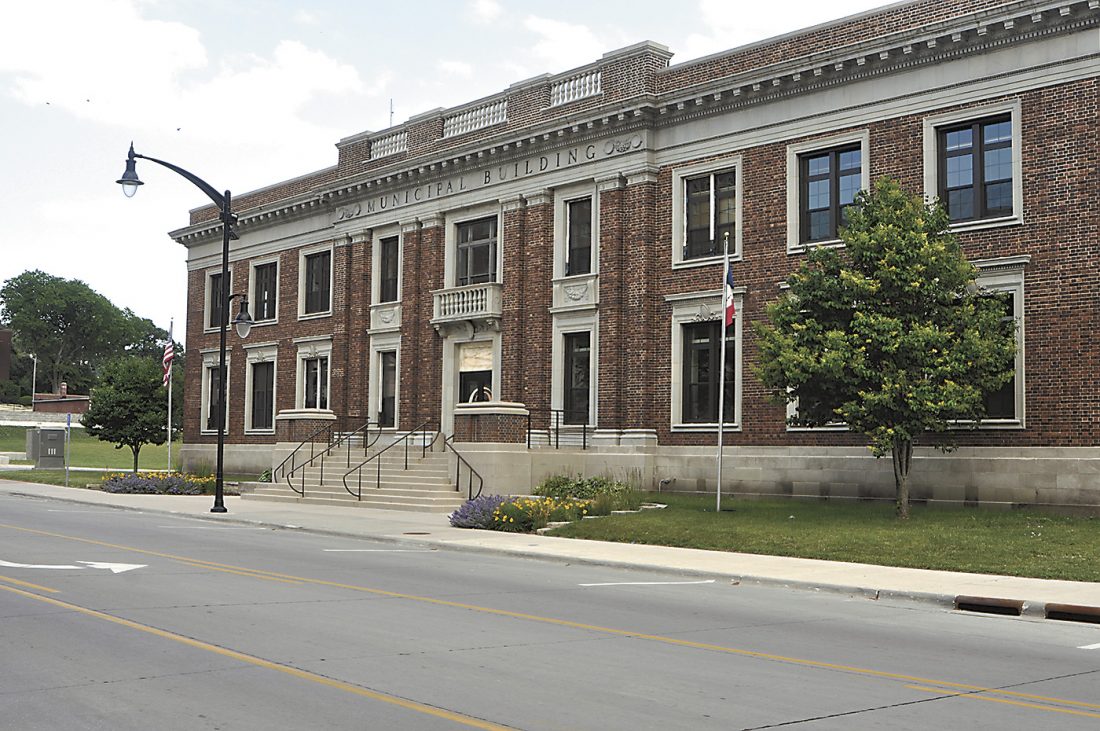
-Messenger file photo The Muncipal Building, 819 First Ave. S., is shown. The city of Fort Dodge has a variety of debt totaling around $210 million.
Every year, Fort Dodge residents borrow money to work on their homes or buy something big, like a new car.
Their city government does the same kind of thing, borrowing money via bond issues to pay for infrastructure work and major purchases, such as buying fire trucks.
The city’s debt is much higher than that of any resident, however.
In the current City Council campaign, some candidates have pegged the debt at $197 million.
That figure is about a year old, according to City Manager David Fierke.
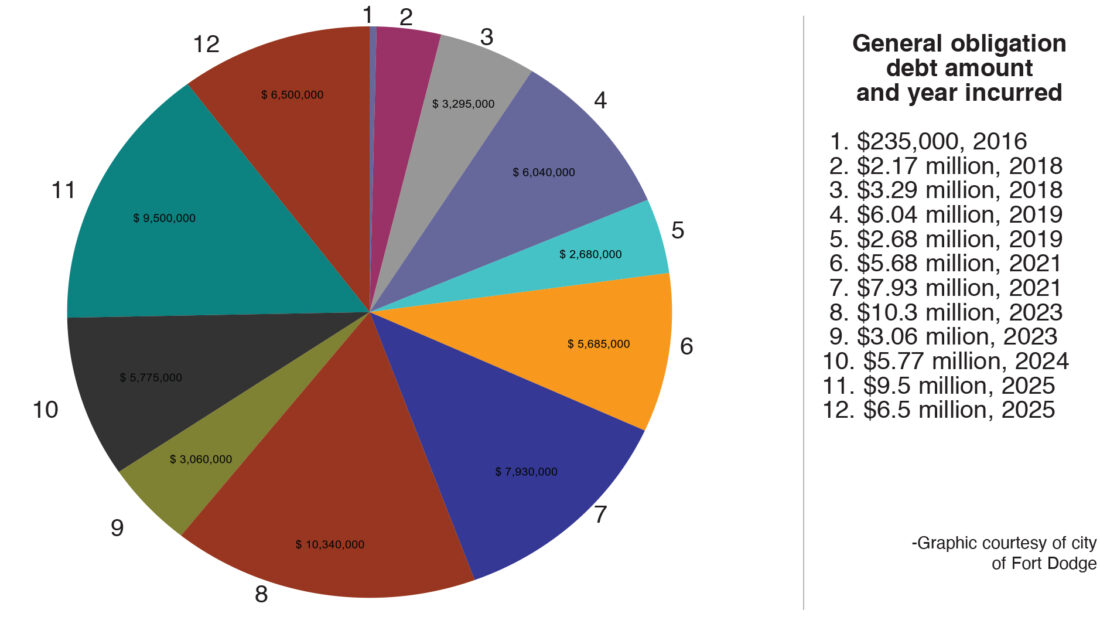
The most current figure he has shows that debt total at $210,950, 859 as of June 30.
Most of that debt — $147,740,850 –will be paid off with revenue from utility bills.
The remaining debt — $63,210,000 –will be paid off with taxes, tax increment financing and the reinvestment district that the state approved for Corridor Plaza.
Fierke said 8 percent of the $210 million total indebtedness is being paid off with property tax revenue.
What are the different types of city debt?
The city borrows money through two different kinds of bond issues.
Most of the debt, about $148 million, is in the form of revenue bonds. Fierke said this kind of debt is paid off with money from water, sanitary sewer and Fort Dodge Fiber bills.
Some of that revenue bond debt is being paid by companies located in the ag industrial park called Iowa’s Crossroads of Global Innovation. Fierke said water and sewer projects completed to serve the park are being paid off by those companies, and not by residents.
He said about $7 million of water debt will be paid off by specific industries instead of all the rate payers.
He added that about $27 million worth of sewer debt is being paid off by industries rather than all the rate payers.
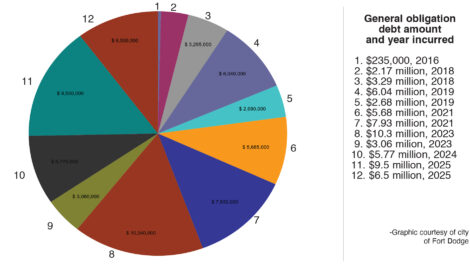
The other kind of bond is called a general obligation bond. The city has about $63 million in general obligation bond debt.
The city levies a property tax of $4.50 per $1,000 of taxable value to pay off general obligation bond debt. Fierke said that levy will pay off about $18 million worth of debt.
The remaining $46 million worth of general obligation bond debt will be retired with money that doesn’t come from residential property tax payers.
Part of that money comes from tax increment financing, which occurs when increased property tax revenue from a designated area is set aside to be reinvested in that area. Often, the city uses tax increment finance revenue to pay off debt that was incurred to do infrastructure projects in those designated zones, which are collectively known as the center city and industrial park urban renewal area.
The reinvestment district at Corridor Plaza enables the city to retain sales tax revenue generated there, which is in turn used to pay off the debt that was incurred to develop the site.
Will the debt impact services?
While the total debt is very large it will not impede the ability to provide services, according to Jeff Nemmers, the city finance director.
That’s because the money to pay off debt comes from a different stream of revenue than the money that pays for providing services, he said.
“The money that goes to paying for services comes out of a different section of the tax levy,” he said. “You cannot use the debt service levy to pay for services.”
Why does the city have so much debt?
Fierke said decades worth of deferred maintenance is at the root of a large portion of the debt. He said for years the city did not invest in its infrastructure. The result, he said, is that the city is having to make significant investments now. The only way to make those investments is to borrow money, he said.
What have the citizens received as a result of all this debt?
One of the biggest single debt line items is $45 million borrowed to pay for sanitary sewer improvements. Fierke pointed to that investment as a major success.
For years, every major rain storm resulted in water getting into sanitary sewer lines, which led to disgusting sewer backups into homes. To try to prevent these messes, Public Works crews used to set up portable pumps to pump out manholes.
In the early 2000s, the city undertook a sanitary sewer evaluation study followed by a multiphase improvement project. All of this is being paid for by revenue bonds which are in turn being paid off with a community sewer initiative fee on the monthly utility bills.
The success of the project, Fierke said, was demonstrated on Sept. 16, when a storm system hovered over Fort Dodge and dumped up to 4 inches of rain. He said there were no complaints about sewers backing up into homes and the Public Works Department did not have to pump out any manholes.
He said another $36 million was borrowed to build the Fort Dodge Fiber broadband system. In a 2019 referendum, voters authorized the city to pursue a municipal broadband utility, approving the measure by a 72 percent majority.
Another $23 million was borrowed to install a reverse osmosis system in the John W. Pray Water Facility. Fierke said that investment brings the city into compliance with regulations and enables residents to use their water softeners less.
What is a Moody’s rating and why does it matter?
Moody’s Investors Service in New York City checks out the financial practices of any local government seeking to issue bonds and gives the community a grade. Investors consider those grades when deciding if they want to loan money to a city by buying its bonds.
Since 2011, the company has given Fort Dodge a rating of Aa3.
Nemmers described that as “very solid and strong.”
“The company that does this all over the world for people who want to buy bonds says we’re pretty good,” Fierke added.
He said the city can get a little bit lower interest rate on its bonds because of that grade.
Local News
New EMS coordinator ready to make an impact

Racing, rodeo, and family fun

Chelesvig honored for 45 years at Iowa Central
Go and Do: July 10, 2026
In Fort Dodge FORT DODGE — Karl L. King Municipal Band Concert is 7:30 p.m. SUNDAY at the Karl L. King Band ...

Tritt concert is moving downtown