
Learning through research
Gustafson puts cover crops to work on Boone farm
-
-
-Messenger photo by Lori Berglund
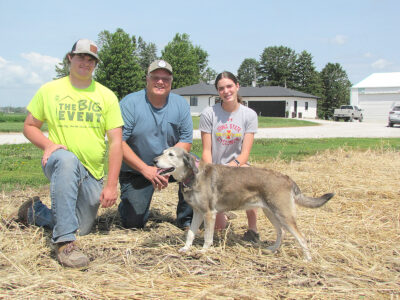
Jeremy Gustafson checks some of the early pumpkin plants emerging from the cover crop. He waits until June 1 to seed so that the pumpkins are ready at the right time. With him are son Henderson and daughter Hadley, along with farm dog Annie.
-Messenger photo by Lori Berglund
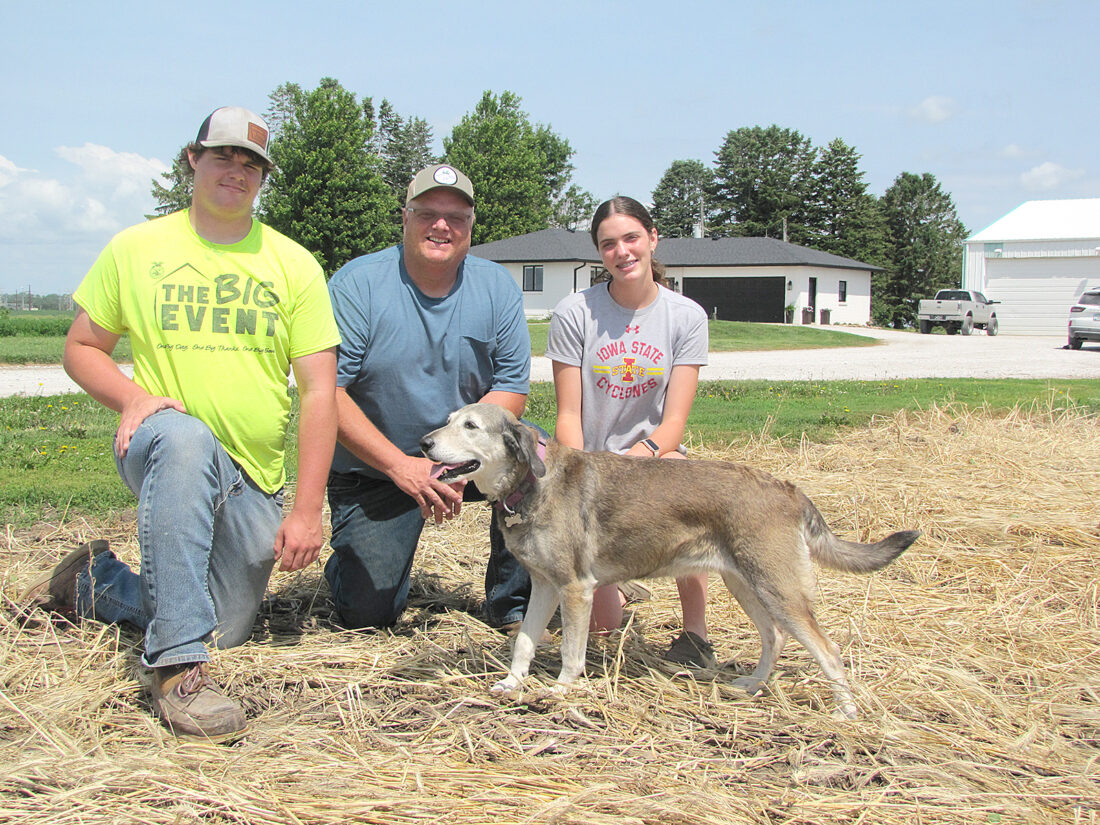
Jeremy Gustafson checks some of the early pumpkin plants emerging from the cover crop. He waits until June 1 to seed so that the pumpkins are ready at the right time. With him are son Henderson and daughter Hadley, along with farm dog Annie.
BOONE — Jeremy Gustafson is always looking for a better way on his family farm a short distance northeast of the Farm Progress site near Boone. That desire to learn is a big part of the reason he sought to learn more about Practical Farmers of Iowa (PFI) several years ago.
“I’ve been a member of Practical Farmers of Iowa for maybe 15 years or more,” Gustafson said. “When we started doing cover crops, I looked at them because at the time they were one of the only groups that were promoting and doing research on it.”
Based in Ames, the way PFI operates is reminiscent of the motto of that other major institution based in Ames, Iowa State University. PFI takes to heart the age-old motto of Iowa State, “Science with Practice.”
The idea that PFI does research on working farms, gathering reliable data, and then helping farmers put that research into practice appealed greatly to Gustafson.
“I got started when they were doing small plots of cover crops to see what would work in Iowa, and they had them all over the state,” he said.
There’s something about knowing that real farmers are running the trials that builds confidence in the information. Gustafson was one of tens of farmers all over the state slated to host field days at their own farms this summer so that other farmers who want to learn more can see the research in action, and talk to the farmer operating the trial.
“We do research trials every year on something,” Gustafson said. “If we have a product or a new technique we want to try in the field, they’ll try to get other farmers together with the same thoughts and put together a replicated trial so we can actually get good data from it. They do all of the work for us. We don’t just say it yielded three bushels more; we can actually say 15 times over five different locations, it was always winning or always losing, and we can apply that to next year.”
Through the years, Gustafson has become a strong advocate for the benefits of cover crops. He plants cover crops on the majority of his corn, soybean and even pumpkin acres.
“The first benefit we always talk about is just erosion control against wind and water,” Gustafson explained. “It seems like it’s windy all the time anymore, and we don’t get just a nice inch of rain. We get two or three inches, and sometimes five. My first goal was to hold all of the soil in place.”
Holding soil in place goes hand in hand with holding water in the soil on the Gustafson farm. He’s a strong believer in the benefits of farm tile, but also sees cover crops as a tool to help protect soil and retain needed moisture.
“We try to capture every raindrop where it lands,” he said. “The more water we can get to infiltrate the soil and not run off, it’s water we have for later in the season. We still have ponds when we get big rains — we can’t hold it all — but we’ve noticed that infiltration is a lot better on our farms that have cover crops.”
Reducing weed pressure is another benefit that Gustafson sees from cover crops. On his three-acre pumpkin patch, the mat from the terminated cover crop provides a cushion for the pumpkins that keeps them clean and reduces disease risk.
The pumpkins and soybeans are each planted on a cereal rye cover.
“Rye is our primary go-to,” Gustafson said. “We also do oats. I did rye and camelina in front of my soybeans this year, and I did camelina and winter wheat in front of my corn ground.”
Camelina, a brassica, is relatively new among cover crops. He is seeing it as a good option on corn ground.
“We want something that will not aggravate the corn,” he said. “When you use rye, you have to be careful not to aggravate the corn because they are both grasses.”
When they decided to start growing pumpkins, Gustafson and his wife, Kelly, designated the revenue from the three-acre patch as a college fund for their three children. It’s an enterprise that was born out of the desire to get the kids involved in the family farm operations.
In addition to protecting the pumpkins from weed and disease, the matted cover crop lifts the pumpkins off the ground and keeps them clean, nice for picking and nice for city folks who may not want to wander in the dirt to pick their own. Even after a rain, it’s usually possible to work in the pumpkin patch without getting muddy.
“When we got out of the hog business, we said, ‘What can we do to still teach our kids how to work?'” he recalled.
The pumpkins are planted about June 1 so that they are ready at the proper time. Gustafson uses his corn planter to put the seed in the ground, and the kids take it from there.
“They do the weeding, most of the picking, and we work together on the pricing,” he said. “The money they make off it is what they are going to use for college.”
More than even the financial gain, Gustafson has seen what the experience has taught his children.
“They know how to work; they know how to communicate with people,” he said.
In other words, they are simply carrying on the long-standing family tradition of farming as a family, sharing in the work as well as the benefits.
Local News

EMS levy money could be flowing soon

Williams starts bid for Iowa House seat
LifeServe offers blood donor incentives
LifeServe Blood Center, which has a facility in Fort Dodge, has launched two donor reward initiatives for 2026 to ...

Police seek shooting suspect

A legacy of service