
WELCOME HOME
Public gets a first look at completed Dodger Stadium renovation project

Photo by Lydia Schuur <br> The ribbon cutting ceremony at Dodger Stadium on Thursday included members from the Greater Fort Dodge Growth Alliance, the Fort Dodge Community School District administration team, and FDCSD board members.
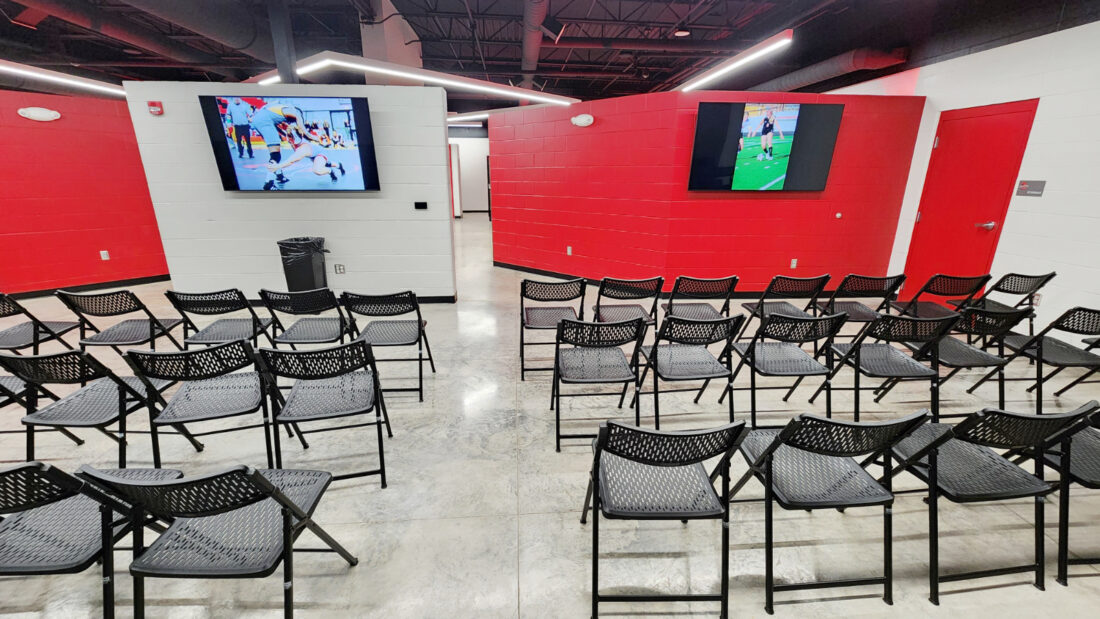
Photo by Lydia Schuur <br> The film room area has multiple screen sets for athletes and coaches to use.

Messenger photo by Eric Pratt <br> The training-room area at the newly-renovated Dodger Stadium in Fort Dodge.

Messenger photo by Eric Pratt <br> The new coaches' office at Dodger Stadium has a clear view of the field.

Messenger photo by Eric Pratt <br>The new locker room area at the renovated Dodger Stadium has ample room for athletes to change and get ready.

Messenger photo by Eric Pratt <br> Members of the Greater Fort Dodge Growth Alliance and Fort Dodge Community School District administrators and board members tour the new Dodger Stadium locker rooms, restrooms and concessions area on Thursday.
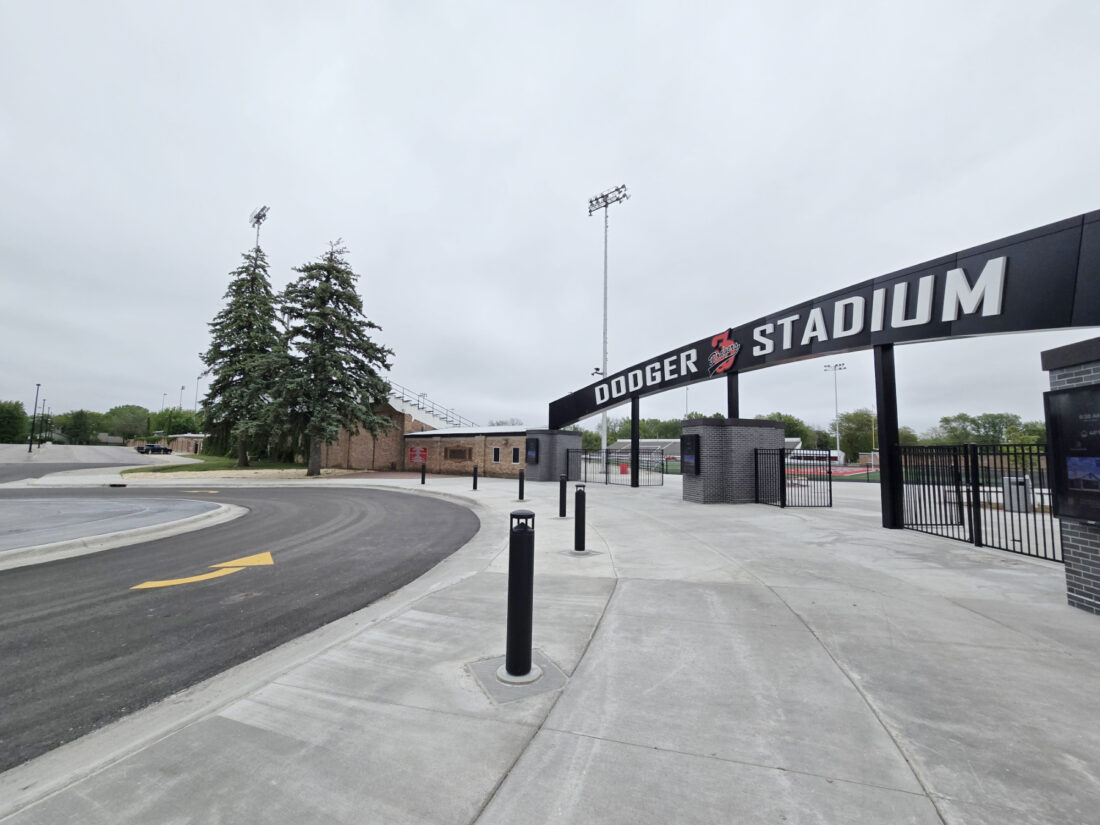
Messenger photo by Eric Pratt <br> The new entrance at Dodger Stadium in Fort Dodge.

Messenger photo by Eric Pratt <br> Greater Fort Dodge Growth Alliance members join Fort Dodge Community School District administrators and board members in a tour around the new Dodger Stadium renovation project area on Thursday.

Messenger photo by Eric Pratt <br> The new concessions area, locker rooms and restrooms at Dodger Stadium in Fort Dodge are shown here, just to the east of the main entrance.

Messenger photo by Eric Pratt <br>The film room is shown here inside the newly-renovated Dodger Stadium locker rooms.

Messenger photo by Eric Pratt <br> A red border glow is on display in the new locker room area when the main lights are out.

Messenger photo by Eric Pratt <br>Members of the Greater Fort Dodge Growth Alliance join Fort Dodge Community School District administrators and board members on Thursday in a tour of the renovated Dodger Stadium.

Messenger photo by Eric Pratt <br>The backside of the new Dodger Stadium concessions area, locker rooms, training rooms and restrooms are shown here.
Photo by Lydia Schuur <br> The ribbon cutting ceremony at Dodger Stadium on Thursday included members from the Greater Fort Dodge Growth Alliance, the Fort Dodge Community School District administration team, and FDCSD board members.
Photo by Lydia Schuur <br> The film room area has multiple screen sets for athletes and coaches to use.
Messenger photo by Eric Pratt <br> The training-room area at the newly-renovated Dodger Stadium in Fort Dodge.
Messenger photo by Eric Pratt <br> The new coaches' office at Dodger Stadium has a clear view of the field.
Messenger photo by Eric Pratt <br>The new locker room area at the renovated Dodger Stadium has ample room for athletes to change and get ready.
Messenger photo by Eric Pratt <br> Members of the Greater Fort Dodge Growth Alliance and Fort Dodge Community School District administrators and board members tour the new Dodger Stadium locker rooms, restrooms and concessions area on Thursday.
Messenger photo by Eric Pratt <br> The new entrance at Dodger Stadium in Fort Dodge.
Messenger photo by Eric Pratt <br> Greater Fort Dodge Growth Alliance members join Fort Dodge Community School District administrators and board members in a tour around the new Dodger Stadium renovation project area on Thursday.
Messenger photo by Eric Pratt <br> The new concessions area, locker rooms and restrooms at Dodger Stadium in Fort Dodge are shown here, just to the east of the main entrance.
Messenger photo by Eric Pratt <br>The film room is shown here inside the newly-renovated Dodger Stadium locker rooms.
Messenger photo by Eric Pratt <br> A red border glow is on display in the new locker room area when the main lights are out.
Messenger photo by Eric Pratt <br>Members of the Greater Fort Dodge Growth Alliance join Fort Dodge Community School District administrators and board members on Thursday in a tour of the renovated Dodger Stadium.
Messenger photo by Eric Pratt <br>The backside of the new Dodger Stadium concessions area, locker rooms, training rooms and restrooms are shown here.
Trending
A celebration decades in the making introduced the new-look Dodger Stadium to hundreds of curious community members on Thursday.
The first major renovation project in the facility's 86-year history is complete, and the public spent all day touring the new concessions area, locker rooms, restrooms and training facilities. A formal ribbon-cutting ceremony brought the Greater Fort Dodge Growth Alliance together with Fort Dodge Community School District administrators and board members just before noon, bookended by an early-morning Dodger football program tour and afternoon filled with multiple open houses.
"It just gives you a big-time feel," FDCSD Superintendent Josh Porter said. "I saw a lot of smiles and heard so many positive conversations. We've emphasized from day one that this is a true community project. We invited teachers and staff from St. Edmond and Iowa Central over to join ours (at 3:30 before the community open house from 5-7).
"This is about Fort Dodge. Dodger Stadium is a cornerstone of this town, and something so many of us take a great deal of pride in caring about. It was nice to be able to show it off with the new features that really addressed both the wants and needs of so many."
Coaches' offices, officials' locker rooms, storage areas and improved parking were also included in the $4.865 million package. A large pavilion area, modern fiber lines, upgraded and additional lighting, extensive camera coverage and an enhanced security system were included as well.
All together, the project covers 8,676 feet of new or renovated space.
In addition, the scoreboard was expanded on the north side of the football field, as nine new panels were added to increase the size.
"When you think about it, no one builds or buys a house and doesn't make any changes for 70, 80, 90 years," Porter said. "We were all kind of thinking the same thing when it comes to addressing some of these issues. It was time.
"It's safer and upgraded in areas where it should be. As a superintendent, you think about that a lot: we have a responsibility to provide a positive environment and experience not just for the student-athletes, but the fans, band members, workers, volunteers and everyone involved in making any activity at Dodger Stadium a successful one. We're trying our best to do things right for everyone across the board."
Kolacia Construction of Fort Dodge served as the project manager. Local businesses Baker Electric, Flooring America, Fort Dodge Asphalt, Hawkeye Masonry, Midstate Plumbing and Heating, Midwest Fence and Gate, Rasch Construction, Stone Creek Landscaping, Cemstone Concrete, Custom Builders Cabinet Shop and Central States Roofing were all a part of the 16-month process, along with Denison Drywall.
The architect was ISG, Inc. of Mankato, Minnesota.
"I honestly think this may be the most well-organized and well-coordinated job I've ever been a part of," said Project Superintendent Craig Kolacia, himself a long-time Fort Dodge resident. "There are a lot of very good people on site who have put their heart and soul into making sure this is done right, and because of that, we're very lucky. Every single contractor has done what they're supposed to do. I think it's a testament to our businesses here ... you aren't going to just go all local for the sake of doing it. When you know the job is going to get done and you can trust the work they do, it's the best of both worlds."
The Fort Dodge Community School District used funds from the physical plant and equipment levy (PPEL), as well as revenue accrued from the 1 percent state sales tax for school infrastructure, to complete the project.
Dodger Stadium was built as part of President Franklin D. Roosevelt's Works Progress Administration plan. The venue officially opened for competition on Oct. 4, 1940. Total project cost at the time was $150,000.
Workers took 385,000 bricks from the old Fort Dodge junior high building on the corner of First Avenue North and 10th Street for the outside-wall structure. Although 60,000 bricks were added to complete the structure, most of the original pieces -- now more than 120 years old -- are still a part of today's framework.
O.C. Pfaff, then-president of the Fort Dodge Board of Education, was the point person for the project. Pfaff kept a low profile and shied away from taking credit.
Fort Dodge had previously played its home football contests at Duncombe Field, next to Duncombe Elementary School.
The baseball field at Dodger Stadium -- designed by former Major League hitting coach Lew Fonseca -- opened for play in 1943. It was named Ed McNeil Field in 1992.
The bleachers on the football and track and field side combine to hold approximately 5,000 people. J.H. Nitzke track was rededicated to honor the legendary Fort Dodge coach in 1994.