
Iowa needs its trees
Master Woodland Stewards learn forestry management skills
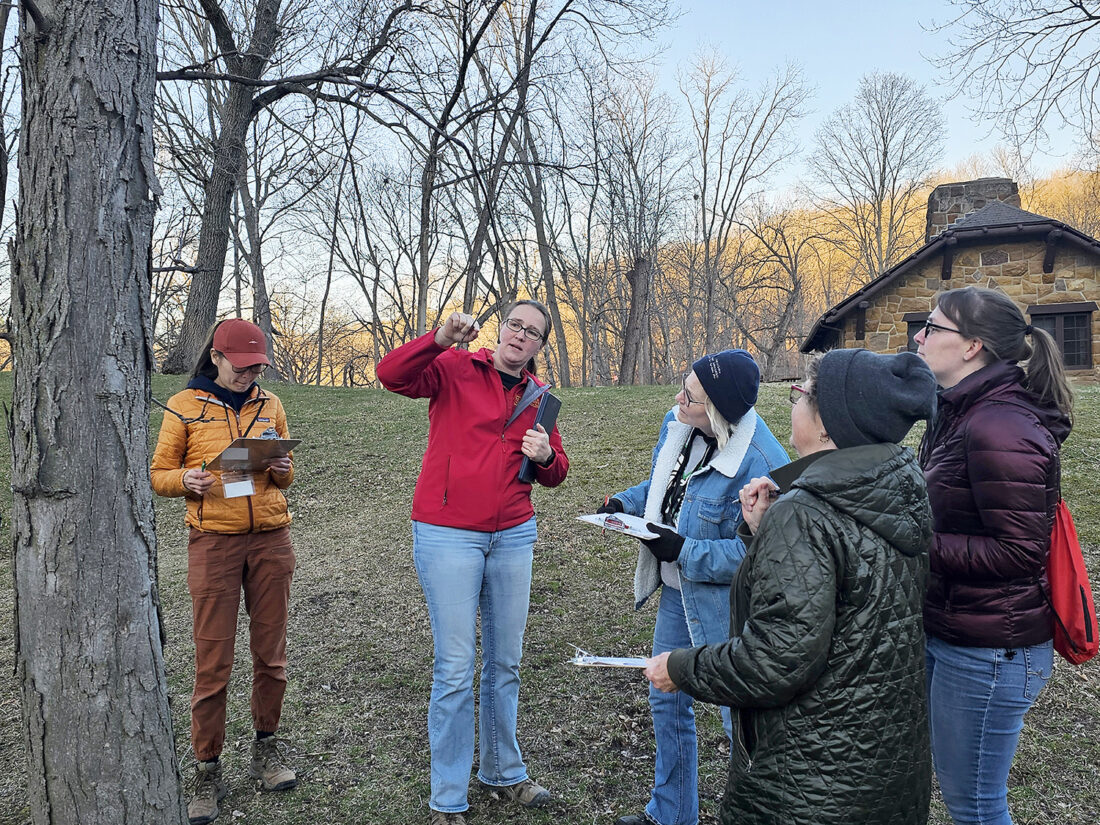
-Messenger photo by Darcy Dougherty Maulsby <br> Jen Merryman, second from left, a forestry specialist with Iowa State University, helped Iowa Master Woodland Steward Program participants with a tree identification exercise at Dolliver Memorial State Park south of Fort Dodge earlier this spring.
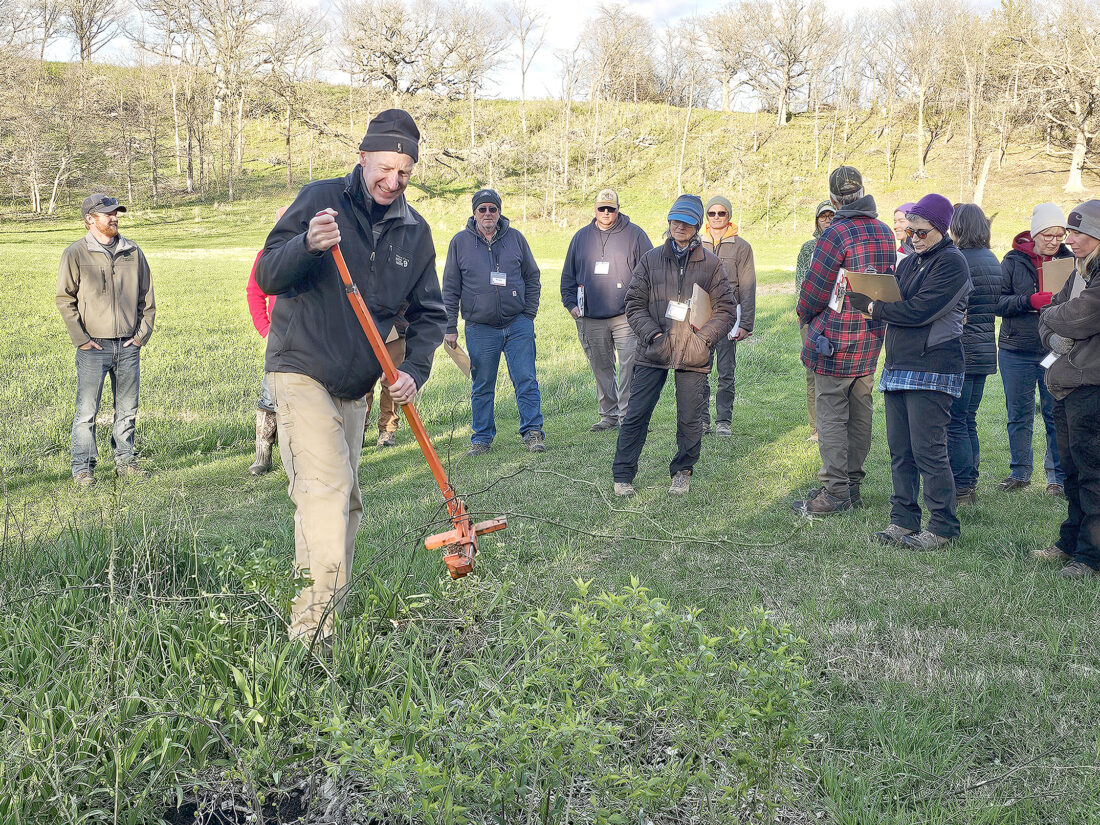
-Messenger photo by Darcy Dougherty Maulsby <br> Dr. Bob Hartzler, a retired ISU Extension weed scientist, second from left, regularly volunteers at the Christiansen Forest Preserve near Huxley. This spring, he showed participants in the Master Woodland Steward Program various ways to remove invasive species.
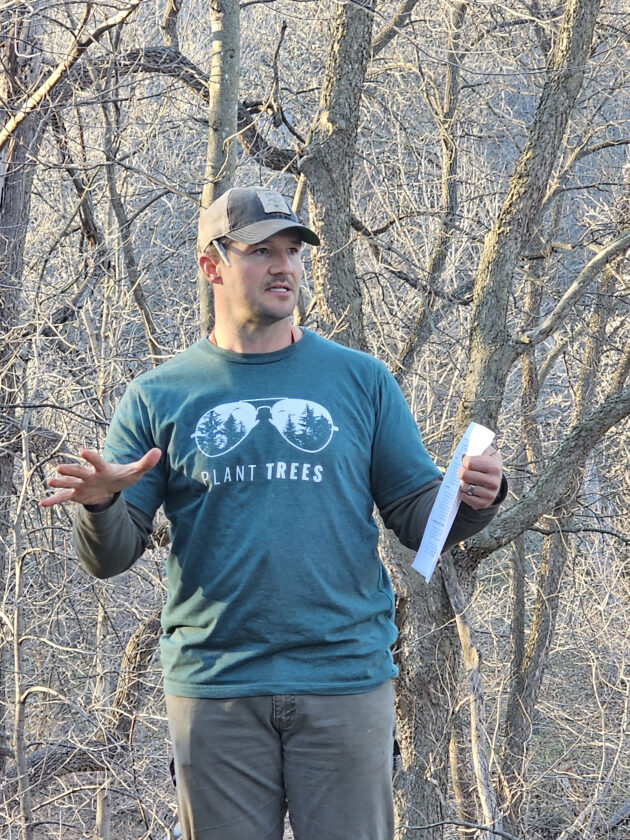
-Messenger photo by Darcy Dougherty Maulsby <br> Most (85 percent) of Iowa’s woodland acres are privately owned by farmers and other landowners, according to Joe Herring, a DNR district forester based in Iowa Falls.
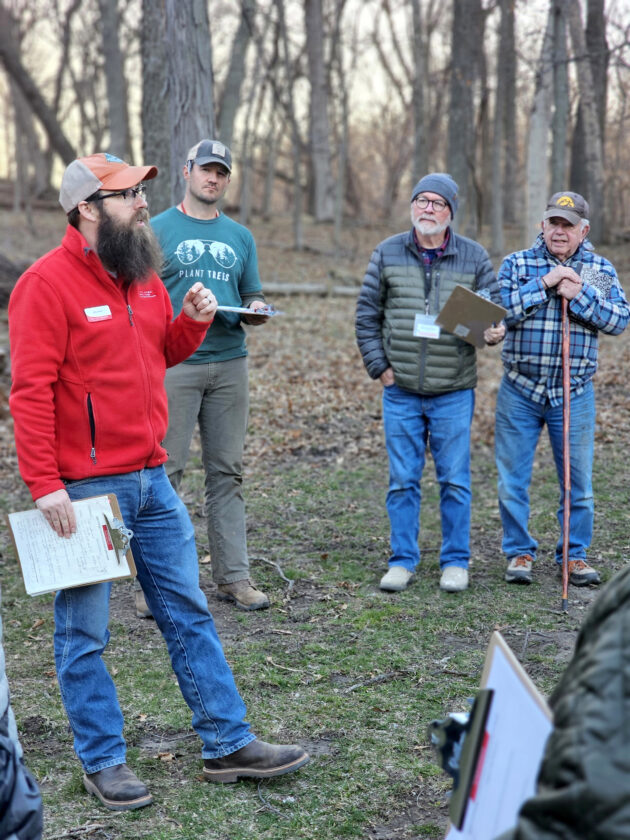
-Messenger photo by Darcy Dougherty Maulsby <br> During an in-person learning module at Dolliver Memorial State Park, William “Billy” Beck (left), an Iowa State University Extension forestry specialist, emphasized that the goal of the Master Woodland Steward Program is to develop a community of highly-motivated, knowledgeable woodland stewards who are champions of forests and forestry in Iowa.
-Messenger photo by Darcy Dougherty Maulsby <br> Jen Merryman, second from left, a forestry specialist with Iowa State University, helped Iowa Master Woodland Steward Program participants with a tree identification exercise at Dolliver Memorial State Park south of Fort Dodge earlier this spring.
-Messenger photo by Darcy Dougherty Maulsby <br> Dr. Bob Hartzler, a retired ISU Extension weed scientist, second from left, regularly volunteers at the Christiansen Forest Preserve near Huxley. This spring, he showed participants in the Master Woodland Steward Program various ways to remove invasive species.
-Messenger photo by Darcy Dougherty Maulsby <br> Most (85 percent) of Iowa’s woodland acres are privately owned by farmers and other landowners, according to Joe Herring, a DNR district forester based in Iowa Falls.
-Messenger photo by Darcy Dougherty Maulsby <br> During an in-person learning module at Dolliver Memorial State Park, William “Billy” Beck (left), an Iowa State University Extension forestry specialist, emphasized that the goal of the Master Woodland Steward Program is to develop a community of highly-motivated, knowledgeable woodland stewards who are champions of forests and forestry in Iowa.
Trending
Iowa may be known for its fields of corn and soybeans, but this fertile landscape also supports a surprising number of trees.
Iowa has approximately 2.85 million acres of forest land that cover 8 percent of the state's land base.
"Since Iowa's population is about 3 million, and we have nearly 3 million acres of woodlands in this state, that means there's about 1 acre of woodland for every Iowan," said Jeff Goerndt, state forester with the Iowa Department of Natural Resources.
Most (85 percent) of these woodland acres are privately owned by farmers and other landowners, added Joe Herring, a DNR district forester based in Iowa Falls. To help more Iowans learn how to manage this natural resource effectively, Iowa State University Extension and Outreach and the DNR offer the Iowa Master Woodland Steward Program (MWSP), which recently completed a seven-week course in north-central Iowa.
"The goal of the MWSP is to develop a community of highly-motivated, knowledgeable woodland stewards who are champions of forests and forestry in Iowa," said William "Billy" Beck, an Iowa State University Extension forestry specialist and assistant professor in ISU's Department of Natural Resource Ecology and Management.
This is important, since trees provide a wide variety of benefits, from windbreaks and wildlife habitat to erosion control. From early April to mid-May, approximately 30 MWSP participants from Madison County to Marshall County to the Des Moines metro completed 30 hours of in-person, intensive forestry training at a variety of parks and other sites around northern and central Iowa, from Dolliver Memorial State Park south of Fort Dodge to Dayton Oaks near Dayton.
The MWSP is designed to serve woodland owners and land managers, school teachers, loggers, government employees, conservation specialists and others. The weekly MWSP module for 2024 covered a range of critical forest topics, including an overview of Iowa's woodlands and forestry; planning and goal setting; how trees grow; how woodlands grow; how woodlands change; woodland management; and passing on your woodland legacy.
Some participants like Jeff and Louisa Perry from Bondurant wanted to learn more about controlling invasive species.
"We have about 7 acres of woodlands and want to learn how to keep honeysuckle from taking over," Louisa Perry said.
Another MWSP participant, Jan McGinnis, owns timber acres around Marshalltown.
"The derecho did a lot of damage and uprooted some older trees," she said. "I signed up for MWSP to learn how to manage these woodlands better."
The MWSP modules are taught by a diverse range of forestry professionals, including DNR staff, ISU faculty and Extension specialists, county conservation staff, private consultants and contractors, loggers and timber buyers, private forest landowners and more.
"Participants also have the opportunity to connect with other people who share their passion for protecting Iowa's invaluable woodland resources," Beck said. "They learn new ways to work with management professionals to improve and expand Iowa's woodland resources."
Preserving and maintaining Iowa's woodlands
While Iowa once had 6 to 8 million acres of forest land prior to pioneer settlement in the 19th century, preserving and protecting Iowa's woodland resources today doesn't mean completely reverting back to the 1840s and 1850s.
"It's important to look forward, and tree planting is a big part of this," Herring said. "It's good to reclaim some of the acres where it makes sense, like along streams."
For more than a century, Iowa has maintained a law to encourage landowners to plant and maintain woodlands and fruit trees in order to restock marginal croplands with trees. In 1906, the Iowa Legislature passed a landowner property tax incentive known as the Forest and Fruit Tree Reservation Act (Chapter 427C of the Code of Iowa) to "reduce or eliminate property taxes to induce landowners to hold their poorer lands in timber not only as a source of farm income but also for erosion control, watershed protection and game cover."
Landowners can still enroll in the Forest and Fruit Tree Reservation Act (commonly known as the "Forest Reserve") and be exempt from property taxes. A landowner's private forestland must meet specific criteria. The law states the forestland must be at least 2 contiguous acres in size, it shall not contain less than 200 growing trees per acre, and no cattle, mules, horses, sheep, goats or hogs are permitted on forest reservations.
Tree planting for windbreaks and shelterbelts can also be part of the Conservation Reserve Program (CRP), noted Herring, who helps write these plans.
So who owns Iowa's woodlands?
The vast majority (85.2%) of Iowa's wooded acres are owned privately. according to 2021 data from the U.S. Department of Agriculture (USDA).
About 11 percent of Iowa's woodlands are managed by state and local governments, while 4 percent are managed by the federal government.
Iowa ranks 15th in forest land acres among the 20 Midwest and Northeast states. Most of Iowa's forest land is able to produce commercial timber. Black walnut and white oak are some of the most valuable trees in Iowa.
"Oak trees are strong, durable and long-lived," Herring said.
Not only do oak trees produce desirable wood resources, but they also provide excellent habitat for songbirds and other wildlife, he added.
Forestry also helps drive Iowa's economy. Iowa's forest-related industries supported nearly 33,656 jobs (directly and indirectly) in 2017, according to the Iowa DNR. This accounted for 8 percent of Iowa's direct manufacturing jobs, and 10.6 percent of non-food manufacturing jobs.
"People don't always think of forestry as an important part of Iowa's economy, but it has a $5 billion impact," Goerndt said.
Proper woodland management is key
Iowa's woodland resources reflect a surprising amount of diversity.
"There are bottomland riparian forests [relating to wetlands adjacent to rivers and streams] and upland forests," said Beck, who noted that there are approximately 65 native tree species in Iowa.
"Forests in northeast Iowa are a lot different than southern Iowa woodlands."
Diversity is a key to successful woodland management. That includes not only species diversity, but age diversity.
"It's good to have three distinct ages of trees on a property, including younger trees, middle-aged trees and older trees," Herring said.
This provides a wider range of wildlife habitat, he added, plus more diverse woodlands tend to have a lower prevalence of damaged trees from diseases, invasive insect species and storm damage.
What's the single biggest threat to Iowa's woodlands?
"Doing nothing," said Goerndt, whose father, Randy, was also a DNR forester. "Lack of management makes it harder for Iowa's forests to manage a variety of threats."
State and national surveys show that most woodland owners aren't aware of all the resources available to help them manage their woodland acres.
Along with ISU Extension and the DNR, woodland owners can connect with the Iowa Woodland Owners Association (IWOA) at iowawoodlandowners.org. Founded in 1987, IWOA offers field days each year, along with the Timber Talk newsletter and additional resources to promote the wise use and management of woodlands in Iowa.
IWOA and ISU Extension encourage people to get involved in educational opportunities like MWSP.
"We look forward to helping more people appreciate the many benefits that trees and woodlands provide," Beck said. "This helps make trees more valuable in people's eyes."