Mosley moves to have cell phone data, interview suppressed
-
-
-Messenger photo by Kelby Wingert
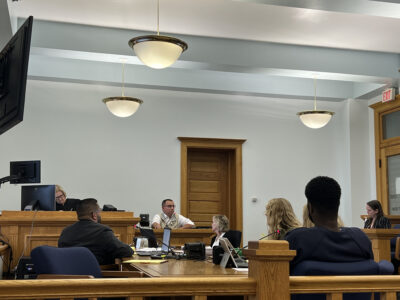
Larry Hedlund, an investigator from the Webster County Attorney’s Office, testifies during a pretrial hearing for defendant Lakendrick Mosley. Mosley is charged with first-degree murder and Hedlund was there to testify about his interview with the defendant at the Webster County Law Enforcement Center during the homicide investigation in January.
-Messenger photo by Kelby Wingert
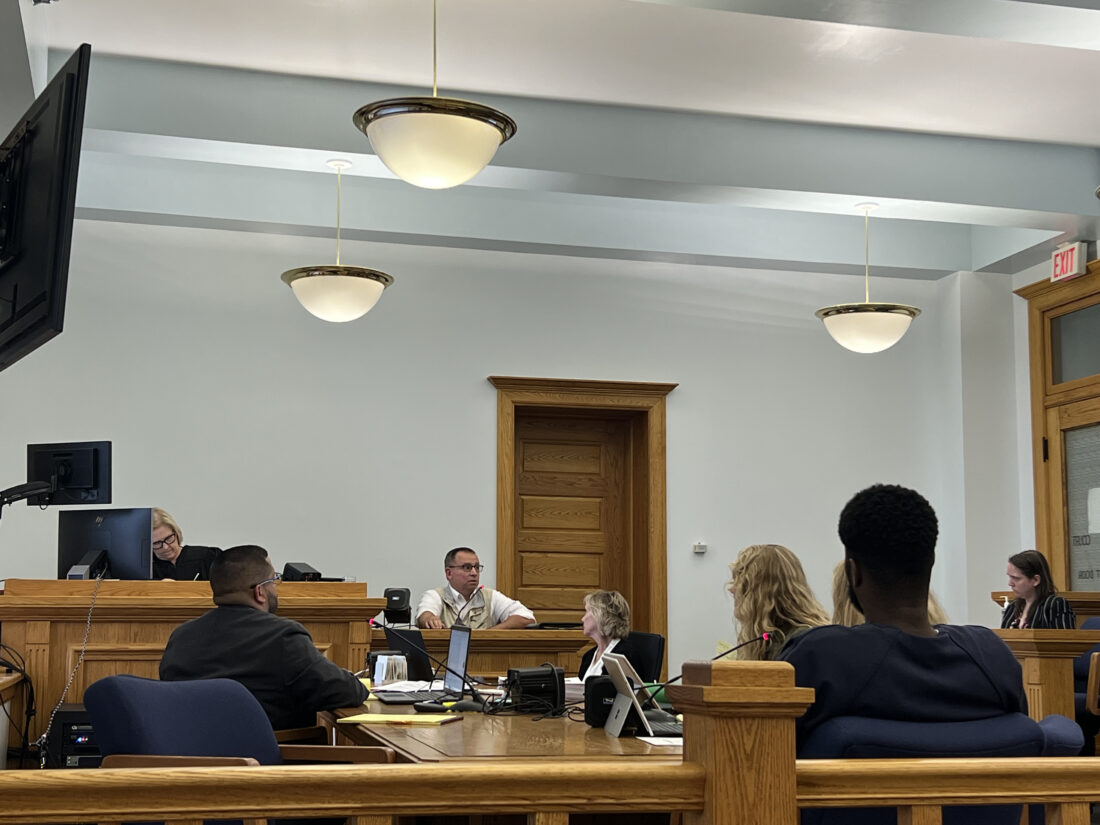
Larry Hedlund, an investigator from the Webster County Attorney's Office, testifies during a pretrial hearing for defendant Lakendrick Mosley. Mosley is charged with first-degree murder and Hedlund was there to testify about his interview with the defendant at the Webster County Law Enforcement Center during the homicide investigation in January.
The use of cell phone location data is being contested in the upcoming murder trial of a man accused of shooting a man in his car in the early morning hours of Christmas Day 2022 in Fort Dodge.
On Wednesday, District Court Judge Angela Doyle heard testimony and arguments for several motions filed by Lakendrick Mosley’s defense team. Mosley, 31, is facing a charge of first-degree murder for the Dec. 25, 2022, shooting death of 46-year-old Montreail Dungy.
The state alleges that Mosley shot and killed Dungy while the victim sat in his own car and that Mosley’s half-brother, Darwin Green, 26, drove the getaway car. Mosley and Green were apprehended and charged with the death in late March.
Data collected from forensic searches of several cell phones, as well as location data subpoenaed from the cellular telephone companies, are key to the state’s case against Mosley, Assistant Attorney General Ryan Baldridge said during the hearing.
The defense objects to the use of the data, arguing that the location information gathered from the wireless carrier violated the Fourth Amendment right against unlawful search and seizure. The defense argues that the search warrants for that information lacked the probable cause needed to justify the search and should not have been issued.
Fort Dodge Police Sgt. Caitlin Carlyle, who wrote the search warrants, testified that cell phone tower information is important for establishing the relative location of a cell phone and can help establish that a person was in the vicinity of an incident when it occurred. She testified that she was able to show probable cause to justify the search warrant based on witness statements, interviews with parties involved and video surveillance of the areas in question.
Carlyle also testified that she knew from witness statements and interviews that Mosley and Green were brothers and that Green had had prior confrontations with Dungy. Green’s girlfriend at the time, Shakiya Clayton, is the mother of Dungy’s 3-year-old child, according to the search warrant.
The defense, led by Assistant Public Defender Laury Kleinschmidt, also argued that the location data that can be gathered by a search warrant of a cell phone is imprecise, citing an article that states that GPS coordinates are “only accurate from 100 meters to 1,000 meters.”
Carlyle testified that in her conversations with Special Agent Holly Witt, the Iowa Division of Criminal Investigation’s expert on cell phone data, she learned that GPS location coordinates obtained from a cell phone can be as accurate as four meters, though she did admit that cell phone location data is not always an “exact science.”
“There’s a lot of factors,” Carlyle said.
However, she said, she was able to confirm the cell phone location data when it was corroborated with security and surveillance video from the area, as well as the Brass Monkey bar, where the individuals involved had been just a few hours prior.
Due to time constraints, the remainder of the hearing and testimony from the defense’s expert witness had to be postponed and rescheduled.
The defense also filed a motion to suppress evidence from an interview of Mosley conducted by Webster County Attorney’s Office Investigator Larry Hedlund. Hedlund interviewed Mosley when Mosley was summoned by a county attorney’s subpoena to the Webster County Law Enforcement Center on Jan. 12.
Earlier in the afternoon, Hedlund took the stand for nearly an hour to testify to the conditions of the interview.
Baldridge, who was the first assistant Webster County attorney at the time of the investigation, was also present at the interview, Hedlund testified. He said that the county attorney’s office used a subpoena to ensure Mosley’s attendance at the meeting, but that the subpoena did not require Mosley to answer any questions and the defendant was free to leave at any time.
Hedlund noted that while Mosley was being interviewed at the LEC, three separate search warrants were being simultaneously executed at residences in Fort Dodge and Des Moines as part of the investigation.
The defense argues that a comment by Mosley at the beginning of the interview was the defendant invoking his right to an attorney and that Hedlund and Baldridge continuing to conduct the interview violated that right and thus any information gathered during the interview should be suppressed at trial.
Baldridge played the audio recording of part of the interview and he and Hedlund can be heard explaining to Mosley that they wanted him to be placed under oath prior to asking him questions. Mosley hesitates and says “If you’re going to put me under oath, maybe I need a lawyer.” The defense asserts that this was Mosley invoking his right to an attorney while being questioned.
“The state’s belief is that he absolutely did not,” Baldridge said. “There’s nothing direct or expressly implied by ‘Maybe I need a lawyer.”
Baldridge noted that existing case law calls for a request for an attorney to be “unequivocal” and unconditional. The “If you’re going to put me under oath,” statement creates a condition for wanting an attorney, he said.
The defense disagrees, arguing that Mosley “made a clear request to have a lawyer present.”
Doyle noted that she would take the testimony and arguments into consideration and issue a written ruling on the motion to suppress the interview and other items noted in the motions. A continuance of the hearing on the motion to suppress the cell phone data will be scheduled prior to trial.
In June, the defense was granted its motion to move the trial out of Webster County. Mosley’s trial is now scheduled to begin Aug. 21 in Cerro Gordo County.
Local News
Fort Dodge Choral Society’s Christmas concert nears
The Fort Dodge Choral Society will perform its annual Christmas concert on Sunday, but members of the group won’t ...
OWI charge against Bemrich dropped
A drunk driving charge against Mayor Matt Bemrich was dropped Wednesday, days after a judge ruled that police had ...
FD Police investigate shots fired incident
A man was detained by police after firing a gun in Fort Dodge Wednesday evening. The incident at 720 B St. was ...

‘Kindness always matters’

Countdown to Christmas