
Infrastructure issues
Webster County Jail is outdated and overcrowded
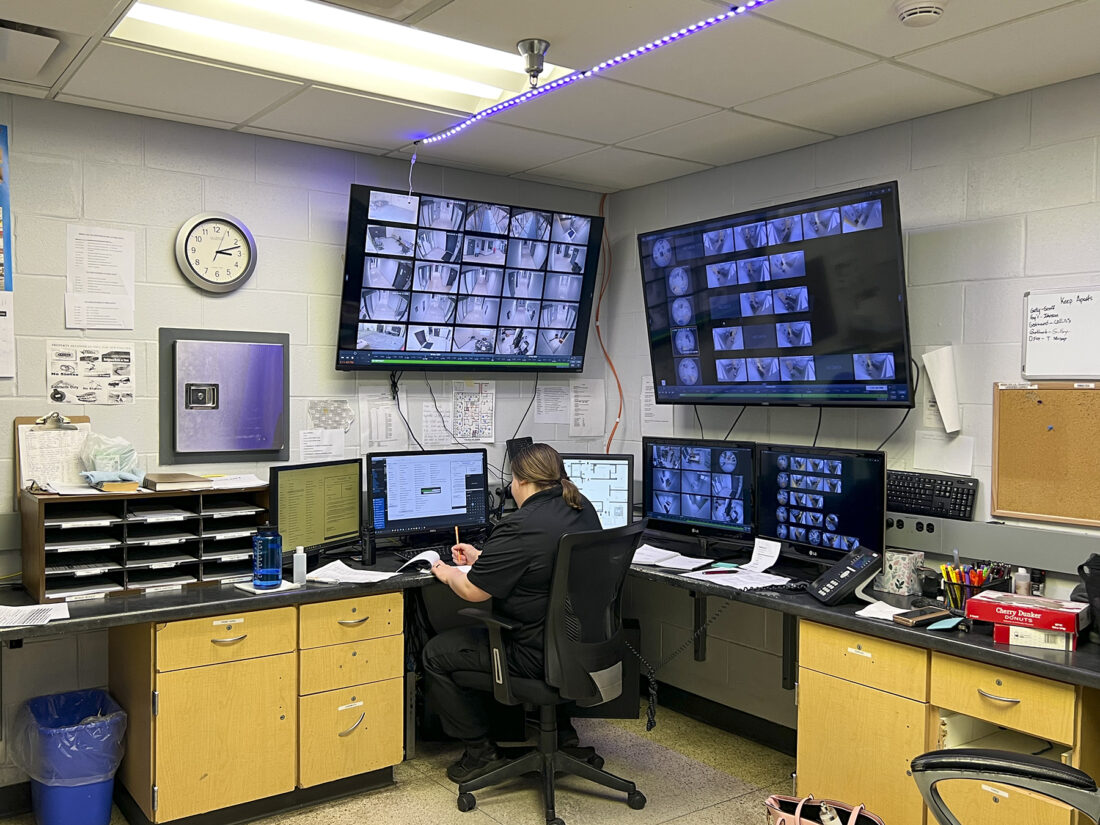
-Messenger photo by Kelby Wingert <br> The control room at the Webster County Jail is a windowless room and does not have any direct lines of sight into any cells or inmate spaces. All inmate monitoring is done through security camera feeds.
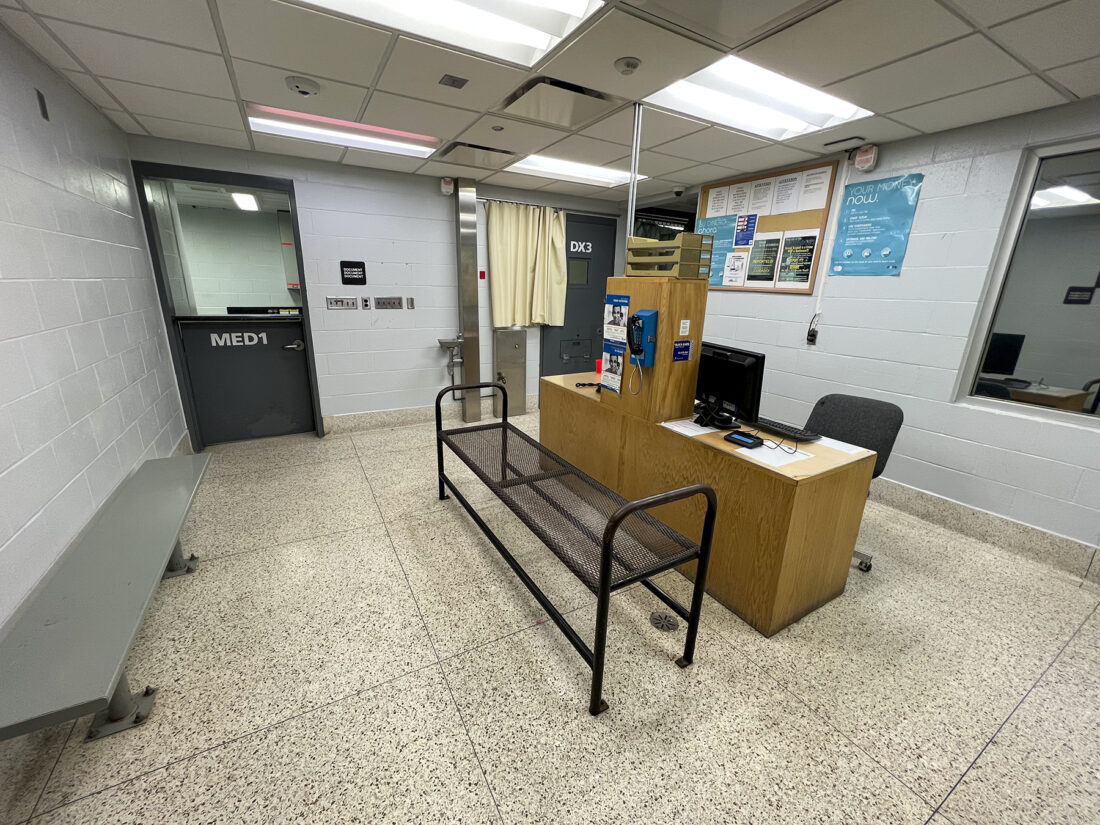
-Messenger photo by Kelby Wingert <br> The booking area of the Webster County Jail is small for the jail's needs, Jail Administrator Mark Gargano said. The space is also a major pass-through area when moving inmates, causing potential security and safety issues.

-Messenger photo by Kelby Wingert <br> The Webster County Jail currently has two residential-grade washers and one commercial-grade dryer to process all laundry in the 56-bed facility.
-Messenger photo by Kelby Wingert <br> The control room at the Webster County Jail is a windowless room and does not have any direct lines of sight into any cells or inmate spaces. All inmate monitoring is done through security camera feeds.
-Messenger photo by Kelby Wingert <br> The booking area of the Webster County Jail is small for the jail's needs, Jail Administrator Mark Gargano said. The space is also a major pass-through area when moving inmates, causing potential security and safety issues.
-Messenger photo by Kelby Wingert <br> The Webster County Jail currently has two residential-grade washers and one commercial-grade dryer to process all laundry in the 56-bed facility.
Trending
A proposal for a new jail facility could be put in front of the voters of Webster County this fall.
For the last two and a half years, Webster County Sheriff Luke Fleener has worked with a West Des Moines consulting firm to look into whether Webster County needs a new jail or law enforcement center to replace the current one located at 702 First Ave. S., giving periodic updates to the Webster County Board of Supervisors.
The results of the study conducted by The Samuels Group were clear -- the current Webster County Jail and Law Enforcement Center are not meeting the county's needs and, in fact, are a source of hemorrhaging money.
The most recent update was presented to the board on Tuesday.
Representatives from The Samuels Group and Venture Architects, another firm working on the project, told the Board of Supervisors that the current design of an 87,195-square-foot jail facility with 82 inmate beds and the ability to expand to 139 with double-bunking is estimated to cost about $54.5 million with current construction costs and inflation.
Because of the amount of funds that the county would have to borrow to complete this project, it will have to first pass a public general obligation bond referendum, with at least 60% of voters casting their ballots in favor.
On Tuesday, the consultants showed the Board of Supervisors a couple of examples of the possible impact on county taxpayers.
In one scenario, assuming a successful November 2023 G.O. bond referendum for a $55.9 million bond, using April 2023 interest rates on a 20-year bond, the levy impact on taxpayers would be $1.94 per $1,000 taxable value.
The consultants also worked with another public finance company to create two scenarios where the cost of the project is taken out in bonds in two separate installments. In scenario A, a long-term G.O. bond of $9.5 million in 2024 and a $45.5 million short-term G.O. bond in 2025 would create a levy impact of $1.58 per $1,000 taxable value. In Scenario B, a $20 million long-term bond taken out in 2024 and a $35 million long-term bond would create a levy impact of $1.71 per $1,000 of taxable value.
Fleener is acutely aware of the challenges a tax impact would have on residents, but contends that a new jail is still a necessity. Since the beginning of the project, he has worked to pare back as much as possible to save the taxpayers money.
The initial draft of the design proposal in January 2022 included all the bells and whistles that -- in a perfect world -- Fleener would like to see with a new facility. However, keeping the taxpayers in mind, over the last year has scaled the design down to the bare bones of what is needed. While the initial draft was for an entire law enforcement center with the Fort Dodge Police Department included, the current draft is just for the jail and Sheriff's office.
If this can keeps getting kicked down the road, the price tag is only going to increase, Fleener said. Similar proposed projects in Webster County were projected to be $6.7 million in 2001 and $18.7 million in 2007.
Time is beginning to run out to get the proposal on the ballot for a public referendum this year. Earlier this year, Gov. Kim Reynolds signed into law a measure that limits public referendums to be held only on the general election date, the first Tuesday after the first Monday in November.
If the referendum does not get added to the ballot in November -- or if it is on the ballot but does not pass -- it will not have the opportunity to be voted on until November 2024.
The need for a new jail
The Webster County Law Enforcement Center was built in 1983. At the time, it was exactly what was needed to replace the condemned former county jail on the fourth floor of the Webster County Courthouse. It also became headquarters to both the Webster County Sheriff's Office and the Fort Dodge Police Department. Other departments that have called the building home over the years include the telecommunications/911 center, Webster County Emergency Management, Webster County Magistrate Court and juvenile court services.
The catalyst for this project is the jail -- it's become too small and too outdated to operate efficiently, Fleener previously told The Messenger.
The current jail has a capacity of 56 inmates, yet the county has an average of 75 to 90 inmates in custody at any given time, Fleener said. When the jail fills to capacity, the county has to turn to jails in nearby counties to house the Webster County inmates.
Over the past decade, Webster County has paid more than $610,000 to house inmates in jails in neighboring counties, spending $247,545 in 2021 alone. For his fiscal year 2024 budget, Fleener has budgeted $350,000 for this problem.
According to the jail study, if the need to house inmates out of county continues at the current rate, Webster County will end up paying $13 million to other counties over the next 20 years.
Those costs don't include the cost of fuel to transport inmates to other jails and back to Webster County for court proceedings. It also doesn't include the cost of the deputies' salaries nor the cost of the wear and tear on the department's vehicles. In the month of December 2022 alone, just one of the transporting deputies drove over 2,500 miles to transport inmates.
Safety when transporting inmates is also a concern Fleener has.
"The increased risk for us as a county is the lone deputy or jailer in a vehicle traveling up and down the highway with one or two or three inmates in a car," he said. "We try to do everything we possibly can to make that as safe as possible. But let's face it, the car could break down or get into an accident, they could get ambushed by somebody that wants to break them out. All those things are real possibilities that could happen and that is a huge liability for us."
There are also more than 1,000 individuals waiting to serve time for non-violent misdemeanors. These individuals have been sentenced to short jail stays, often just a few days to a week, but because of the overcrowding have been unable to complete their sentences.
Capacity isn't the only problem with the current jail. The jail's design and floor plan is outdated and lacks the safety features of more modern jail designs. The jail has a linear design that creates safety and security problems, according to John Sabinash of Venture Architects.
"It tends to be a staff-intensive way of managing things and persons in custody," he said. "It also becomes extremely camera dependent."
In a linear design with the inmate cells running along tight hallways, sightlines into the cells become difficult, creating contraband problems, staffing inefficiencies and an increased potential for inmate and staff assaults.
The current jail's control room is a windowless room in the center of the building where corrections officers do not have a direct line of sight to the inmate spaces and instead rely on security camera live feeds to monitor inmates.
The proposed design for a new jail has a "podular" set-up, with a central control room surrounded by two levels of cells in a horseshoe formation, allowing the staff in the control room to have a direct line of sight into each cell. The proposed design will house 82 beds in the pod, with the option of expanding to 139 beds with double-bunking if needed.
The aging building is also running into a series of infrastructure problems. There have been multiple instances where water from plumbing issues on the jail floor has made its way to the floor below, causing extensive damage to offices, courtrooms, staff areas and computer equipment.
History has shown that failure to act on a solution to these problems leads to even more expensive solutions down the line.
Deja vu
Fleener isn't the first -- or even the second -- Webster County Sheriff to go to the Board of Supervisors to look into replacing the aging building.
In 2000, then-Sheriff Chuck Griggs approached the Board of Supervisors to consider expanding the jail because there wasn't enough room to house the number of inmates in custody. The jail at the time had 29 beds, with an additional 10 at the jail annex then located at 602 Third Ave. N., and at least a dozen inmates were being housed in the Hardin County Jail because of the lack of space.
According to reports from the county auditor's office at the time, in fiscal year 2001, the county spent more than $244,733 to house inmates in other counties. That number does not reflect the cost of transportation or the salaries of the deputies transporting inmates.
Despite more than a year of work by the Jail Study Committee and Board of Supervisors -- and even the board's approval on a plan for a $6.7 million, 82-bed jail only -- nothing came of it. The Fort Dodge Betterment Foundation even donated 3.5 acres of land west of the Fort Dodge Correctional Facility. The proposed designs for the jail would have allowed for future additions of office space for the Webster County Sheriff's Office.
By 2006, then-Sheriff Brian Mickelson went to the board with the same complaints and requested a new jail study be completed. That study, done by StrataVizion, a consulting group from Des Moines, was presented to the board in May 2007.
The StrataVizion study confirmed the building's inadequacies first identified in 2001. StrataVizion presented two proposals for a solution -- refurbish the current jail and construct a jail annex on the county parking lot west of the LEC for $11.9 million, or build a new jail facility for $18,662,463. It is unclear from reporting at the time if the new facility would include the rest of the departments housed in the LEC.
A search through minutes of the Webster County Board of Supervisors from the time shows no more mention of a new jail or LEC project until October 2009. In March 2010, the board approved a plan to renovate the basement, first and second floors of the LEC building and build a new 56-bed jail off site. In April, the board approved the sale of $9 million general obligation local option sales and services tax bonds for the project.
However, by October 2010, the board decided to postpone a new jail facility and construct repairs to the existing jail on the third floor of the LEC building. That project was completed in 2012. The board meeting minutes do not state the board's reasons for axing the new jail at that time.
A look back through The Messenger's archives shows that the jail's capacity woes actually started just a few years after it was built. In an article from October 1989, Griggs reported that the jail was currently housing 45 inmates, though the jail's official capacity was just 29.