
Trending
Residents across the state, including Webster County, have balked at the numbers they're seeing on the new property value assessments that have been sent out recently by county and city assessors.
Some homeowners are seeing that their properties' assessed value has increased dramatically over the last year -- in some cases, by tens of thousands of dollars.
Bob Herum, who owns a home on a small acreage off of North 15th Street in Fort Dodge, was shocked to open that envelope and read that somehow in the last 12 months, his home's value had increased by $179,000.
"It was like out of the blue," he said.
He said he had been expecting an increase of roughly 13%, not 35%. "I thought that was a little extreme."
Herum noted that the land valuation of the 3.09 acres his house sits on did not increase during this time, just the assessed value of the dwelling.
According to Webster County Assessor Angie Vinson, the significant increases in values -- and in some cases, decreases -- is attributed to recent trends in the housing market.
"Anybody who's looked at the market would see what houses are selling for and what we have to look at," she said. "We're looking at last year's sales and last year's sales with the low interest rates and not a lot of houses on the market, that's why they're seeing a huge increase."
She said that even though the housing market is currently slowing down a bit, many properties are still selling at significantly higher prices than their assessed value.
And because state law requires that residential assessed values be equal to 100% market value, plus or minus 5%, those overpriced house sales have caused the values of nearby similar properties to skyrocket.
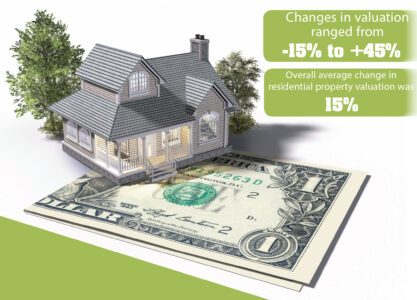
Not everyone's property value went up -- some decreased by as much as 15%. With the highest increases around 45%, the overall average change in residential valuation in Webster County was an increase of 15.5%.
"Believe it or not, there were some areas that did go down and there were some areas that saw little to no change," Vinson said.
Webster County Assessor records show that two homes on Jonathan Drive in northern Fort Dodge sold in the last two years at roughly $80,000 over their assessed value for the year of the sale. Those sales may have had an impact on the property values of their neighbors.
According to Vinson, the city of Fort Dodge is divided into 30 map areas for the purpose of property value assessment in order to calculate more fair and accurate assessments.
"We're not comparing the whole town of Fort Dodge as a whole," Vinson said. "We're not comparing the south side to the north side."
While property values are updated yearly from data gathered through city building permits and "drive-by" assessments, the Assessor's Office has to complete a full "equalization" each odd-numbered year so that each taxpayer is responsible for paying only his or her fair share of the property tax burden. More formal, door-to-door interior inspections for reappraisals happen less frequently.
The last door-to-door inspections were done in 2018 and 2019. Prior to that, this kind of reappraisal hadn't been done in Webster County since 1997.
For homeowners looking to sell their property, these new valuations are good news, Vinson said.
"Our homes are probably one of our greatest assets, so you do want that equity and that value, in my opinion," she said. "So for those of us that aren't wanting to sell, yeah, it's not a fun time. But if we were to sell, we would definitely get more than what we have a lot of them assessed at."
A brief perusal of the data available on the Assessor's website shows that it's not uncommon for property values to fluctuate from year to year. However, that doesn't make this year's assessments any less jarring for those homeowners.
More than a dozen Messenger readers, including Herum, reached out to share their concerns over the increased assessment values.
Craig Schultz, who owns a home near Manson in Calhoun County, said the assessed value of his home increased dramatically after MidAmerican Energy Co. purchased his neighbors' property for nearly three times what it was valued in order to construct a new electrical substation.
Calhoun County Assessor's records show that Schultz's neighbor's home sat on about 1.5 acres and had roughly 1,500 square feet of living space. In 2022, it was valued at $58,220 and sold in December 2022 to MidAmerican for $150,000. The records also show the property's 2023 valuation is $60,440.
Shultz's home, however, sits on 4.5 acres and has roughly 2,500 square feet of living space and went from $113,260 for 2021 valuation, to $180,950 for 2022 and now $238,720 for 2023.
Jodi Ault, who lives in Algona in Kossuth County, told The Messenger her property values went up nearly 30% -- as did her neighbors' property values -- but properties just a few blocks to the south and east saw their assessed valuations decrease. She said she believes that real estate agents in Algona have a monopoly on the market values and are driving up the costs of single family homes.
"It is more affordable to build than buy so older homes go vacant and the older part of town gets dilapidated," she said. "We cannot find a decent starter home in our community because of this and now they are affecting our taxes."
Herum said his concern is how the increased assessed valuations could affect property tax bills for homeowners on a fixed or limited income.
"Assessed value and taxable value are two totally different animals," Vinson said.
Statewide, taxable value cannot increase more than 3%, she said. So after the county and city assessors submit the new valuations to the state, the state will "crunch all those numbers" and determine the "rollback" rate for taxable value.
"For people who went up 40%, I guarantee them that their taxes are not going to go up 40%," Vinson said.
The rollback percentage is used to determine the taxable value for a given property. For example, in 2021, the state's rollback rate for residential properties was 54.6501%, meaning only that percentage of the residential property's assessed value is taxable.
On a property valued at $100,000, with the 2021 rollback rate, the property's taxable value was $54,650.10.
Eligible property owners can also use certain tax credits and exemptions available from the state to further lower their property tax bills.
The effect these changes in assessed valuations will have on property taxes ultimately lies with the state, Vinson said. The elected officials for any levying body -- city councils, county supervisors, public school boards, etc. -- are ultimately responsible for setting the levy rates each year.
Vinson also noted that the assessed value for 2023 will not be the basis for property taxes until September 2024. The taxes payable are always 18 months behind the valuation assessments.
Vinson encourages anyone with questions or concerns to contact her office at 515-576-4721.
"We'll get through this together," she said.