BACK TO THE WORLD
When Vanice Heath was released from prison, it was like entering a foreign country. The AFES DRIVE Reentry program helped him navigate some unfamiliar territory.
-
-
-Messenger photo by Hans Madsen
AFES Director Charles Clayton, center, poses with Vanice “Tiger” Heath recently. Heath is a participant in the AFES DRIVE Reentry Program that helps recently released from incarceration individuals adjust to life outside prison.
-Messenger photo by Hans Madsen
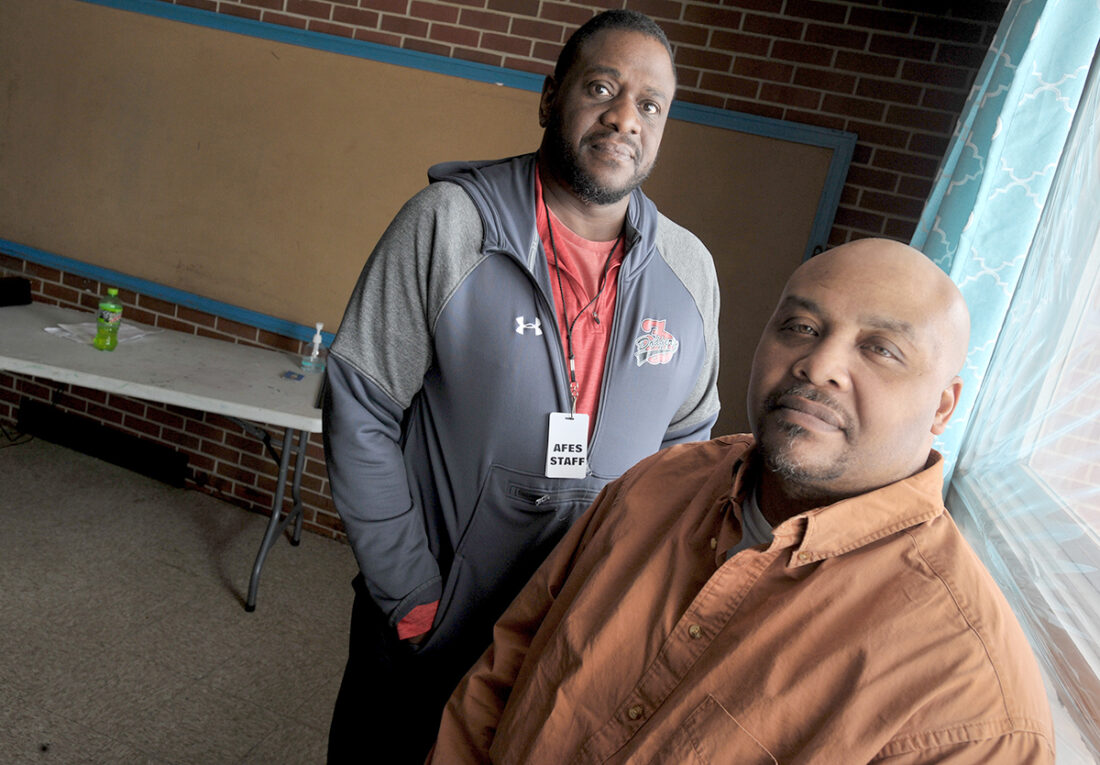
AFES Director Charles Clayton, center, poses with Vanice "Tiger" Heath recently. Heath is a participant in the AFES DRIVE Reentry Program that helps recently released from incarceration individuals adjust to life outside prison.
Vanice “Tiger” Heath was released from prison on Dec. 6, 2022.
He came into a world unlike anything he had known when he was locked up.
“I was in since I was 17,” Heath said. “I’m 45 now.”
Heath was convicted of first-degree murder on Feb. 14, 1996. He was released as a result of life sentences for juvenile offenders being declared unconstitutional. He’s served the 25 years an offender would be sentenced to today.
Since his release, he’s been involved in the AFES DRIVE Reentry Program. Drive is an acronym for Determination, Resilience, Initiative, Values and Encouragement.
AFES Director Charles Clayton formally began the program about two years ago.
“When you’re released,” Clayton said, “there’s a thousand unwritten sentences that you still face — housing, landlords, getting a job, transportation. I might not be from Fort Dodge. I don’t have a ride or a vehicle to take my test in. I don’t have a positive network or social group at all. What am I supposed to do to reconnect? You need to belong to something in life.”
Clayton said that the program helps by helping the recently released take care of those things. A lift to take their driver’s exam and a vehicle for the road test. Rides to job interviews. A list of landlords that are not hostile to renting to felons.
“Some guys just come here to use the gym,” he said. “It’s one guy that needs transportation to a doctor’s appointment. We had another one we took to Boone for a custody hearing so he could get his kids back.”
For Heath, the program has helped him greatly. The key, he said, has been the mentoring.
“For starters,” he said. “Charles has become a mentor. That’s what’s so good about mentors. He can sit down and guide you. You can always talk to him.”
Heath also has Sen. Tim Kraayenbrink as a mentor. The two speak frequently.
He’s also been helped with housing. That’s difficult.
“Just looking for a place,” Heath said. “It’s hard to get housing. They see that felony.”
Even though Heath had done a lot of the preliminary prep work before his release date. There are still things that have to be done in person and sometimes lines of communication break down. He had difficulty being able to communicate with an employer through the correctional system.
Having that mentor or friend to talk to can make a big difference.
“All it takes is a person who will say, ‘Look I’m here to help’ you,” Heath said. “Someone to say, ‘Hey you’re going off track.”
Clayton, who’s also a convicted felon, was lucky when he was released, someone stepped up to serve as his mentor. It wasn’t him and the system. For Clayton, it was the late Jerry Patterson.
“I know that the system without mentorship and help can eat you alive,” Clayton said. “He was that non-family mentor that took me under his wing.”
Heath plans on continuing and expanding his role in the DRIVE program. He would like to spearhead a program to help women struggling with taking care of their family.
“I personally think that AFES can use more help,” Heath said. “Whether they have it or not, there’s a need. They need the mentor program and people that can guide them.”
Clayton and Heath would both like to see more active partnerships with the community. Whether it’s landlords willing to rent, volunteer mentors or additional support from the correctional system.
“It just takes partnerships.” Clayton said.
Local News
Go and Do: April 3, 2026
Around the area CLARION — The Spring Coin Show will be held from 9 a.m. to 4 p.m. SATURDAY at the Heartland ...
Mental exam ordered for McCuddin
Dairy goats a year-round commitment
Bringing the zoo to Friendship Haven
Ag in the Classroom brings Earth Day to life