
Guarding the coast and rivers
Manson veteran found Coast Guard was the right fit
-
-
-Messenger file photo by Hans Madsen
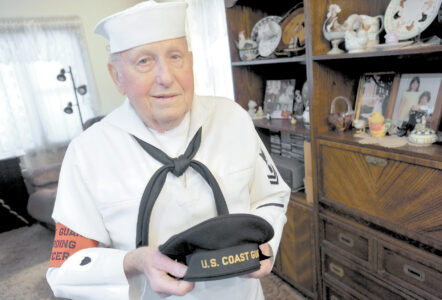
Gordon Hans, of Manson, a U.S. Coast Guard veteran, shows that, yes, he can still fit into his service uniform. Hans served from 1958 to 1962.
-Messenger file photo by Hans Madsen
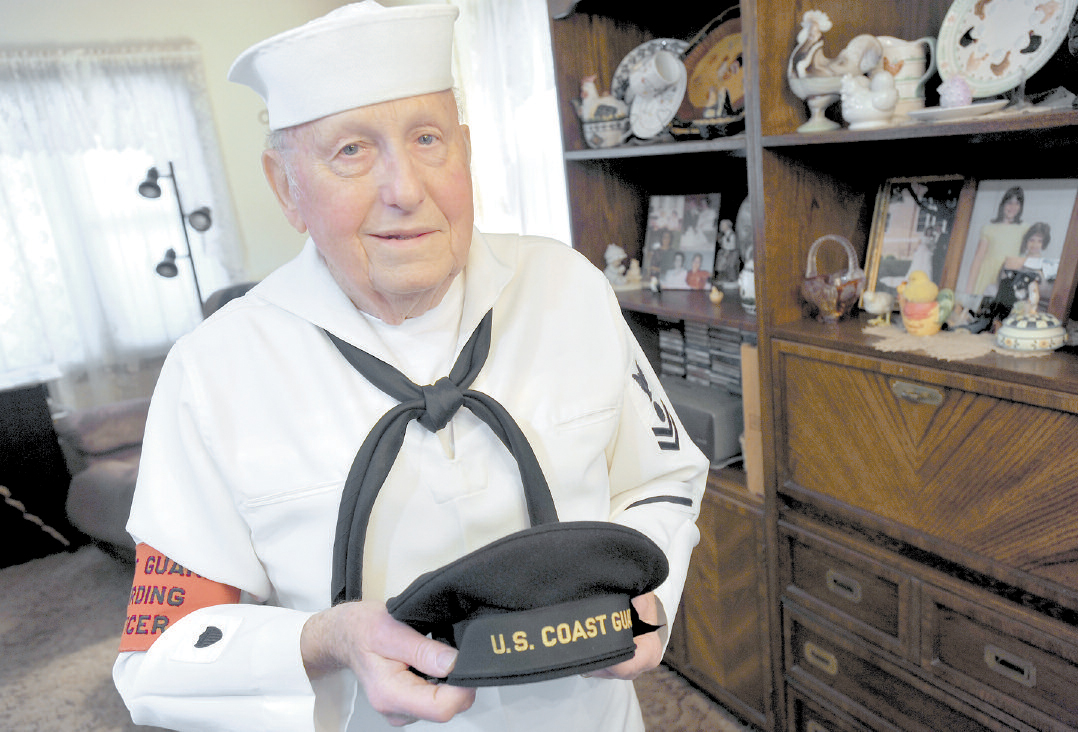
Gordon Hans, of Manson, a U.S. Coast Guard veteran, shows that, yes, he can still fit into his service uniform. Hans served from 1958 to 1962.
Editor’s note: This Serving Our Country feature first appeared on Nov. 9, 2017.
MANSON — So how does a young man just out of high school still kicking around in his hometown of Lakota end up thousands of miles away from Iowa on a U.S. Coast Guard ship patrolling the waters off the California coast?
For Gordon Hans, that story was a mix of not wanting a life on the farm, a chance conversation with a salesman, and a dislike of ties.
“After high school,” he said, “I had no big plans. I wasn’t interested in farming, so I took a job at the Super Value. The owner came to see if I wanted to learn to cut meat.”
Hans knew his draft number was coming up sooner rather than later and he decided to try the Coast Guard.
“I ended up talking with a salesman,” he said. “He had been in the Coast Guard in World War II. I had never heard of it. I checked into that and found out they had small crews. That appealed.”
They also didn’t have ties as part of their uniform.
“I never did like to wear a tie,” he said. “Small units and no neckties. Perfect.”
Hans enlisted in Omaha in 1958. He then went to Cape May, New Jersey, for his 16 weeks of recruit training.
“This included the usual running, jumping, crawling, shooting, climbing, swimming and first aid,” he said. “There were other Coast Guard requirements such as Morse code, semaphore flag hoists, light signals, life boat hoist operations, surf rowing and things that escape me now.”
After basic training, he went to Groton, Connecticut, where he studied to become an electrician.
Hans was sent for a short stint at Government Island in Alameda, California, before being stationed on the cutter “Active.” They worked from near San Francisco to north of Santa Barbara.
“Our task was to locate lost and disabled craft in the Pacific,” he said. “We also maintained buoys, lights and sound devices.”
Finding the lost ships was a process that relied on old school navigation and a reliable radio.
“They would be broken down or taking on water,” he said. “We had to find them. There was no GPS then, we would use radio triangulation. Even if they had a poor engine they had a good radio.”
After a year in California, he was transferred to the cutter “Sumac.” It was stationed in Owensboro, Kentucky. He went onboard his new vessel with a promotion to petty officer, second class.
From its base, the cutter “Sumac” patrolled the lower Ohio River, plus the Cumberland, Tennessee and Green rivers, as well as Old Hickory Lake and Kentucky Lake.
His duties on the “Sumac” were much the same as the duties he performed on the “Active” — well, almost the same.
“During the winter the “Sumac” was fitted with an ice breaking bow and was sent to Peoria, Illinois.” he said. “We kept the river channel open on the Illinois River.”
Hans’ next docking was at Memphis, Tennessee, where he trained for and joined one of the first boarding teams on the mid-U.S. river system.
One of the things they were supposed to look for during a boarding was contraband, although not the contraband usually found today.
“It was more moonshine back in those days,” he said. “If we found any we were supposed to let ’em go and call the U.S. Marshals.”
It was a call they didn’t have to make. “We never did find anything,” he said.
The crew kept pretty busy.
“I had stopped about 700 boats and checked them,” he said.
Hans still has the armband he wore as part of the boarding team, It, along with his uniform, still fit.
In spite of being trained as an electrician, he often spent his time below decks in the engine room.
“When the engine was running you had two guys down there,” he said. “I was the engineer of the watch. Being an electrician, I don’t know how that worked.”
Once the engine was up and running, on most of the vessels there wasn’t much to do. It was during the startup that manpower was needed.
“It had a governor on it,” he said of one of them. “You stood there in case of a runaway; it was your job to pull the fuel rack.”
It wasn’t without its hazards.
“We had one cylinder blow the side out of the engine once,” he said. “Pieces of flying steel missed someone by a couple of feet. Someone could have ended up losing a leg.”
One ship he worked on had three engines — and no reverse.
“You stopped the engine and started it in reverse,” he said. “There was a big wheel on the side that you turned. You turned it to go forward.”
The engines, two-cycle Fairbanks Morse units, were not exactly tiny.
“They were big engines,” he said. “They had eight cylinders. The cylinders were a foot across. They burned a lot of oil along with the fuel.”
After he was discharged in 1962, Hans stayed in Tennessee and went to work at a Kroger’s in Nashville as a meat cutter.
He met his wife, Judy, in Paris Landing, Tennessee. They were married in 1963. She died in July 2016.
The couple moved back to Iowa, settling in Manson.
“I came here,” he said. “I liked the size of the town. After 53 years, I guess I’ll stay.”
Hans spent his working career as a meat cutter. He continues to be active in American Legion Post 204 in Manson.
“I’ve been the commander of the firing/honor squad for about 30 years,” he said.
He also has a long proud family history of service.
“At least two relatives served in the Revolutionary War and four in the Civil War,” he said. “I had one great uncle in the Spanish American War, at least six uncles in World War I, one uncle in World War II and eight cousins in World War II. Four brothers-in-law in World War II as well, one killed, two wounded and one was a POW. I had one brother in Korea and at least three nephews in Vietnam, two of them were wounded.”
Local News

Celebrate the chill with TWINterFest
Plush pet adoption event supports humane society
Area children will soon have an opportunity to adopt a pet that doesn’t bark, meow or make a mess on the ...
Senate seeks $100M increase for schools
Community Health Center, UnityPoint Health team up
Community Health Center of Fort Dodge has announced a partnership with UnityPoint Health — Fort Dodge to expand ...
Naig excited about Career Academy
‘Pond Paintings’ to debut at Blanden
The Blanden Memorial Art Museum announces “Pond Paintings,” a solo exhibition by artist Kim Bromley, on view in ...