
In search of groceries
Area customers face frustrations when shopping for once-common items
-
-
-Messenger photo by Michaela Frerichs
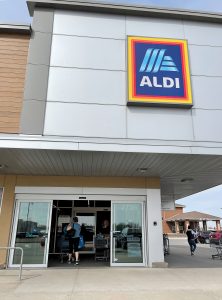
Shoppers come and go from the Fort Dodge Aldi grocery store Sunday afternoon. Stores all over Iowa are seeing higher prices while struggling to keep stock on shelves for certain grocery products.
-
-
-Messenger photo by Michaela Frerichs
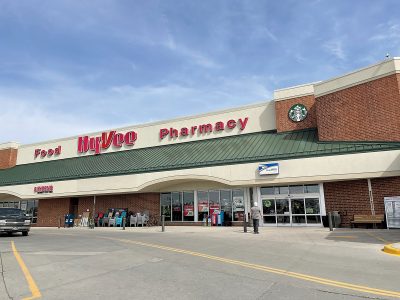
Rising grocery costs and supply chain issues causing low or no stock didn’t slow down the Sunday shopping traffic in Fort Dodge. With a packed parking lot and constant stream of shoppers coming and going, HyVee stayed busy with customers buying what they could Sunday afternoon.

-Messenger photo by Michaela Frerichs
Shoppers come and go from the Fort Dodge Aldi grocery store Sunday afternoon. Stores all over Iowa are seeing higher prices while struggling to keep stock on shelves for certain grocery products.
By KELLI BLOOMQUIST
editor@messwengernews.net
Shopping for groceries has long been a fairly mundane and systematic task for Deb Smith, of rural Harcourt. That is, until recently, when Smith routinely couldn’t find commonly used food items in area stores.
“Canned biscuits, chicken, pizza crusts, pop — I couldn’t find them anywhere,” she said.
Smith said that she drove to Boone and even Ames to find grocery items that she was needing, but that empty shelves, out-of-stock notices, and increased prices continue to be frustrating.

-Messenger photo by Michaela Frerichs
Rising grocery costs and supply chain issues causing low or no stock didn’t slow down the Sunday shopping traffic in Fort Dodge. With a packed parking lot and constant stream of shoppers coming and going, HyVee stayed busy with customers buying what they could Sunday afternoon.
“Eggs went from $3 to $7 for 60,” said Smith. “I have a teenage son who is a wrestler and eats four eggs daily. My grocery bill has increased greatly, from on average $250 every two weeks to upwards of $350 now.”
Sam Funk, director of agriculture analytics and research with the Iowa Farm Bureau Federation, says that Smith’s experiences at the grocery store aren’t uncommon given the demand for products.
“A lot of factors come into play for any point-in-time regarding availability in a grocery store,” said Funk. “In general, the demand has been high for poultry as people sought to find high-quality animal proteins and thought broilers looked appealing. There has been a lot of continued pressure within the supply chain to bring that many birds to market.”
Funk added that most chickens raised in Iowa are for laying eggs, not broilers being eaten, which would explain why eggs continue to be in store refrigerators, but that chicken meat is harder to find.
“Iowa is the leading egg-producing state, but not in the top level for number of broilers,” said Funk. “Many of the broilers raised in Iowa actually head to the processing plant that supplies a national chain and not local grocery stores.”
According to the Iowa Egg Council and Iowa Poultry Association, Iowa has approximately 48 million laying hens and an “ample supply of eggs in stores for Iowa shoppers.”
“What farmers, retailers, and shoppers are currently seeing may be volatility in egg prices due to market pricing and costs,” said Sara Petersen, director of marketing communications for the Iowa Poultry Association. “It’s important to know that egg farmers don’t usually get to choose the price of eggs.”
Eggs, like many food items, are sold as a commodity and prices are influenced by supply and demand as well as by prices for feed ingredients like corn and soybeans that are fed to the animal.
“It’s not all about what’s happening on the farm,” added Funk. “While Iowa produces a lot of eggs, many of them are for further processing into cracked eggs used in restaurant settings or in hotels. There is a tremendous pressure on the prices of eggs as they see high demand given the protein prices in many grocery stores.”
The USDA has projected higher poultry and egg prices for 2022 with three of the four quarters said to be higher than they were in 2021. According to Funk, this means it would not be difficult to expect many grocery prices to remain high, but this doesn’t always equate to higher prices for farmers.
“Oftentimes, it is the marketing channel that sees the higher costs attached to grocery prices and not necessarily a higher return to the farmer who originally produced the chicken or the eggs,” said Funk.
Cutting out the retailer and going directly to a farmer for meat or eggs can be a better option, if the product is available from a local farmer and, if it pertains to meat, there is a local locker available for processing.
“There have been opportunities for private on-farm sales of beef or other animal proteins,” said Funk. “Supply chain factors have driven higher volumes to local locker plants and made it somewhat more difficult to find openings to get a steer or other animal processed privately. The continued search for locally produced meat will likely continue, but consumers should be ready to take a whole beef or find someone to share part of the bounty while making certain they have a reserved spot to get the animal processed in a timely fashion that meets their needs.”
Katie Olthoff, chief operating officer for ChopLocal, an Iowa online interface that connects consumers with farmers, says Iowa farmers saw an increase in demand for meat in late spring 2020 when COVID outbreaks shut down meat processors. While that demand has waned some, Olthoff said it’s still strong.
“Part of the demand increase relates to price,” said Olthoff. “Purchasing directly from the farmer can be more cost effective if you’re able to purchase half of the animal at once, but that’s not feasible for everyone, especially if you don’t have room to store that much meat.”
The increasing demand for proteins and specific food items will continue to be pressured within the supply chain, and the strain on grocery budgets and in stores won’t be going away in 2022, according to Funk and the USDA’s projections.
“There are a lot of empty shelves,” said Smith. “I put things in my cart and the next thing I know, I get an out-of-stock message. It’s just hard and frustrating.”
These supply chain disruptions and increased pricing can be disheartening to consumers, said Funk, but added that Iowa farmers are doing the best they can given the circumstances.
“If farmers had a way to profitably produce more products, they would,” he said. “It takes a supply chain to get the products moved to consumer store shelves to feed the entire country and many parts of the world.”
Local News

Floating through history
Grassley releases new information on online child exploitation
U.S. Sen. Charles Grassley said he is using his position as chairman of the Senate Judiciary Committee to ...
Go and Do: April 10, 2026
Around the area LEHIGH — The Lehigh Methodist Church will serve Second Sunday Supper from 5 to 7 p.m. SUNDAY ...
City works to retain animal control service
Fort Dodge officials are moving quickly to ensure that there is no lapse in animal control services in the ...

Trial begins in Labor Day murder