Funding broadband
Sen. Grassley talks infrastructure bill in FD
-
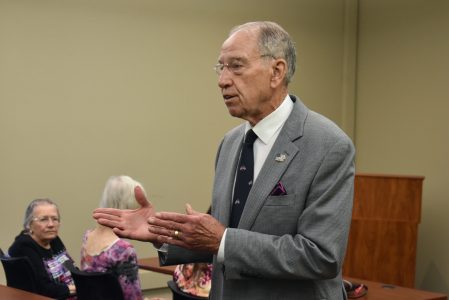
- -Messenger photo by Chad Thompson U.S. Sen. Chuck Grassley, R-Iowa, speaks to a crowd gathered at the Greater Fort Dodge Growth Alliance on Tuesday. Grassley, the longest serving U.S. senator in Iowa’s history, will announce in September or October if he will seek reelection.
-
-
-Messenger photo by Chad Thompson
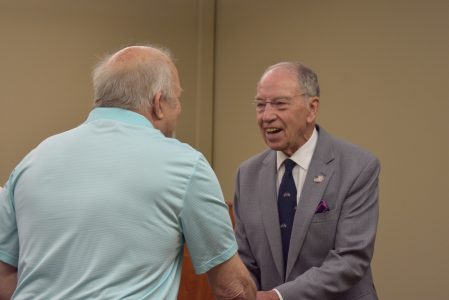
U.S. Sen. Chuck Grassley, R-Iowa, greets Terry Seehusen, of Humboldt during a town hall meeting at the Greater Fort Dodge Growth Alliance on Tuesday.
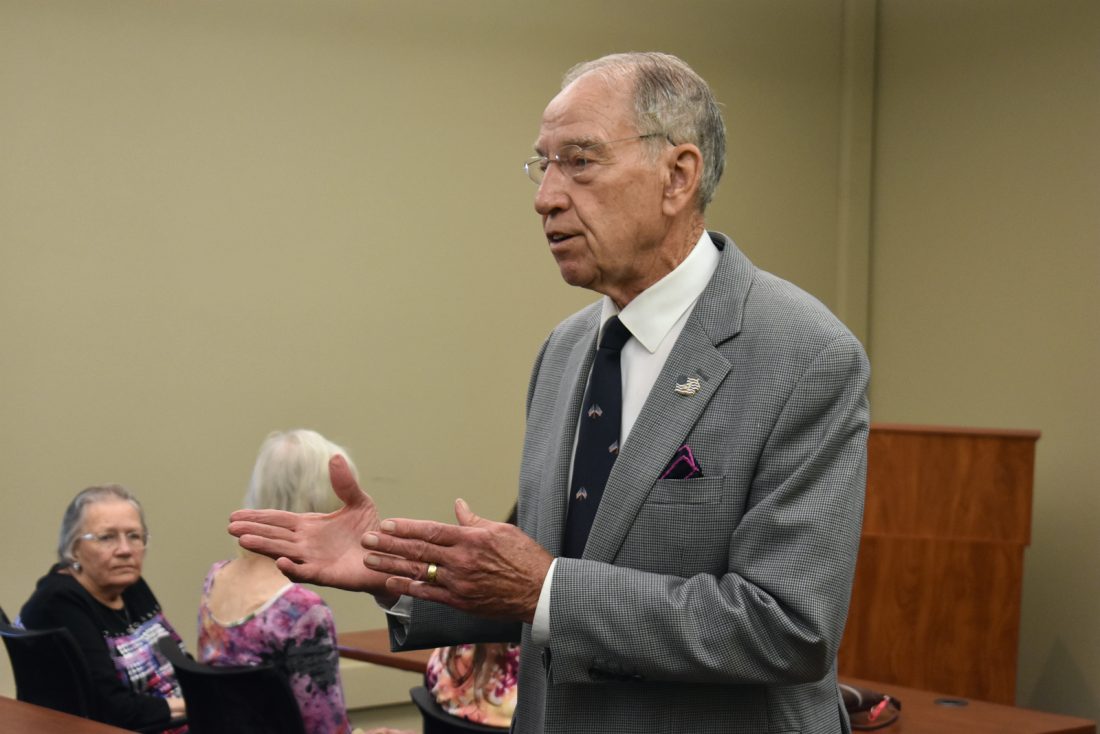
-Messenger photo by Chad Thompson U.S. Sen. Chuck Grassley, R-Iowa, speaks to a crowd gathered at the Greater Fort Dodge Growth Alliance on Tuesday. Grassley, the longest serving U.S. senator in Iowa’s history, will announce in September or October if he will seek reelection.
Within the proposed bipartisan infrastructure bill, there should be grant money available for cities like Fort Dodge that are in the process of setting up their own municipal broadband system, according to U.S. Sen. Charles Grassley.
“I’d assume you’d find grants in that $55 billion,” the Republican senator said Tuesday in response to a question from Andy Reed, of Fort Dodge, pertaining to the difficulties of funding a municipal broadband system.
Reed asked Grassley during a town hall meeting at the Greater Fort Dodge Growth Alliance, 24 N. Ninth St., if he considered broadband and fiber optics essential infrastructure.
“I consider it that way already, but this bill certifies that,” said Grassley. “If you get $55 billion in that bill for broadband. I don’t know how far that goes.”
He added, “I think there’s plenty of policy that says it’s essential.”
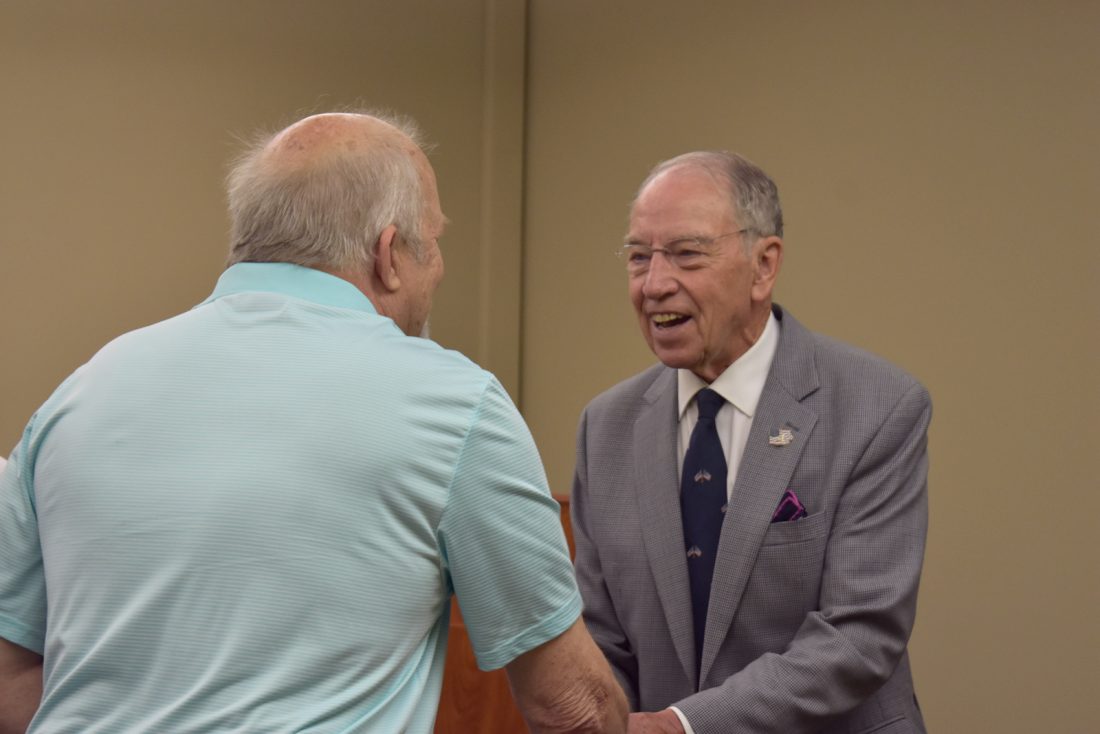
-Messenger photo by Chad Thompson
U.S. Sen. Chuck Grassley, R-Iowa, greets Terry Seehusen, of Humboldt during a town hall meeting at the Greater Fort Dodge Growth Alliance on Tuesday.
A municipal broadband system authorized by Fort Dodge voters in 2019 could serve its first customers in March of 2023.
For that to happen, however, local leaders will have to begin making some decisions and taking some action soon.
The first of those actions could come July 12, when the City Council will hold a public hearing on the possibility of borrowing up to $40 million to pay for the system.
At that same meeting, the council will also consider awarding a contract for detailed design and engineering of a broadband system that would take fiber optics to the home or business of every customer.
On Monday, Mike Maloney of the firm D.A. Davidson in Des Moines, told the council that he is working to finalize the financial package for the proposed system.
He said the city will need $29.4 million to pay for the materials and equipment needed to build the system.
He estimated that the city will need $3.2 million for the startup operating expenses.
Maloney said his estimates are based on 53 percent of the city’s potential broadband customers actually signing up for the service.
Todd Kielkopf, president of Kielkopf Advisory Services of Indianola, warned the council that there is a “materials back-order shortage,” so the city would have to pre-order its supplies.
The council may issue a request for proposals from suppliers during its July 12 meeting.
The tentative plan is to offer three options for download and upload speeds on the proposed system: 100 megabytes, 1 gigabyte or 10 gigabytes.
During the November 2019 referendum on giving the local government the authority to pursue a broadband utility, 71.6 percent of those voting voted yes.
On Tuesday, Reed compared the project to starting a business with no revenue.
“We are going through this process right now, and looking at a municipality for broadband here in town,” Reed said. “And that’s one of the challenges is you are essentially financing a startup business with no revenue, and no collateral to pledge.”
Reed expressed concern that Fort Dodge may not qualify for some of the potential funding.
“We are a little too big to qualify for some of those funds to come to us,” Reed said. “As far as creating a municipality, the ability of local governments to seek private financing – there are some things in place that prevent them from dedicating funds to those projects or injection into those to make the financing more attractive.”
Grassley said, “A big portion of this 900 billion infrastructure bill is public private partnership.”
Reed asked the senator his thoughts about censorship.
“If the city did own broadband, how do you feel about if a municipality owned that fiber optics, obviously the information that is flowing through there — should there be any ability for censorship on that now that they are municipal-owned fiber optics?” Reed asked.
“Put the information out there and let the public decide,” Grassley said.
At the same time, Grassley said entities like Facebook and Twitter have too much censorship.
“I think we have too much censorship among the platforms — Google, Facebook and Twitter” he said. “There is a bipartisan effort to rein them in.”
Grassley said U.S. Sen. Amy Klobuchar, a Democrat from Minnesota, is working on a bill that addresses companies like Facebook.
“She’s working really hard not just to go after the platforms, she is doing it on the broader basis of rewriting some antitrust laws,” Grassley said. “But it would affect them as well.”
The U.S. Supreme Court made a ruling recently in regards to the Federal Trade Commission.
“The Federal Trade Commission was trying to break up Facebook and they ruled almost unanimously 8-1 that the FTC didn’t have the authority to do that,” Grassley said. “So I would imagine that Klobuchar’s legislation is going to try to correct that and give FTC the authority to do it.”
He added, “Section 230 passed in 1996 before the words Google, Facebook and Twitter existed. This section 230 said you can’t sue these people because somehow they aren’t responsible for what goes through their platforms. You can sue newspapers, but you can’t sue them. So doing away with that is what I would propose.”
In terms of growing rural Iowa, Grassley said broadband is vital.
“I think broadband makes a big difference,” he said. “If you don’t have good internet service, it’s hard to recruit.”
Grassley said he believes Fort Dodge has done well growing industry in recent years, particularly as it relates to the Iowa Crossroads of Global Innovation. There, companies CJ Bio America and Cargill have invested millions of dollars and employ hundreds.
“Where those two railroads come together,” Grassley said. “I remember Fort Dodge when they had packing plants and they closed down. Everything was (tough) for about 20 years. They’ve come back big time. Bigger than they were before.”
Grassley has yet to announce if he will seek reelection in 2022.
“I’ll be making that announcement in September or October,” he said. “No later than the first week of November, but it could be earlier than later. I am going through the process of making up my mind on it.”
Grassley, 87, is the longest serving U.S. Senator in Iowa history.