
Hanging up the robe
Iowa’s longest serving magistrate retires after 47 years
-
-
-Messenger photo by Elijah Decious
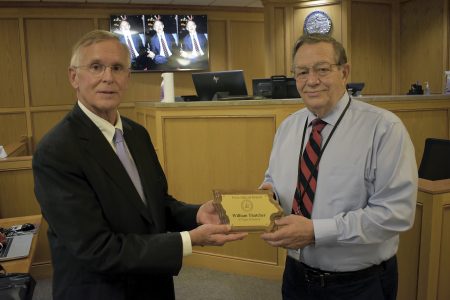
Chief District Court Justice Kurt Wilke, right, presents long-time colleague, Magistrate Judge William Thatcher, with a plaque commemorating 47 years of service to Webster County.
-
-
-Messenger photo by Elijah Decious
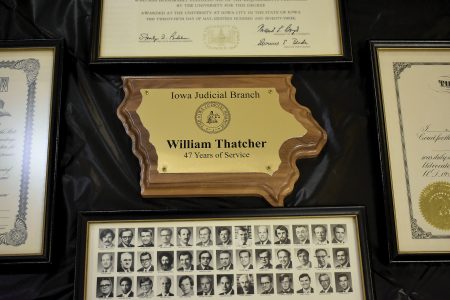
With 47 years of service, retiring Webster County Magistrate Judge William Thatcher was one of the first magistrates hired in the unified court system of Iowa in 1973 and is the longest serving one in the state.
-Messenger photo by Elijah Decious
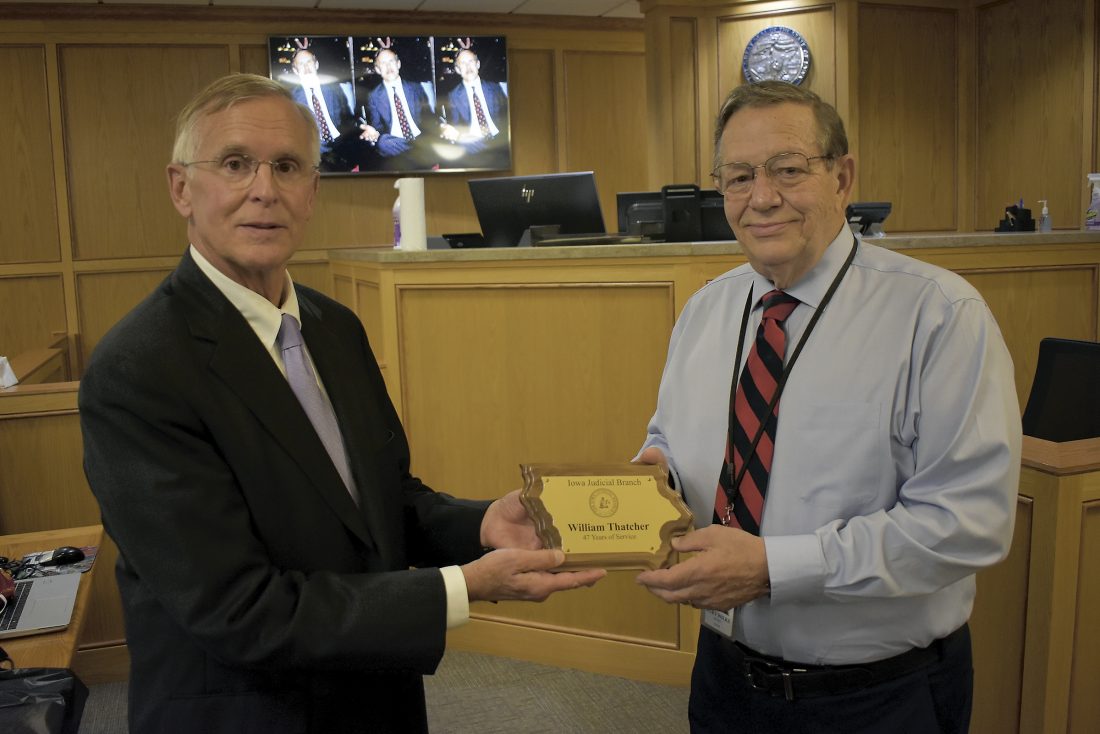
Chief District Court Justice Kurt Wilke, right, presents long-time colleague, Magistrate Judge William Thatcher, with a plaque commemorating 47 years of service to Webster County.
“When the robe goes on, he changes,” said Webster County Magistrate Court Attendant Katrina O’Brien, reflecting on the personal style of Magistrate Judge William Thatcher at his retirement open house on Friday. It was one thing that distinguished him from the other magistrates she worked with over the years.
As he nears retirement on Sept. 5, those closest to Thatcher reflected on a strict, but fair style that was fitting for one of the first magistrates in Iowa’s unified court system, formed in 1973. At retirement, Thatcher holds the title of longest-serving magistrate in the state’s history, with 47 years under his robe.
As the last of the original magistrates, Thatcher witnessed the evolution of Iowa’s former court from one of police judges untrained in the law and justices of the peace to a unified system he believes is more fair to defendants and sensitive to individual rights in the pursuit of justice.
“At the first magistrate seminar I went to … they were teaching us how to walk into the courtroom without tripping over the robe,” Thatcher said, then fresh out of law school from the University of Iowa. “Now, they teach us about all sorts of discrimination, how to apply search warrant law in a unified way and how to improve sentencing techniques.”
But at 72, the mandatory retirement age for magistrates, Thatcher said 47 years was only the blink of an eye. Overall, he believes the court’s transformation to a formal, professional system has been a vast improvement to criminal justice — a genesis colleagues said his oversight was well-suited for.
-Messenger photo by Elijah Decious
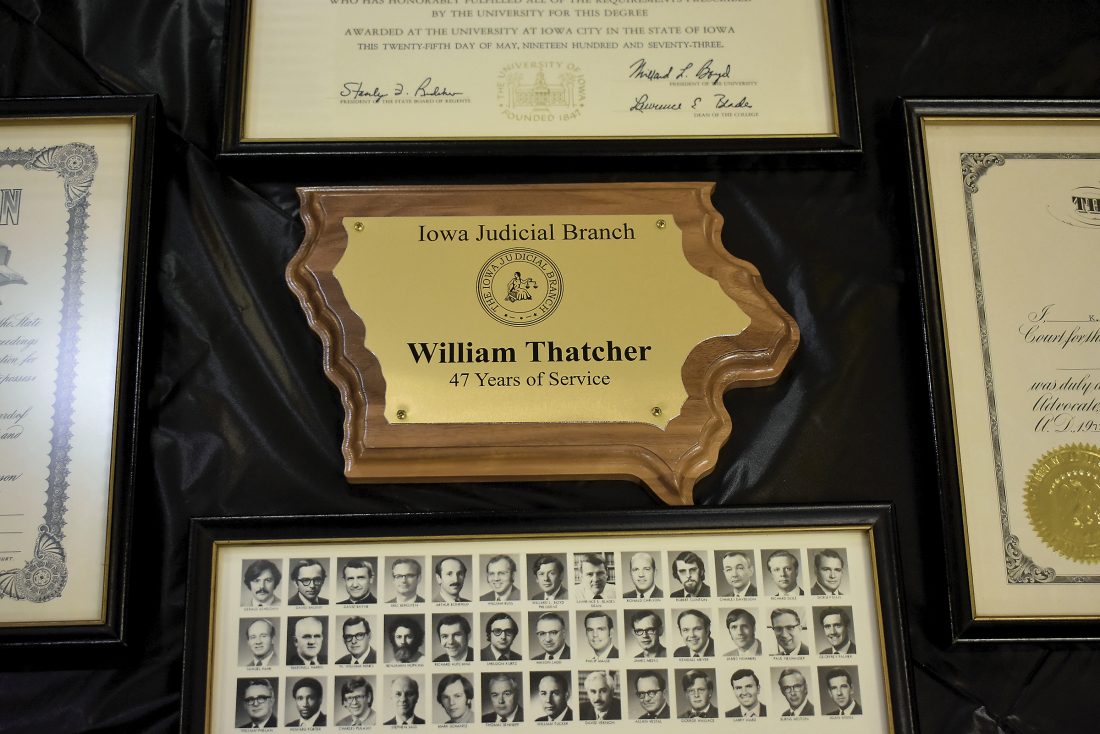
With 47 years of service, retiring Webster County Magistrate Judge William Thatcher was one of the first magistrates hired in the unified court system of Iowa in 1973 and is the longest serving one in the state.
“We had neat characters 47 years ago,” Thatcher said, “but now, we have good judges.”
In the old system, the right to a lawyer, though enshrined in the Constitution, was one that many, de facto, did not have. From arrest, to initial appearance and pleading, to a verdict, some cases were often resolved in 24 hours.
“You (showed up) at 8:30 a.m. … and if you plead not guilty, your trial was right then,” Thatcher said.
“It was what we called speedy justice,” Senior District Court Judge Thomas Bice joked.
Now, the magistrate sees the first of everything from traffic violations to first-degree murder.
“As magistrate, you meet the people. Your involvement with the public is a lot greater,” said District Chief Judge Kurt Wilke, a former magistrate judge. “People have to perceive you’re fair.”
And though strict was often the first descriptor of Thatcher’s style by those who watched him at work most, fair and empathetic were always the words to immediately follow in the sentence.
And after nearly half a century, Thatcher recalled the examples that stuck out to him most, demonstrating a person with a discretion emblematic of why judges are addressed as “your honor” in court.
“Some people deserve a gentle hand,” Thatcher said. “Other people, you almost have to hit them with a two-by-four before they realize (their appearance in court) is serious.”
If you want to avoid the metaphorical two-by-four, it’s probably best to ensure your name and address don’t appear often enough to become familiar to Judge Thatcher.
When a nun pleaded guilty to a traffic offense in court about 25 years ago, the magistrate judge imposed the minimum fine, only to receive an unusual reaction.
“I imposed the minimum fine and she turned white,” Thatcher recalled.
Being told to pay a $65 fine, Thatcher soon learned that the nun with no money was poor for a reason: her vow of poverty.
“I think we’ll find somebody to pay for you,” he assured her.
And he did.
Others came to thank him after throwing them in jail — a decision to take away one’s freedom that Thatcher said always weighed heavy on him, no matter how many times he did it.
One winter morning, a large man approached the judge in his driveway as he shoveled snow. Hesitant to identify himself to the man inquiring for Judge Thatcher, he learned that the visitor was there for an unexpected reason.
He took off his glove to shake Thatcher’s hand.
A year earlier, Thatcher had jailed the man for 30 days. In the last 10 days of his sentence, after stages of anger and self-pity, the man “decided that he never would do anything which would put him back in jail.”
He was released, reconciled with his wife, got his job back and stopped using drugs and alcohol.
“You don’t get thanks very often in this job, but that kept me going for a long, long time,” he said.
It was through Thatcher’s example that many in Webster County learned that a fair judge’s discernment was the difference between knowledge and wisdom.
“The firm hand was not necessarily just to berate someone, but (as) encouragement not to be seen again and change one’s behavior,” said County Attorney Darren Driscoll, who counts Thatcher as his first mentor in the legal profession. “For the right person, that can make a difference.”
The county attorney’s first time watching Magistrate Court was under Thatcher’s watch.
“I always saw him as a man of integrity,” Driscoll said. “Serious, but with a sense of humor.”
Though most defendants wouldn’t know it, he said the good-spirited judge loves a fun practical joke.
While Thatcher said that most defendants agree to change their ways in court with no intent to do so, a few actually follow through. Often, many don’t until they are in the worst possible situation, he said.
“You have to be brutally honest in court,” Thatcher said — whether that means saying “I don’t believe you,” or “you’re not sorry, you’re just sorry you got caught.”
Open-mindedness, perseverence, hard work and dedication are some of the Thatcher qualities that Fort Dodge attorney Jerry Schnurr, president of the Iowa State Bar Association, hopes new bar members bring to the table.
“As magistrate, that’s where the rubber really hits the road for judicial systems,” he said.
With a pleasing trajectory of court progress that Thatcher has had the honor to witness in his tenure spanning the Webster County Magistrate Court’s history, his concern has shifted to what he sees in society today.
“Just here in Webster County, we’ve had six murder cases in the last 12 months. We wouldn’t have had six in a decade before,” he said. “People are getting more violent. It’s not a good trend.”
After 47 years of judicial persistence and consistency, he has confidence that Sarah Livingston,who will soon be the first female magistrate in Webster County history, will hit the ground running, too.
Local News
Go and Do: April 3, 2026
Around the area CLARION — The Spring Coin Show will be held from 9 a.m. to 4 p.m. SATURDAY at the Heartland ...
Mental exam ordered for McCuddin

Dairy goats a year-round commitment
Bringing the zoo to Friendship Haven

Ag in the Classroom brings Earth Day to life