Supervisors keeping an eye on WOTUS, state legislation
Board is concerned about possible impact on drainage districts
-
-
-Messenger photo by Elijah Decious
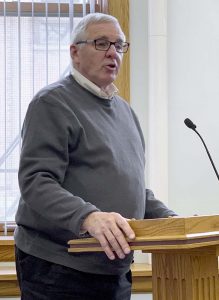
John Torbert, executive director of the Iowa Drainage District Association, gave a presentation to the Webster County Board of Supervisors Tuesday.
-Messenger photo by Elijah Decious
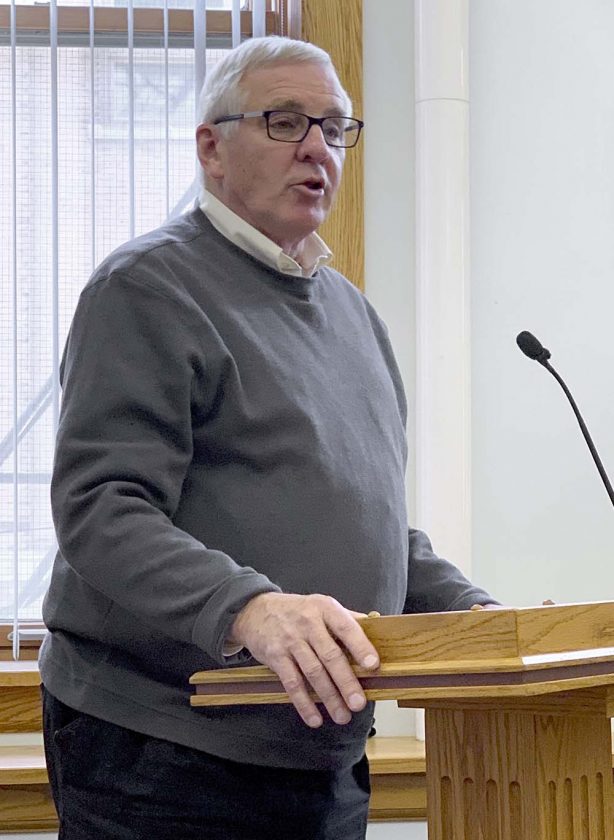
John Torbert, executive director of the Iowa Drainage District Association, gave a presentation to the Webster County Board of Supervisors Tuesday.
Webster County Supervisors got a preview of issues facing Webster County drainage districts in both federal and state legislation, including the contested WOTUS rule on “navigable waters,” leaving some unsure of what awaits the county for future drainage projects.
Changes between the Obama administration and the Trump administration on the authority the federal government has in Waters of the United States — WOTUS — has left counties unsure of the impact on drainage districts.
Under the Obama administration in 2015, the Environmental Protection Agency defined its authority to regulate both “navigable” and non-navigable waters. The Trump administration finalized repeal of that rule, once again returning the EPA’s authority to only navigable waters.
“The problem with those regulations is the impact on you all, acting as drainage trustees for districts, is unclear,” said John Torbert, executive director of the Iowa Drainage District Association. “It’s up in the air what the impact is going to be on drainage.”
The worst case scenario, he said, is an unknown status for drainage project coverage, and whether such projects will need to be permitted by the U.S. Army Corps of Engineers.
“That is not a scenario we want,” he said.
Other issues on the federal radar include legal quagmires involved with billing the U.S. Fish and Wildlife Service for drainage assessments. Torbert said they have generally refused to pay on legal grounds.
“They claim they don’t have the legal ability to pay it,” he said.
The IDDA is working with Republican U.S. Sens. Charles Grassley and Joni Ernst to research solutions.
The executive said that 2020 will be a busy year in Iowa for state legislation affecting drainage districts, too.
“Some years are quiet. This is not going to be a quiet one, drainage wise,” he said.
Legislation from western Iowa, where many areas have been inundated by severe flooding and some drainage districts have been underwater since the spring, may attempt to alleviate the situation as soon as possible.
An issue from eastern Iowa, which Torbert said will be taken up with the state legislature in January, will affect how the Department of Revenue classifies drainage taxes for tax purposes.
The IDDA will be approaching the legislature with several pieces of legislation as well, the biggest one involving reclassification.
Torbert said legislators may attempt a sales tax of three-eighths of a cent; it’s unclear whether they will go through with it.
“We were told in April that it would happen in 2020, but we’ve been told that many times,” he said.
The recent meeting between the IDDA and the Iowa Department of Agriculture and Land Stewardship revealed that the latter is looking into appropriating additional funds into programs for nitrate control, which Torbert said would help in the effort to build wetlands and sustain water quality initiatives.
Local News
Go and Do: April 3, 2026
Around the area CLARION — The Spring Coin Show will be held from 9 a.m. to 4 p.m. SATURDAY at the Heartland ...

Mental exam ordered for McCuddin
Dairy goats a year-round commitment
Bringing the zoo to Friendship Haven
Ag in the Classroom brings Earth Day to life