
Linked
Doctor: Mental health, medical conditions often go hand in hand
-
-
-Submitted photo
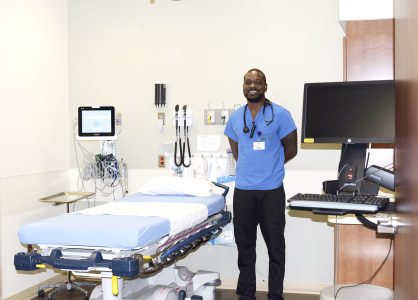
Dr. Chad Rennie stands inside one of the emergency room exam rooms. Rennie treats patients at UnityPoint Health — Trinity Regional Medical Center.
-

-
-Messenger photo by Hans Madsen
When it comes to treating patients, local doctors say mental health and medical conditions often go hand in hand. According to Dr. Megan Srinivas, mental health and physical health must be treated together.

-Submitted photo
Dr. Chad Rennie stands inside one of the emergency room exam rooms. Rennie treats patients at UnityPoint Health — Trinity Regional Medical Center.
Editor’s note: This is the second in a series of stories that explore the impact of mental health on the community.
Mental health and medical conditions often overlap, according to Jess Bailey, director of emergency cardiovascular and support services at UnityPoint Health — Trinity Regional Medical Center.
And that presents many challenges for health care providers in trying to effectively diagnose and treat patients as they come into the hospital or emergency room.
“Some people might come in and it appears to be mental health related, but it could be a medical condition contributing to the decline of their mental status,” said Bailey, who oversees the ER at Trinity Regional Medical Center.

-Messenger photo by Hans Madsen
When it comes to treating patients, local doctors say mental health and medical conditions often go hand in hand. According to Dr. Megan Srinivas, mental health and physical health must be treated together.
According to Bailey, one national study indicated more than 68% of adults with a mental disorder reported having at least one general medical disorder.
Dr. Megan Srinivas, an infectious disease and internal medicine physician at Community Health Center, said sometimes people see mental health and medical care as two separate things.
“Everyone segments mental health and medical care, but in health care they go hand in hand,” Srinivas said. “Fifty percent of Americans experience some sort of mental illness at some point in their life and we suspect that’s underdiagnosed.”
Srinivas added, “If you go into primary care, that’s where you will see mental health. You can’t treat one without the other — mental health and physical health.”
Bailey and Srinivas both said depression is the most common mental health condition they see in Fort Dodge.
“Worries and stresses get built up internally,” Srinivas said. “That’s an extremely pervasive problem in our community. Some people turn to drug abuse, alcoholism, violence or self harm. Or some people just struggle on their own, facing the same demons every day without getting any help.”
Through her experience, Srinivas believes, in general, that therapy is the most effective way to help with depression and anxiety.
“Sometimes we use medication initially to overcome certain stressors,” Srinivas said. “Some can come off the medicine; some can’t.”
Other common mental health conditions include anxiety, thoughts of suicide, panic, delusions and schizophrenia.
According to Bailey, a number of things can trigger a mental health condition.
“If someone is going through a hard time,” Bailey said. “It can be situational. A family member or loved one passes away. It could be job related, pain related — it could be a medical diagnosis where you don’t see an end in sight.”
According to Bailey, a person’s environment plays a key role in mental well-being.
Studies show that low-quality schools and housing, limited employment opportunities and problems in access to health care services and transportation have an impact on someone’s mental health.
Screen time and sleep deprivation can also contribute to a person’s mental health.
“Studies show the more time you spend on social media, the more likely you will be depressed or have anxiety,” Srinivas said.
Teenage suicides are at an all-time high, according to Srinivas.
And Srinivas sees a connection.
“Between the ages of 10 and 13 in the U.S. is the highest it’s ever been,” Srinivas said. “A lot of that is because you can’t escape bullying anymore. Bullying extends beyond your daily life. You get text messages or Facebook messages at any time.”
In general, white men over the age of 50 are at a higher risk of suicide, Bailey reported.
Bailey said that could be a result of a loss of income, a medical condition, lifestyle choices or something else.
The process for helping someone with mental health is the same for all patients who come through the emergency room.
“We have a standard practice for all patients,” Bailey said.
That includes checking in at registration and asking the patient about their complaint.
Patients receive an assessment and are directed to the waiting room or if there is space the patient is immediately taken back to a room.
Bailey said the process is dependent upon availability of rooms and providers.
Someone experiencing a serious mental health episode would be considered more emergent, Bailey said.
The ER has two behavioral health rooms, Bailey said.
“We have rooms considered more equipped and designed to provide a safe environment for patients who need them,” Bailey said.
Some recommendations for someone experiencing a mental health condition can include: medication, a transfer to another facility for additional observation, or discharge the patient to follow up.
“There’s a variety of mental health inpatient and outpatient facilities,” Bailey said. “Those facilities depend on availability. Bed availability can be impacted by their gender or specific need that they have. We have a list of facilities in the state, sometimes we go out of state.”
Srinivas, who serves on the National Alliance on Mental Illness board, said the number of mental health beds in Iowa is too low.
“It’s a sad statement when 3 million people have less than 70 beds in the entire state to provide for mental health care,” Srinivas said. “Beds dedicated specifically for adult mental health patients.”
She added, “That’s one of the worst stats in the whole country.”
According to Srinivas, Iowa ranks 49th for mental health resources per capita.
At the same time, Alyssa Stanek, UnityPoint Health — Fort Dodge senior marketing communications specialist, said UnityPoint has increased its number of providers in recent years.
“From a Fort Dodge perspective, we have increased provider availability in our different sites, whether at Berryhill or our family medicine clinics,” Stanek said.
In 2013, UnityPoint had 1.5 full-time equivalents for psychiatry. In 2019 that number is 8.3 FTEs.
During that same time frame, UnityPoint went from 3.5 FTEs for therapy to 10.8 FTEs, Stanek reported.
In terms of the overlap in medical and mental health care, Bailey said the ER treats far more people for medical care.
Bailey said the ER sees an average of about 55 patients during a 24-hour period. About three of those 55 patients are there for just mental health conditions.
Srinivas and Bailey each said that raising awareness about mental health and fighting the stigma associated with it are ways to help.
“Talking about mental health and being more accepting of mental health and that it’s more pervasive than people think,” Srinivas said. “Whether that’s online or in person over coffee or mentioned briefly, having that insertion into every day life and breaking down those walls. Continuing those conversations.”
Additional funding and resources are also needed, the two health care professionals said.
“We need to make sure we are getting the funding and resources needed when new regulations are put into place,” Srinivas said, referring to government mandates that she said aren’t funded for things like mental health. “From a system standpoint, to ensure we have the resources we need on an every day basis, call your local officials, city council, county supervisors, state legislators and the governor and explain that action needs to be taken. More letters to legislators, more letters to the editor, more online posts. Those things are a huge step to getting more resources in rural areas like Fort Dodge.”
But there are some low-cost strategies that could make a positive impact on mental health.
“Supporting one another, reaching out to one another,” Srinivas said. “Hey, I’ll pick up your kids for you or give you a pie or cover your shift or just give you a hug. It’s a way to acknowledge that we don’t have to be perfect all the time.”
Srinivas said training laypeople who can visit and spend time with people struggling with mental health is another idea that is in the works for Fort Dodge.
“Support groups can help,” Srinivas said. “That’s been extremely effective. We don’t have enough here in Fort Dodge and we don’t have any that are patient-led. Knowing that there are other people in this fight with you is so powerful.”
Both Srinivas and Bailey agree that mental health is something that is not limited to age, race or gender.
Fifty percent of Iowans will be diagnosed with a mental health condition at some point in their life, whether that’s temporary or something they deal with the rest of their lives, Srinivas reported. And of the other 50%, half of them will face a mental health issue that goes unrecognized in their lives.
“Mental health does not discriminate and can impact every one of us,” Bailey said.
Local News

Community members voice animal control concerns

Behind the scenes in Hollywood
Fort Dodge school district receives A+ bond rating
Fort Dodge Community School District reported that S&P Global Ratings has assigned the district an A+ long-term ...

Backing the budget

‘Iowa Scenic Views by Foot’ founder travels to Fort Dodge