Algona wins green award
Permeable parking lot reduces storm water runoff
-

-
-Submitted graphic
This image shows what Algona’s ecological parking lot will look like once the plants are growing. Permeable pavers throughout the lot allow water to filter down slowly through rock, instead of flowing straight into the storm sewer, and water then will pass through these planters from one end to the other
-

-
-Submitted photo
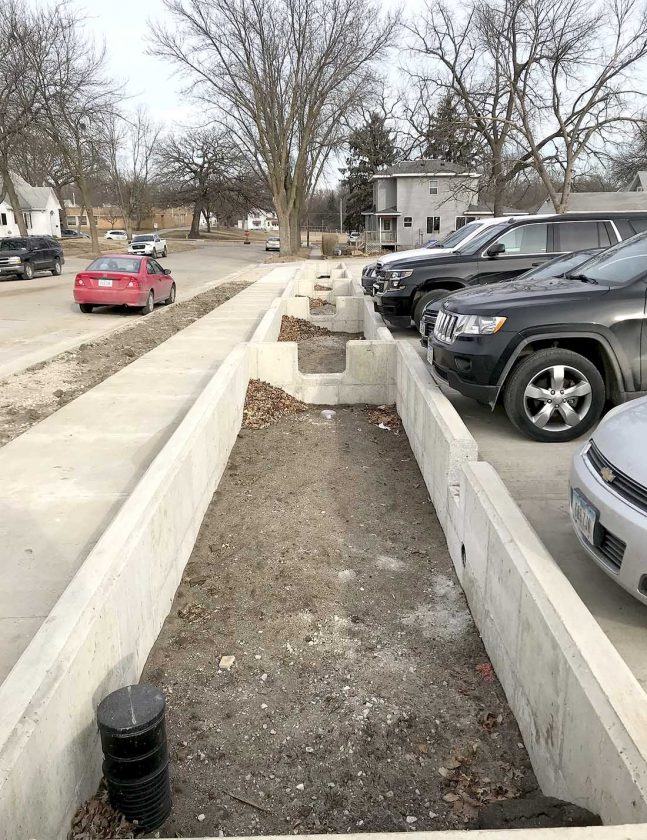
Tree trenches here along one side of Algona’s “green” parking lot will be filled with trees and other plants in the spring. Rainwater from the lot will filter into the trench, where plants can filter out nutrients and pollutants as the water moves slowly to the storm sewer inlet at the other end.

-Submitted graphic
This image shows what Algona’s ecological parking lot will look like once the plants are growing. Permeable pavers throughout the lot allow water to filter down slowly through rock, instead of flowing straight into the storm sewer, and water then will pass through these planters from one end to the other
ALGONA — The city of Algona has been recognized for its work in managing and cleaning up stormwater that flows from its public spaces.
Algona was one of eight recipients of a Best Development Award recently given out by the environmental group 1,000 Friends of Iowa, for the city’s downtown green parking lot infrastructure renewal.
When Algona needed to replace an aging city parking lot, it also took advantage of a state program to treat runoff, said City Administrator Curt Wiseman. That program was available because of an earlier project.
“We did a project to make improvements to our sanitary sewer collection system, so we utilized state revolving loan fund monies through the DNR to finance that,” Wiseman said, referring to the Iowa Department of Natural Resources.
“There’s been kind of a new program in the last couple years, where if you use SRF monies you are eligible for what they call an SRF sponsored project,” he added.
-Submitted photo
Tree trenches here along one side of Algona’s “green” parking lot will be filled with trees and other plants in the spring. Rainwater from the lot will filter into the trench, where plants can filter out nutrients and pollutants as the water moves slowly to the storm sewer inlet at the other end.
Algona borrowed about $2.4 million from the revolving loan fund, so it was eligible to receive back $240,000 to do a project that would be related to storm water management.
“There are a lot of different options for slowing down, catching and in theory treating stormwater,” Wiseman said. “So we had a city parking lot near downtown that was in very poor condition, so what we did is we used that money to reconstruct the whole parking lot.
“The majority of the parking lot has permeable pavers, so when it rains the water will land on those pavers and go between the pavers, and underneath the pavers there’s varying gradations of rock underneath,” he said. “So the water in theory will filter down through the rock underneath those pavers.”
Then the water will flow through pipes under the rock to concrete tree trenches at the west end of the parking lot.
“It’s not done yet, but it will be this spring,” Wiseman said. “It will be filled with various soils and compost material, and we’ll have trees planted in it with other plantings. So the water will slowly flow through those tree trenches, and the plantings and the trees can uptake the nutrients in that water, providing another level of treatment.”
Essentially, the water is slowed down, and treated on its way to the storm sewer, Wiseman said.
“It goes back to the big nutrient reduction effort that’s going on statewide,” he said. “It’s not yet common, especially in this part of the state. The big urban centers are doing more and more of it. There’s detention basins that are being built, rain gardens, bio-swales.”
This is something the Iowa Department of Natural Resources wants to see more of, he said.
“Especially in a parking lot, you’ve got vehicles that are dirty, dripping oil or other fluids, — a storm washes all that stuff off. Instead of washing those pollutants into the river, it can go down and be treated through natural processes.”
The engineering firm for the project, ISG, made the application for the 1,000 Friends award, Wiseman said.
“The city of Algona was chosen from the other stormwater management nominations because it did a retrofit when it didn’t have to, used innovative tree trenches, and has plans to monitor water quality,” said Julia McGuire, Best Development Awards coordinator for the group.
The Development Awards are meant to “bring attention to cities, companies, nonprofit organizations, and individuals who demonstrate how responsible development and planning practices provide benefits to the community, the environment, and quality of life for future generations,” according to the group.
In the stormwater category, jurists considered impact on downstream water quality, reduction of impervious surfaces, and public outreach or education among other factors.
“It’s kind of a new concept for Algona, but we’re trying to be a leader in that area, and get people to think about things a little differently than they’re used to,” Wiseman said. “It will be attractive, there will be plantings around, and also it will serve as educational for the public to understand what the whole philosophy.”
Algona has also added bio-swales when it constructed its new city hall, he said. This drains the storm water to a certain area where it can infiltrate into the ground, instead of flowing straight into the sewer. A bio-swale was used in construction of a parking lot in a park at the east side of town.
Local News
Go and Do: April 3, 2026
Around the area CLARION — The Spring Coin Show will be held from 9 a.m. to 4 p.m. SATURDAY at the Heartland ...

Mental exam ordered for McCuddin

Dairy goats a year-round commitment

Bringing the zoo to Friendship Haven

Ag in the Classroom brings Earth Day to life