Miracle Kids
Three Tanzanian teens desperately needed help. A doctor from Iowa rose to the challenge.
-
-
-Messenger photo by Peter Kaspari
Sahdia Abdallah, 14, center, thanks all the people who helped save her life, as Wilson Tarimo, 13, right, and Dr. Steve Meyer, left, look on. Abdallah and Tarimo are two of the three children who survived a bus crash in Tanzania and were treated for their critical injuries in Sioux City. All children have made full recoveries.
-Messenger photo by Peter Kaspari
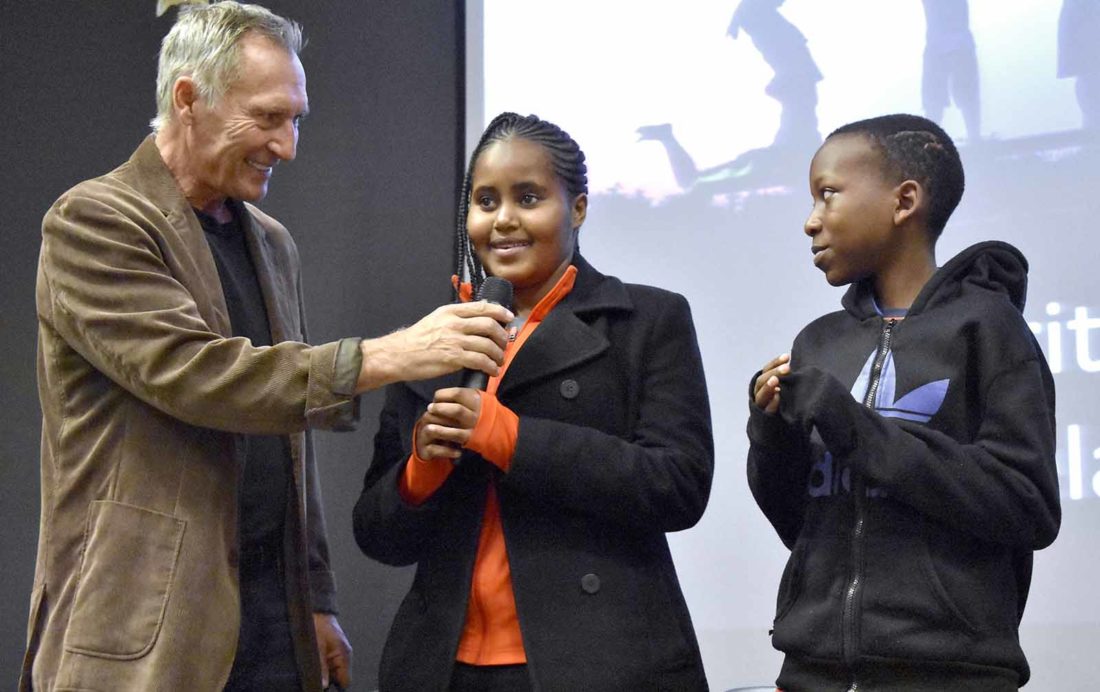
Sahdia Abdallah, 14, center, thanks all the people who helped save her life, as Wilson Tarimo, 13, right, and Dr. Steve Meyer, left, look on. Abdallah and Tarimo are two of the three children who survived a bus crash in Tanzania and were treated for their critical injuries in Sioux City. All children have made full recoveries.
They’re called “The Miracle Kids of Tanzania.”
Three children, who were the only survivors of a bus crash in that African nation in 2017, have made full recoveries just a year and a half later, despite being critically hurt in the crash.
And Dr. Steve Meyer, a Dakota Dunes, South Dakota-based orthopedic surgeon, said he believes that the children survived because God had a plan for him and his colleagues to be in Tanzania at that time.
Meyer, along with two of the three children who were saved — Sahdia Abdallah, 14, and Wilson Tarimo, 13 — spoke to a group of Iowa Central Community College students Tuesday at the Bioscience and Health Sciences Building.
Meyer is the co-founder and president of the Siouxland Tanzania Educational Medical Ministry, a nonprofit founded in 1997 that provides medical treatment for underprivileged people — particularly children — in Tanzania.
In May 2017, Meyer said he and three of his friends traveled to Tanzania to visit a medical clinic that had no orthopedic surgeon, despite serving 2 million people.
They learned that shortly before their arrival, the hospital’s chief medical officer, the district medical officer and the regional medical officer had all been fired. By the time Meyer and his team arrived at the clinic, there were only three people there that needed treatment.
With very little to do, Meyer suggested that his teammates go on a safari, which they decided to do on May 6, 2017.
As the trio were in line waiting to get in, they heard a commotion up ahead of them.
A bus carrying 38 people — 35 students, two teachers and the bus driver — had lost control while traveling down a slippery road and crashed into a ditch.
“The whole nose of the bus crashed right into a mountain,” Meyer said.
•
The bus was taking the children on a field trip to play soccer and do mock exams for their national exams at another school.
Realizing they needed to help, Meyer’s three teammates got off their bus and ran to the accident scene. Among all the bodies, Meyer said three survivors were found; all were seventh-graders.
The children were loaded onto the back of a pickup truck and taken to a hospital.
Soon everybody in the area knew who the three rescuers were, as a local newspaper had photographed them and their pictures appeared on the front page.
Meyer said the children were in “terrible condition.” Between the three of them, they had 25 fractures.
“Sahdia had a broken neck,” he said. “Wilson had a thigh bone sticking out of his leg, an open fracture, both arms broken.”
The third child, who Meyer identified only as 13-year-old Doreen, “had her face completely shattered.”
Meyer’s wife, Dana, said, “We’ve got to bring these kids back to America.”
Meyer didn’t think that was possible. Tanzania had previously rejected millions of dollars in aid from the United States.
There was also the logistics. How would he get three critically ill children over the Atlantic Ocean?
But then Meyer said his wife “reminded me that the Bible says, ‘with man it may be impossible, but with God, everything is possible.'”
•
He decided he would give it a try.
He first reached out to Lazaro Nyalandu, a Tanzanian parliamentarian who is also a co-founder of STEMM. Nyalandu arranged a meeting with Samia Suluhu, the vice president of Tanzania.
Meyer said she was able to get approval for the three children to leave the country to get medical treatment in America.
Meyer also reached out to Dr. Steve Joyce, who serves on the medical executive committee at Mercy Medical Center Sioux City. Joyce was initially skeptical that the hospital would be able to provide treatment for the children, as it was going through some financial troubles.
But after meeting with the medical executive committee, Joyce reported that everyone on the committee was fully supportive of the efforts and would treat the children once they arrived in America.
That left just one more obstacle; transporting the children to the states.
Meyer said he got in touch with U.S. Rep. Steve King, R-Kiron, who then got ahold of the Rev. Franklin Graham, president and chief executive officer of Samaritan’s Purse, an international Christian relief organization.
Meyer said Graham provided a DC-8 aircraft that was used to fly the children to the states.
It took just five days for the children and their mothers to get their visas approved for the journey.
Eight days after the bus crash, the DC-8 touched down in Charlotte, North Carolina.
•
But there was a problem. During the landing process, the plane blew an engine and could not fly any further.
The emergency room doctor at the University of North Carolina Medical Center called Meyer and said he recommended the children not travel to Sioux City, but Meyer insisted they keep going.
“God did not do all these miracles to get these kids this far and be half a continent short of Sioux City,” Meyer said. “They’re coming to Sioux City.”
He signed a waiver for the children to be transported and the following day private aircraft transported the three children to Sioux City.
Doreen is paralyzed from the waist down.
The other children made full recoveries.
Meyer credited the power of prayer, as well as God, for the outcome.
On Aug. 18, 2017, just three and a half months after the crash, the children stepped off a plane and returned to Tanzania.
Meyer said the entire African nation knows who the children are now.
“Everyone, even in the most remote village, knows about the miracle kids of Tanzania,” he said.
Both Abdallah and Tarimo took the stage briefly after Meyer spoke to talk to the audience.
Tarimo told the audience he wants to be an engineer when he grows up, and Abdallah wants to be a pilot.
Doreen wants to be a doctor.
Abdallah said they came back to Iowa for multiple reasons.
“We came back for a medical checkup and to thank all the people who helped us,” she said.
There’s another reason why they came back.
“And also to thank the people who have come here to hear our story and share with us.”