
King touts Taiwan trade deal
Taiwanese business leaders pledge 30 percent increase in soybean imports
-

-
-Messenger photo by Joe Sutter
Local farmer Bill Horan, left, with State Sen. Tim Kraayenbrink, U.S. Rep. Steve King, and Eric Juin-yaw Huang, Director General of the Taipei Economic and Cultural Office in Chicago, visit during a meeting at Iowa Central Community College Sunday. King brought a Taiwanese agricultural procurement delegation throughout midwest Iowa on Sunday as Taiwan plans to increase their purchase of American soybeans by 30 percent.
-

-
-Messenger photo by Joe Sutter
Jason Cheng-ta Tsai, vice president of Taisun Enterprise Co., left, and Eric Juin-yaw Huang, Director General of the Taipei Economic and Cultural Office in Chicago, visit with local farmer Bill Horan during a trade delegation to northwest Iowa Sunday. Numerous farmers and officials met with about ten delegates from Taiwan as part of a tour of Iowa farms. Taiwan has agreed to increase its purchase of American soybeans by 30 percent.
-
-
-Messenger photo by Joe Sutter
Eric Juin-yaw Huang, Director General of the Taipei Economic and Cultural Office in Chicago, addresses the farmers and lawmakers meeting together with a Taiwanese delegation on agriculture trade Sunday morning at Iowa Central Community College, as the visitors were given a tour of the area by U.S. Rep. Steve King. Next to King is State Sen. Tim Kraayenbrink; at right are Jason Cheng-ta Tsai, vice president of Taisun Enterprise Co., and Pat Shou-Hao Lee, manager of the Soybean Procurement Team for TTET Union Corporation.
-Messenger photo by Joe Sutter
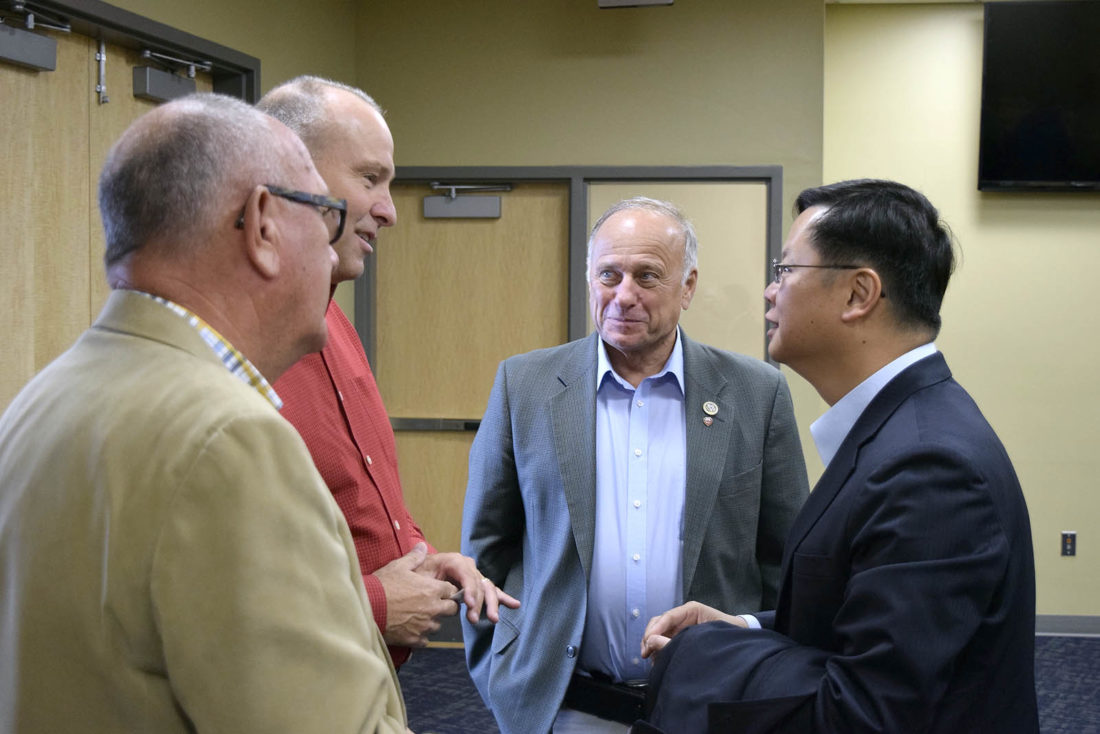
Local farmer Bill Horan, left, with State Sen. Tim Kraayenbrink, U.S. Rep. Steve King, and Eric Juin-yaw Huang, Director General of the Taipei Economic and Cultural Office in Chicago, visit during a meeting at Iowa Central Community College Sunday. King brought a Taiwanese agricultural procurement delegation throughout midwest Iowa on Sunday as Taiwan plans to increase their purchase of American soybeans by 30 percent.
This week Taiwan announced it would increase its purchase of U.S. soybeans by 30 percent.
A $1.56 billion intercontinental trade deal necessarily involves countless people. But it doesn’t have to be impersonal.
Sunday, a group of Taiwanese business people and cultural leaders took a tour of northwest Iowa to see some of the faces that make this deal possible.
Building relationships is key in encouraging good business between the two countries, said U.S. Rep. Steve King, R-Kiron, who organized the delegation’s tour Sunday.
“I wanted to express how important it is that we build relationships with our trade partners,” King said Sunday afternoon at Iowa Central Community College to a gathering of local farmers and state lawmakers who came to have brunch with the Taiwanese visitors. “We want them to know where their products come from. I want them to think about the faces of our producers that are here today.
-Messenger photo by Joe Sutter
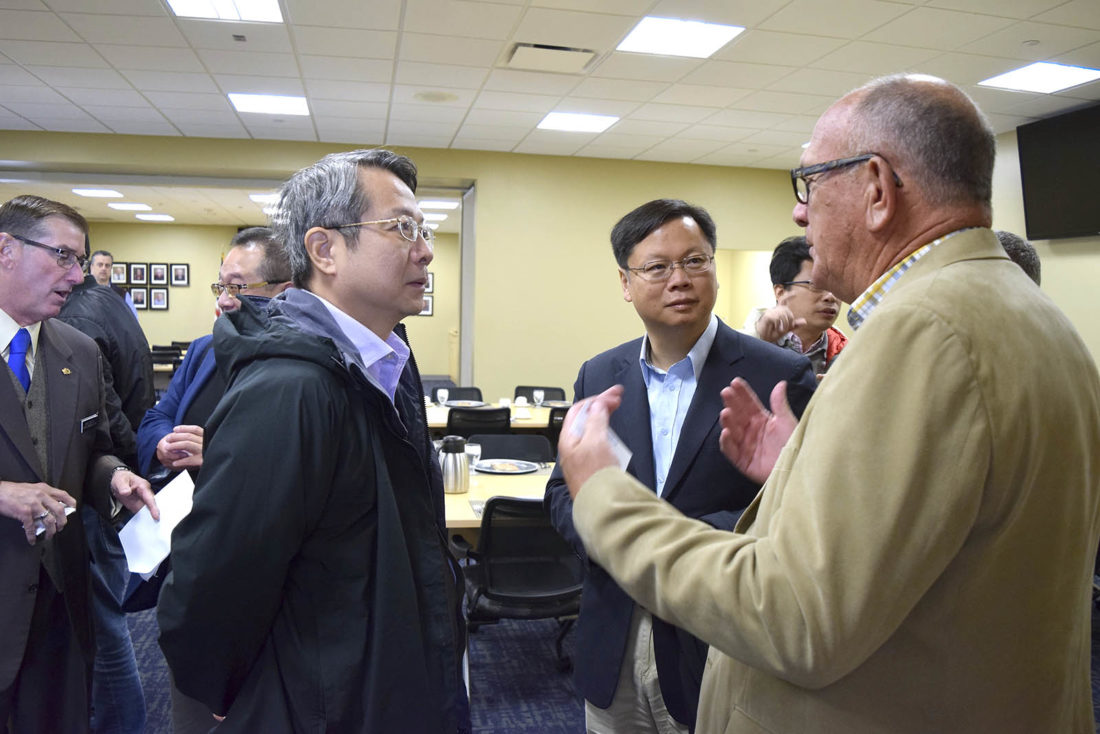
Jason Cheng-ta Tsai, vice president of Taisun Enterprise Co., left, and Eric Juin-yaw Huang, Director General of the Taipei Economic and Cultural Office in Chicago, visit with local farmer Bill Horan during a trade delegation to northwest Iowa Sunday. Numerous farmers and officials met with about ten delegates from Taiwan as part of a tour of Iowa farms. Taiwan has agreed to increase its purchase of American soybeans by 30 percent.
“It gives you a real sense of how predictable and how reliable the United States, and especially Iowa, is as a source of grains we expect you’ll be importing for a long time.”
King, a member of the House Agriculture Committee, took part Wednesday in a signing ceremony for the trade increase.
Last September, following a series of meetings King held in Taiwan with government officials, the Taiwanese committed to purchasing $2.8 billion of American grains — corn, soybeans, and wheat — according to King’s office.
Wednesday the Taiwanese announced they planned to increase their previous purchase order of American grown soybeans by 30 percent, to $1.56 billion.
This increase is vital in an era where competing tariffs have put a damper on U.S. grain exports to China, King said.
-Messenger photo by Joe Sutter
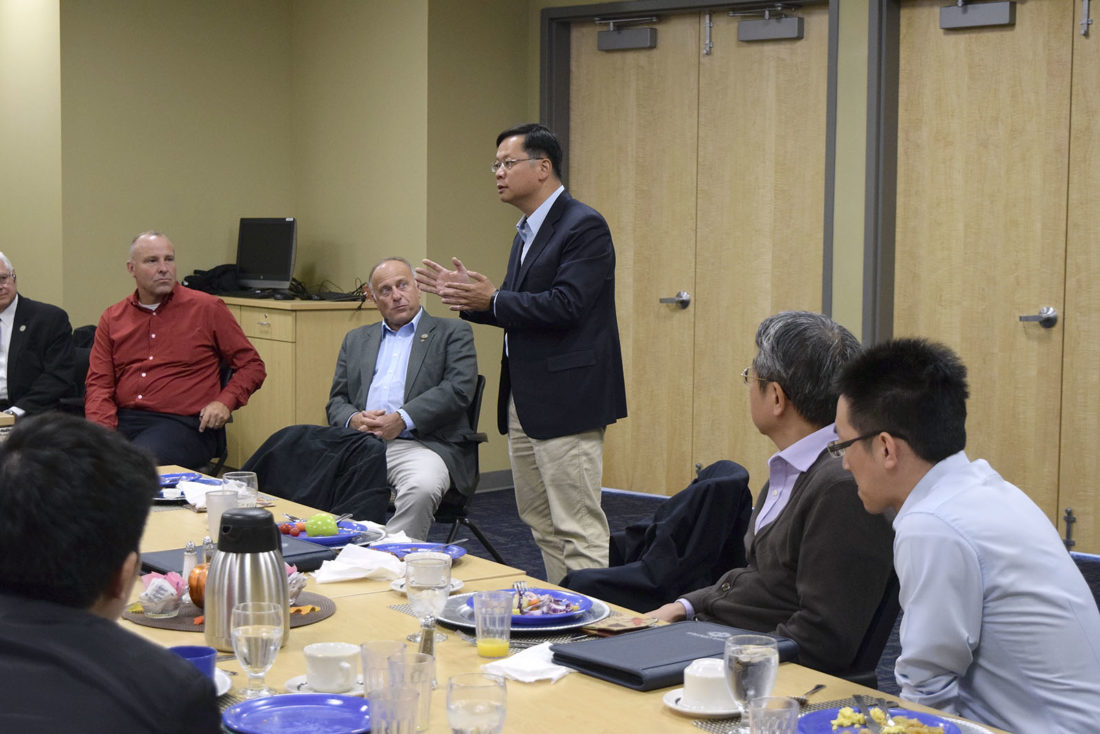
Eric Juin-yaw Huang, Director General of the Taipei Economic and Cultural Office in Chicago, addresses the farmers and lawmakers meeting together with a Taiwanese delegation on agriculture trade Sunday morning at Iowa Central Community College, as the visitors were given a tour of the area by U.S. Rep. Steve King. Next to King is State Sen. Tim Kraayenbrink; at right are Jason Cheng-ta Tsai, vice president of Taisun Enterprise Co., and Pat Shou-Hao Lee, manager of the Soybean Procurement Team for TTET Union Corporation.
“We’re in trade negotiation with China; everybody knows that,” King said. “There was a big pipe of ag products that was being exported to China. That’s been shrunk down. We knew they were going to target soybeans and pork, and this congressional district is number one in America out of all congressional districts in soybeans and pork.
“Our answer to that is, throughout these negotiations — if the big pipe going to China has shrunk substantially, we need to put a lot of smaller pipes together around the rest of the world.”
One country or one “pipe” won’t replace what was lost, but numerous new trade partners could make up the volume of lost trade, he said.
“And it is happening. We have an opening to open up trade with the European Union,” King said. “We’ve got expanded negotiations with Japan, with South Korea. I think the Canadians are likely to get this thing done in the next week or two so that NAFTA’s done.”
Still other countries are involved in private negotiations that he can’t name until after a deal is reached, King said.
“The best-case scenario is that we end up replacing all the markets we used to have,” he added. “We’ve diversified them, our exports, and then when the China deal is made, we may find we have more export markets than we’ve ever had before.”
Eric Jiun-yaw Huang, director general of the Taipei Economic and Cultural Office in Chicago, also said it’s in his country’s best interests to diversify its sources.
He thanked the Iowans for taking time to meet with him about this “mutually beneficial” agreement.
“This is the 12th Taiwan goodwill trade mission,” Huang said. “Out of the 12 missions since 1998, nine missions have come to Iowa. You can understand how important Iowa is to Taiwan in terms of the agricultural products.”
Already, about 55 percent of the soybeans in Taiwan come from the U.S., Huang said, and about 45 percent come from Brazil.
Greg Hora, who farms corn, soybeans and hogs, and is president of the Iowa Pork Producers Association, said the farmers in the room do take time to travel and understand their foreign buyers.
“There are five farmers in the room who have done international travel,” Hora said. “It’s important to know your customers, and for you to know your farmers.”
Delegates were introduced to an Iowa specialty — the sloppy joe sandwich — and were surprised to learn that farmers in Iowa are concerned about the African swine flu that is spreading in China, just like Taiwanese farmers are.
They may not be as close as Taiwan, but Iowa is still affected because animal feed products come from China to America, the Iowans said.
Bill Horan, owner of a large farm in Calhoun County, said anywhere he’s traveled he has found surprises, but also things that he expected.
“I have been to the east and the west and the south of the globe,” Horan said. “Every time I’ve gone and talked to another farmer, whether I could speak the language or not, we could still communicate. Farmers have a way of doing that.”
Local News
Preuschl introduced as Veterans Affairs director

Fire ignites in FD house
Iowa Central offers one application, multiple scholarships
Iowa Central Community College is reminding current and prospective students that the deadline to apply for 2026-27 ...
FD school board OKs 2026-27 calendar
While the 2025-26 school year is still marching on, the Fort Dodge Community School District Board heard about the ...

EMS agreement approved
Pay incentives for police approved
The Fort Dodge City Council on Monday approved some new pay incentives for officers working in the chronically ...