
‘I never really told anything’
Court reporters document veterans’ stories
-
-
-Messenger photo by Peter Kaspari
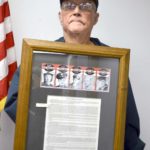
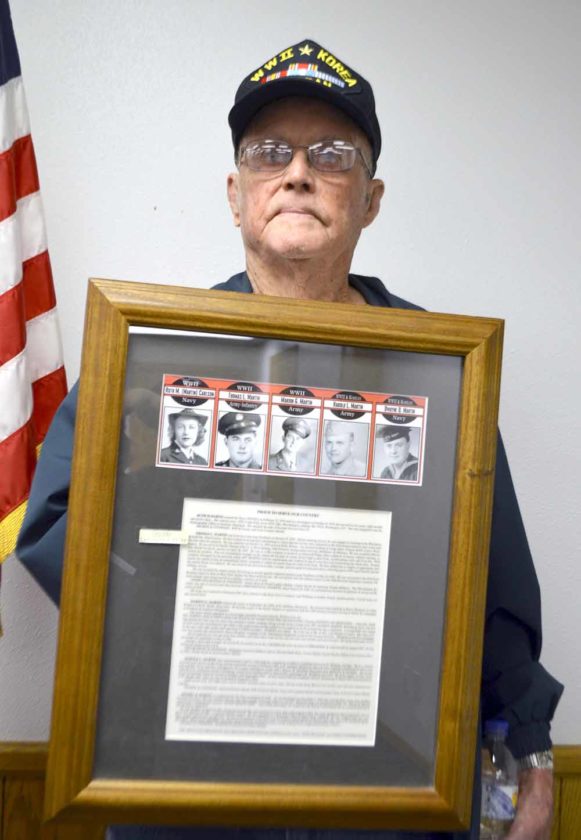
Harold Martin poses with a framed photo that includes photos of him and his siblings, all of whom served in the armed services. Martin was one of several veterans who told their stories to be transcribed by court reporters Friday for the Library of Congress.
-
-
-Messenger photo by Peter Kaspari
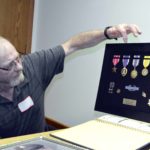
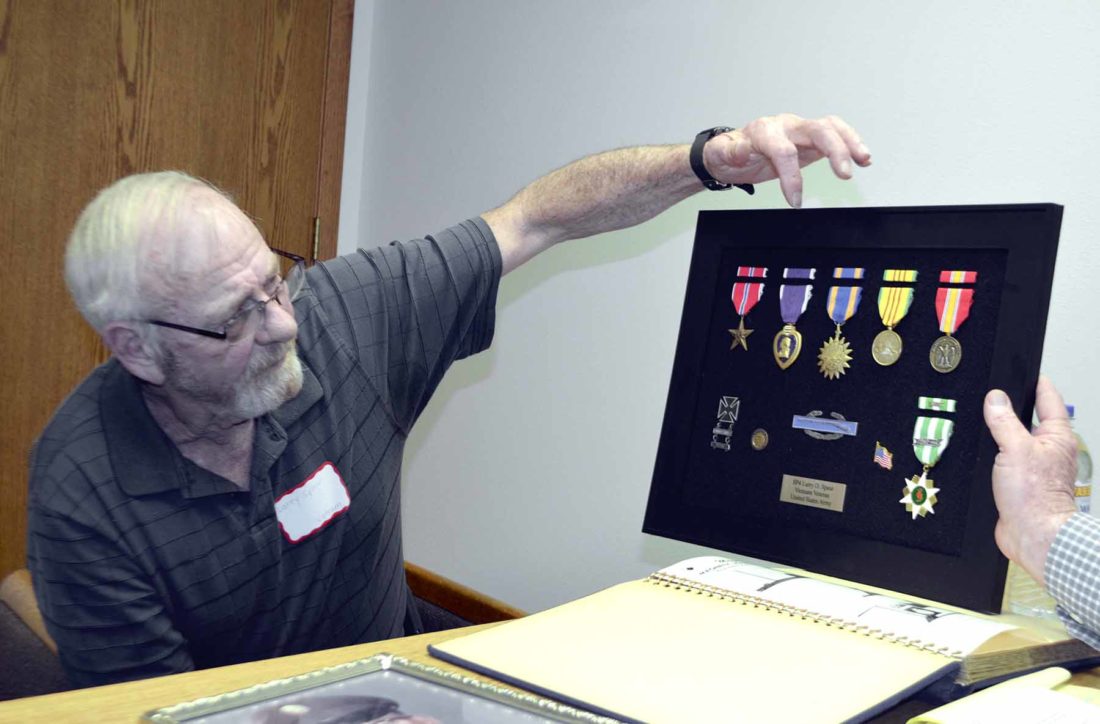
Vietnam War Veteran Larry Spaur points to his Purple Heart, among other medals, during an interview session at Iowa Central Community College’s East Campus Friday. Spaur and other veterans told their stories, which were transcribed by area court reporters to be put in the Library of Congress.
-Messenger photo by Peter Kaspari
Harold Martin poses with a framed photo that includes photos of him and his siblings, all of whom served in the armed services. Martin was one of several veterans who told their stories to be transcribed by court reporters Friday for the Library of Congress.
Larry Spaur’s life changed forever on March 21, 1969.
Just six months into his tour of duty in Vietnam, his unit came under attack during the Tet Offensive and he suffered serious injuries to his legs when the machine gun he was operating was struck by a rocket.
Spaur, of Pleasantville, was one of seven veterans telling their stories to court reporters Friday morning at Iowa Central Community College’s East Campus.
It’s all part of a Veterans Oral History Project, hosted by the 2nd Judicial District members of the Iowa Court Reporters Association.
Spaur, an Army veteran, told his story to Steve Kersten, a local attorney who also serves as a judge in Webster County Magistrate Court.
-Messenger photo by Peter Kaspari
Vietnam War Veteran Larry Spaur points to his Purple Heart, among other medals, during an interview session at Iowa Central Community College’s East Campus Friday. Spaur and other veterans told their stories, which were transcribed by area court reporters to be put in the Library of Congress.
Kersten asked Spaur a series of questions. Both the questions and answers were being taken down by court reporter Jane Smith.
Spaur was drafted in 1968, and received his papers to take his physical on March 21, 1968, exactly one year before his injury.
He was deployed to Vietnam in October 1968, just a month after he turned 20 years old.
Spaur said he served in Echo Company, and had been trained to serve in the infantry. His training included operating M-16s.
On March 21, 1969, Echo Company was sent to a landing zone located between Saigon and the Cambodian border.
Spaur referred to his landing zone as “LZ White.”
“The LZ had been built before and then they tore it down or moved out,” he said. “They went back and built everything exactly where it was the first time.”
But according to Spaur, the time away from the landing zone allowed Vietnamese soldiers to study it and plan for an attack.
His own platoon sergeant said, “This is a death trap for us.”
“He said he wanted to get us out of there, but the company commanders wouldn’t let him,” Spaur said. “So we had to stay and man the bunkers.”
Shortly after their arrival, around 2 a.m., they were attacked.
Spaur manned a machine gun on top of a bunker while another man loaded it.
About 30 minutes into the battle, Spaur heard a noise.
“We heard this whistle come, and that means a rocket’s coming in,” he said. “All of a sudden, there’s a flash and a big boom. We jumped.”
But as they were jumping, a rocket hit the bunker, causing Spaur and the man loading the machine gun to flying in different directions.
Three men under the bunker were killed in the blast.
Spaur said he dragged himself to a weapon but soon realized he was badly injured and passed out.
When he woke up, he was in a hospital being treated for his injuries.
He had been evacuated by helicopter, and said he was the first one to be evacuated because of his injuries.
Eventually, he was transported to Japan for further treatment, and then sent back to Fort Leonard Wood, Missouri for even more treatment.
He was finally released from the hospital in October 1969, and was discharged from the army in March 1970.
Spaur said he still bears scars from the battle.
“My left toes on my left foot are paralyzed,” he said. “I don’t have any feelings in the lower parts of both my legs. I’m having hip problems because I still have shrapnel in my hip.”
Some of his comrades from Echo Company even thought he had died that night. His dog tags were left behind at the landing zone because they were in his boots, which were cut off because of how badly he was hurt.
Spaur said the reason he didn’t have his dog tags out in the open is because the recon missions were conducted early in the morning, and they didn’t want the Vietnamese to see light reflecting off the metal or anything that would have made noise, as that would have blown their cover.
Following his service, Spaur said he worked as a farmer until 1993, and then worked for a fertilizer company, which he still works for part-time today.
Prior to Friday morning, Spaur admitted to Kersten that he never really talked about his service before.
“I never really told anything,” he said. “It’s too tough to talk about, really.”
All the veterans had their own reasons for coming forward.
Harold Martin served in the counter-intelligence corps of the United States Army. Four of his siblings were also in the armed services, although he’s the only one still living.
“I’m the only one left, so I thought it was important to come over and tell the story,” he said. “Not only about myself, but the other four that served.”
Martin, who served during World War II and the Korean War, said he wanted to make sure all his family’s stories were told.
“Family’s important to me, so I want to try and do a good job and give credit to all my family members that served,” he said. “I also had three sons who served in Vietnam.”
The transcripts prepared by the court reporters will eventually be placed in the Library of Congress as a way of documenting the service of America’s veterans.
Local News
EMS levy money could be flowing soon

Williams starts bid for Iowa House seat
LifeServe offers blood donor incentives
LifeServe Blood Center, which has a facility in Fort Dodge, has launched two donor reward initiatives for 2026 to ...
Police seek shooting suspect
A legacy of service