Bill & Randy Posey
Brothers who served
-
-
-Messenger photo by Chad Thompson
Brothers Bill Posey, left, and Randy Posey, stand together outside Bill Posey’s Fort Dodge home recently. Bill Posey is a U.S. Air Force veteran. Randy Posey is a U.S. Navy veteran.
-Messenger photo by Chad Thompson
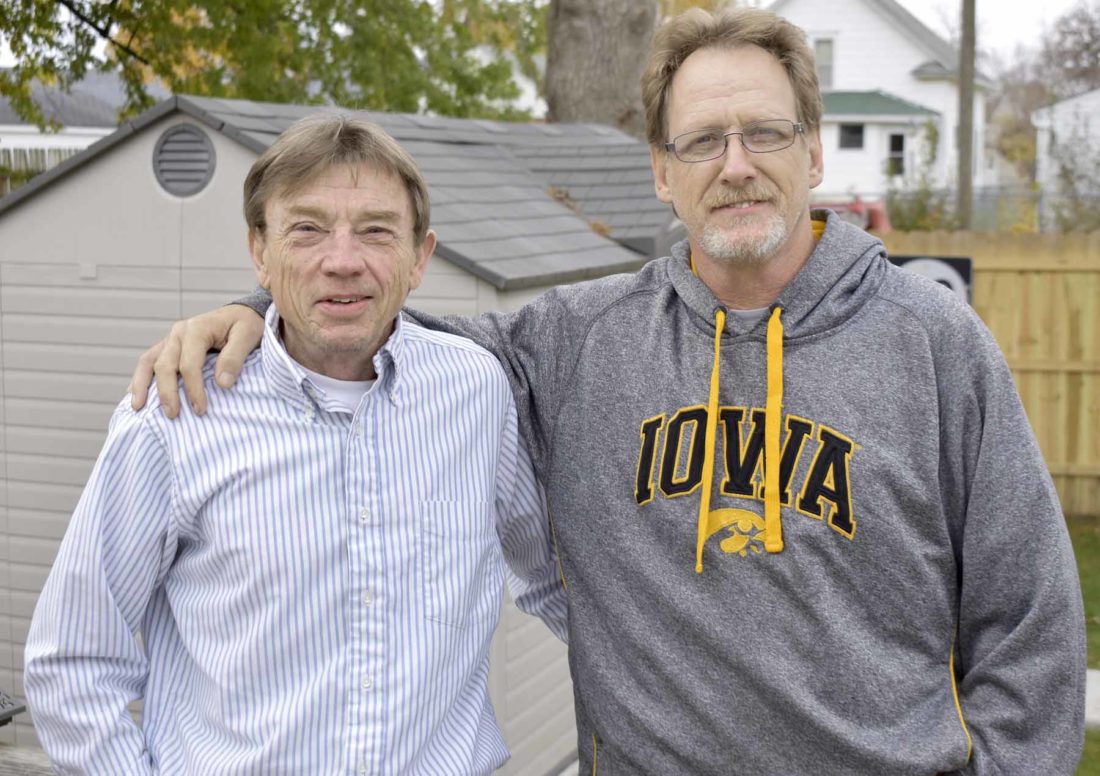
Brothers Bill Posey, left, and Randy Posey, stand together outside Bill Posey’s Fort Dodge home recently. Bill Posey is a U.S. Air Force veteran. Randy Posey is a U.S. Navy veteran.
A U.S. Air Force veteran from Fort Dodge helped load weaponry into aircraft in southeast Asia during the Vietnam War in the early 1970s. About a decade later, his younger brother became a terrorist buster for the U.S. Navy.
Bill Posey, a 1972 Fort Dodge Senior High School graduate, and Randy Posey, a 1982 Prairie Community High School graduate, are those two men.
Bill Posey enlisted in the Air Force right after high school.
“A week after graduation I went in,” he said. “I turned 18 and had to register for the draft. I just went in so I wouldn’t get drafted.”
His wife, Sue Phillips, of Fort Dodge, served as a dental assistant in the U.S. Army. She joined the military in 1969 after her graduation from FDSH.
During the war, Bill Posey was stationed at Korat Royal Thai Air Force Base in Thailand. Meanwhile, Phillips performed her duties at Fort Bragg, North Carolina.
The couple met in high school, but didn’t date until after they returned home.
They have been married for 37 years.
While in Thailand, Posey’s job was to determine which planes had to be loaded with ammunition.
He was in the 23rd Tactical Fighter Wing.
“We were the Flying Tigers,” he said. “Being around that made it a little dangerous, but exciting.”
He was part of a four man crew.
“They have a line of planes that have to be loaded before they take off,” he said.
“It was quite an experience,” he said. “And when you get to the end of the runway, you pull all the safety pins off and watch them take off.”
Phillips realized the impact of the Vietnam War from her job serving troops before they deployed.
She assisted the dentist and performed X-rays in an office setting.
“You started to get to know people and then they would transfer out,” she said. “Some never did come back.”
“That really hit home for me,” she added. “Seeing the consequences of it all was tough.”
Bill Posey said he values his time in the military.
“The people I met,” he said. “I had some pretty good friends there and just the culture of the country.”
The food was memorable.
“One I’ll never forget is rice bugs,” he said. “They suck the rice out of the bugs. I couldn’t handle that. A lot of people like them though. It’s like potatoes here.”
The camaraderie meant to the most to him.
“I am just proud of the people I served with,” he said. “They were like brothers to me.”
Bill Posey served four years. Phillips served two years.
Bill Posey also served in the Iowa Army National Guard for three years in the 1980s.
Randy Posey
Randy Posey joined the Navy in 1982. He became a communications specialist who saw firsthand the devastation of terrorism.
The murder of an American citizen in 1985 resulted in Posey being called on to be part of a terrorist task force.
“We were part of the original task force set up to fight terrorism,” he said. “We were called terrorist busters.”
The name was inspired from the movie ”Ghost Busters,” which was released in 1984.
The murder of the man aired on live TV, according to Posey.
“That’s what started it all,” he said.
A terrorist group made up of four men hijacked the Achille Lauro, an Italian cruise liner, off the coast of Egypt, Posey said.
The hijacking in October 1985 was led by Muhammad Zaidan, leader of the PLF, according to published news reports.
Randy Posey was about a football field away on the USS Saratoga at the time.
“We were within sight distance,” he said.
The terrorist group used Americans as hostages, according to Posey.
The terrorists had demands.
“We just didn’t deal with terrorists,” Posey said. “We are going to kill you and that’s it.”
What happened next shocked the world, according to Posey.
Leon Klinghoffer, 69, an American man in a wheelchair, was shot and thrown overboard by the hijackers, according to Randy Posey.
He heard him hit the water.
“I don’t think you could hear a pin drop,” he said.
Randy Posey said he felt helpless.
“There was nothing I could do,” he said.
The U.S. military would later intercept a plane that the hijackers were aboard.
“They tried to get on a plane to get somewhere and we got them before they got on a plane,” he said.
“That’s how we got labeled the terrorist busters,” he added. “I got my first introduction to terrorism right there, and after that it was nonstop.”
Seeing the loss of a life was tough on him.
“It grew me up a lot that day,” Posey said. “It wasn’t just playing games out there anymore.”
He spent the rest of his service trying to track down terrorist groups in different corners of the world.
His team went to Yugoslavia, Israel, Turkey, Lebanon, Egypt, and Pakistan.
At one point during his service, Posey and the task force he was with were addressed directly by President Ronald Reagan.
“We were in Yugoslavia and Ronald Reagan came over the intercom and told us what we were expected to do,” he said. “It was pretty cool to have the president call you.”
“He told us flat out the world’s watching you,” he added.
As a communications specialist, Posey was on constant high alert.
“You were the eyes and ears of the group,” he said. “Everybody moved on your call, everything went through you. You had to know what’s going on and who’s going where and you have to keep this all in your head.”
He added, “You could screw up easy and sometimes you did, or people would not hear you right.”
Randy Posey spent much of his time on an aircraft carrier.
“Ship board life is like a city on wheels,” he said. “There were general stores, restaurants, we had the whole thing.”
About 5,000 people were on board.
“If you felt the waves on that it was bad out and that’s making you move a little,” he said.
Also during his service, Randy Posey had the opportunity to board the USS Iowa battleship.
He spent six months on the historic ship in 1984.
“That was probably my grandest experience,” he said. “It felt like walking on that boat you were walking on hallowed ground. It made your chest go out a little further. It pumped you up.”
Gunfire on the battleship was a bit unsettling, he said.
“When those guns go off it will bang you right up against the wall if you’re not ready,” he said. “It was nothing but bang boom bang for 10 hours. It rattled your teeth and everything.”
“You learn how to deal with it,” he added.
When the guns weren’t firing, a lot of time was spent cleaning the ship.
“That boat was spotless,” he said. “That’s one thing about being on a battleship — you do a lot of cleaning. Rust cannot exist on that boat.”
Randy Posey was honorably discharged in 1987.
He is proud to be part of a team that pursued terrorists.
“That terrorist task force defined my whole term,” he said. “It was what we were concentrating on back then.”
For the men in Posey’s family, the military was a chance to get away from home life.
“It was like the next step to manhood in our family,” he said. “It was an easy way for us boys to get away.”
His other older brother, Raymond L. Posey, served in the U.S. Navy in the early 1970s. He was not available at the time of the interview.
His father, the late Raymond A. Posey, served in the military as a truck driver during the Korean War.
“He never talked about the military much,” Randy Posey said.
For a time, Randy Posey didn’t think his dad took notice of his service. But later he learned that may not have been the case.
“I never thought my dad paid attention, but I came home one time and found a whole stack of newspaper clippings,” he said. “Just a big packet.”