
When the lights go out
Eclipse party set for Monday
-
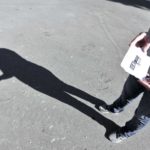
- -Messenger photo by Hans Madsen Webster County Conservation Naturalist Erin Ford demonstrates how a pinhole eclipse viewer works recently. Webster County Conservation is hosting an Eclipse Viewing Party Monday from 12:30 to 2 p.m. Fort Dodge will see about 93 percent of the sun obscured during the peak of the event.
-
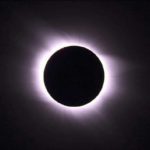
- -Submitted photo courtesy of NASA This image from a previous total eclipse shows what those in the path of totality will see Monday. Fort Dodge eclipse viewers will see a 93 percent eclipse.
-
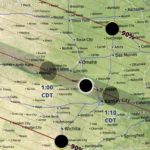
- -Submitted image courtesy of NASA This map shows the path of totality for Monday’s solar eclipse through a section of the Midwest including Iowa. Viewers outside the band will see a partial eclipse. Fort Dodge is going to be about 93 percent, Des Moines is expected to reach 95 percent. A small 400-acre sliver in the southwest corner of Iowa will have totality for a short period of time.
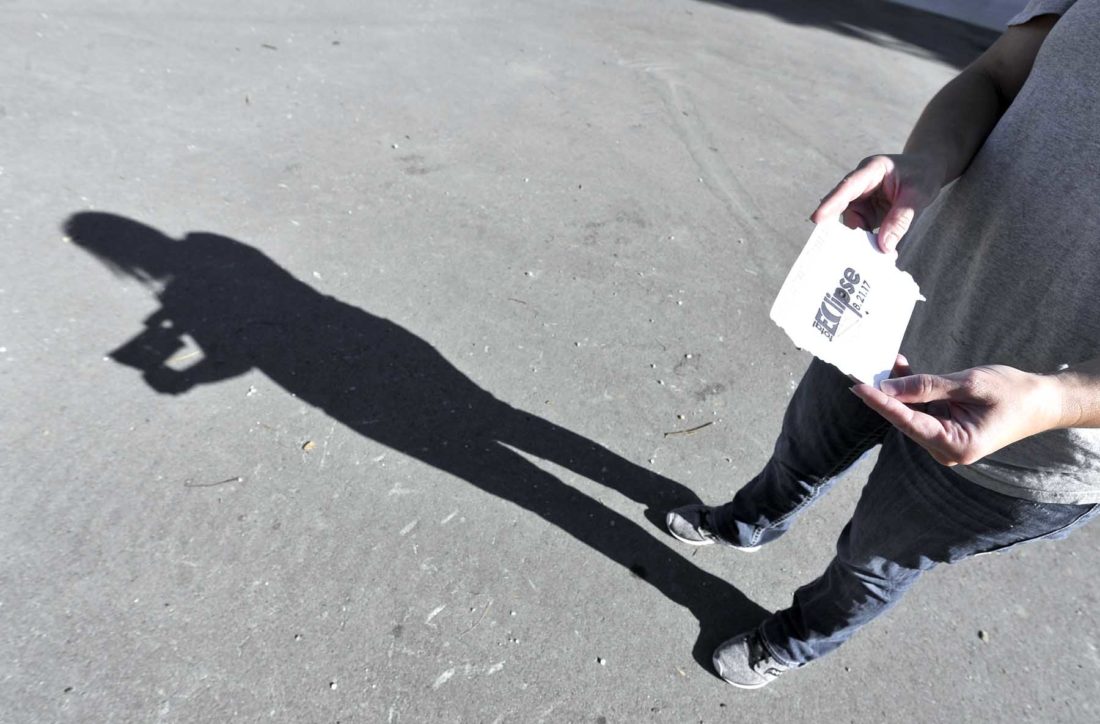
-Messenger photo by Hans Madsen Webster County Conservation Naturalist Erin Ford demonstrates how a pinhole eclipse viewer works recently. Webster County Conservation is hosting an Eclipse Viewing Party Monday from 12:30 to 2 p.m. Fort Dodge will see about 93 percent of the sun obscured during the peak of the event.
Webster County Conservation is going to be throwing a party Monday at John F. Kennedy Memorial Park and guess what — the lights are going to get turned down, way down.
How far down? Far enough down that the birds will begin roosting, nocturnal animals might take a peek to see what’s going on and it might feel a few degrees cooler.
The dimming won’t be because they forgot to pay the light bill — the darkness will be provided by none other than nature and the shadow of the earth’s moon moving across a good portion of the continental United States. The total solar eclipse will blot out 93 percent of the sun in Fort Dodge.
Erin Ford, Webster County Conservation naturalist, said that under ideal conditions, not only will the sun be mostly hidden, something else can be seen.
“You can see some of the planets,” she said.
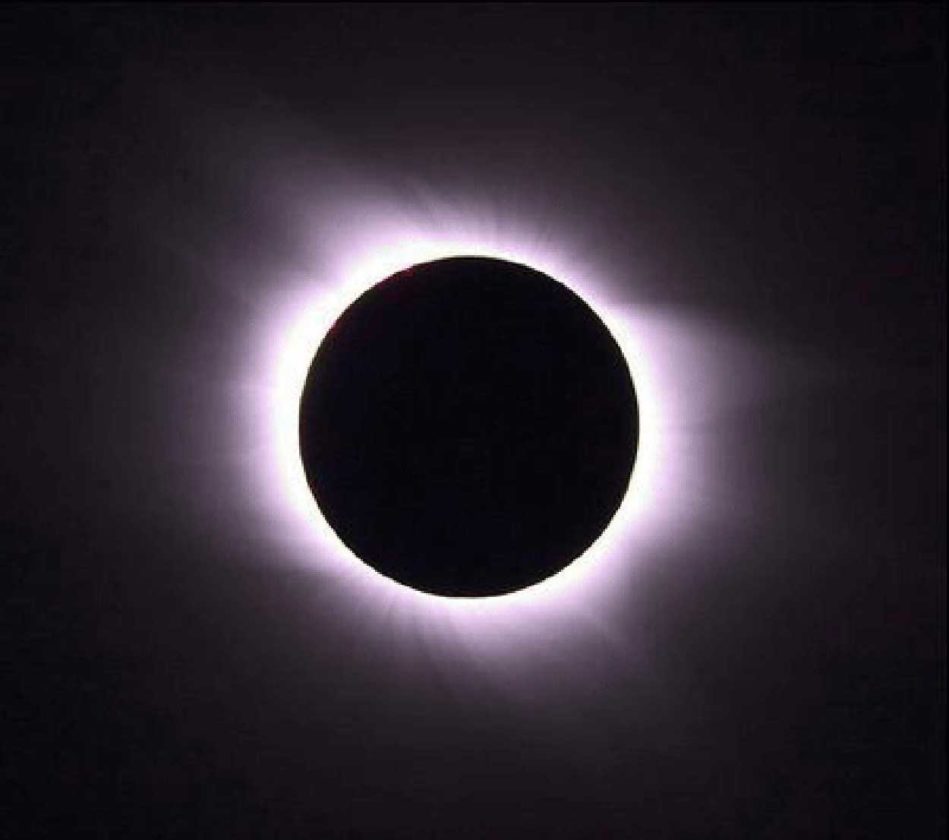
-Submitted photo courtesy of NASA This image from a previous total eclipse shows what those in the path of totality will see Monday. Fort Dodge eclipse viewers will see a 93 percent eclipse.
The gathering of eclipse watchers will be held at the west end of the baseball field at the park. She said that they’ve purchased 50 pairs of eclipse viewing glasses, which will be available on a first-come, first-served basis.
“I only have 50 pairs,” she said.
While there have been eclipses in the past, Monday’s eclipse is the first one in recent history that is not only total, but will be traveling in a path that crosses most of the United States.
NASA maps show a band of totality stretching from near Salem, Oregon, to Charleston, South Carolina.
Ford will also have pinhole viewers available during the party. A pinhole viewer is simply a piece of paper or cardboard with a small hole in it. It can be used to project an image of the sun onto another surface for safe viewing.

-Submitted image courtesy of NASA This map shows the path of totality for Monday’s solar eclipse through a section of the Midwest including Iowa. Viewers outside the band will see a partial eclipse. Fort Dodge is going to be about 93 percent, Des Moines is expected to reach 95 percent. A small 400-acre sliver in the southwest corner of Iowa will have totality for a short period of time.
Many communities in the Midwest, according to the Associated Press, are also expecting a huge influx of visitors to view the total eclipse. Some popular destinations include St. Joseph, Missouri, and Beatrice, Nebraska.
The viewing party at Kennedy Park will start at 12:30 p.m. and continue until 2 p.m. The point of greatest coverage for the eclipse in Fort Dodge will be at about 1:20 p.m.
The Rev. Austin Hill and Gary Lauterbach, both of Fort Dodge, both astronomy buffs, recently spoke during a Lunch and Learn at Gunderson Funeral Home and Cremation Service about what to expect during the eclipse.
Hill and Lauterbach predicted that Webster County residents will experience an eclipse where a little over 90 percent of the sun is hidden. To see the eclipse in totality, you have to travel.
“You have to be in the path of totality,” Hill said. “I know, that’s got kind of a ‘Lord of the Rings’ sound to it, ‘Will you join me on the path of totality.”
There is only one tiny place in Iowa where the eclipse’s totality will be visible.
“It’s only about 400 acres,” Hill said. “It’s just a tiny little tip of the state.”
The one thing that you absolutely, positively do not want to do is stare directly at the sun. The pair offered several methods to view it safely besides a pinhole viewer
“You can buy special eclipse glasses,” Hill said. “They darken everything so you can look at it.”
Lauterbach also demonstrated a technique using two polarizing filters. They are rotated against each other and eventually, produce a completely opaque filter.
One thing you don’t want to do is try it through sunglasses, exposed photographic film or some other makeshift filter.
“Standard sunglasses are not safe,” Lauterbach said. “If you do that you’re going to be seeing the eye doctor the next day.”
Welding helmets are another option sometimes employed to view an eclipse. The required filter is a number 14.
While scientists can predict the timing of the eclipse and its location to within mere fractions of a second and in very short distances, the weather for the day is the wildcard that might make or break the day for not only the viewing party, but for everyone else as well.
With heavy cloud cover, the only visible sign that something odd is going on is that it will be rather dark for a while during the middle of the day.
If the weather doesn’t cooperate, there are several other options, Webster County Conservation will have link on their Facebook page to view the eclipse and NASA will be also be live streaming several views including satellite images of the moon’s shadow moving across the continent.
NASA’s eclipse coverage, as well as a great deal of information on the event can be found at http://eclipse2017.nasa.gov.
Local News

Keeping a legacy of philanthropy alive in Fort Dodge
Iowa Central music students present Spring Showcase

America at 250: A journey through time, told through our communities
Fort Dodge began as frontier military post
Go and Do: April 3, 2026
Around the area CLARION — The Spring Coin Show will be held from 9 a.m. to 4 p.m. SATURDAY at the Heartland ...