
Landus plan impacts Dayton, Sac City
-
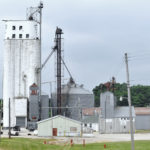
- -Messenger photo by Hans Madsen The grain elevator in Dayton, pictured, will become seasonal in a plan announced by Landus Cooperative. The Sac City site will be similarly impacted.

-Messenger photo by Hans Madsen The grain elevator in Dayton, pictured, will become seasonal in a plan announced by Landus Cooperative. The Sac City site will be similarly impacted.
DAYTON — Landus Cooperative has begun implementation of a multi-year initiative to enhance profitability and reinvest in more efficient assets on behalf of the cooperative’s approximately 7,000 equity holders.
As a result, some of the cooperative’s grain locations will become seasonal sites, including those at Dayton, Sac City, Ackley, Aredale, Kesley, Plainfield and Thompson, said Milan Kucerak, chief executive officer of Landus Cooperative.
Once those sites are full at harvest, they will close for the year.
The overall Landus initiative is called Project 2020: Consolidate Then Grow.
In addition to the seasonalization of the Dayton, Sac City and other sites, it will ultimately result in the following:
• Closure of four locations: Leland, Parkersburg, Bristow and Coon Rapids;
• Shifting agronomy product lines to regional hubs with central dispatch;
• A 5 percent reduction in staff across all part-time and full-time employees in the 26 counties in which the cooperative has locations.
“I think when people hear you are closing locations, the immediate thought is we are in financial trouble, and that is not the case at all,” said Kucerak. “We’re a strong working capital, our bank is aware of the moves and they’re supporting of that.”
Kucerak addressed a rumor alleging one of the nation’s largest cooperatives is coming in and buying Landus Cooperative.
“We have heard those rumors and they are absolutely not true,” he said. “We are not selling to CHS or any other big regional and we’re not going broke and I can say that unequivocally.”
Of the four sites facing full location closure, Kucerak stressed that Landus Cooperative will still be able to service its membership, with one exception: the Leland location.
“That area will cause the most stress for our membership,” he said.
“We all know it is really tough to survive in the downturn that we are currently in in the ag industry,” he said. “Particularly in the grain commodity side. We’re just more or less deciding how do we hunker down, make sure we take care of our core business. The things that we do well with and make sure we are focused on improving our efficiencies and reducing our costs in the operation so that we can continue to provide services our members’ need and position ourselves to really thrive when the ag economy turns around.”
Kucerak said there will be a freight incentive to producers to haul their grain to another Landus Cooperative location when the announced changes are made.
“We will add so much a bushel, so that covers the freight cost, it should be financially natural to the customer,” he said.
Effective July 1, grain assets being closed will include Dumont, Hampton and Audubon, with Exira to be closed effective Jan. 1, 2018.
The closed grain assets are no longer efficient and will be for sale, he said.
Kucerak thinks this may be an opportunity for a larger grain producer to be able to increase its storage capacities, more so than a competitor to come in and buy them.
“The efficiencies of those sites make it reluctant for a competitor to come in and buy,” he said. “A farm that has an eight-, 10- or 12-row corn head, they don’t want to be delivering to an elevator that only as 5,000-bushel-per-hour unloading capacity. They don’t want to wait two hours in line to wait to be unloaded. They need a half-hour turn around time to get back to the field. They only have a certain amount of time to get the crop in and the equipment they use is pretty expensive to just have sitting there waiting.”
According to Landus Cooperative, capital expenditure proposals are being finalized for board approval, with implementation of a growth phase anticipated in the next fiscal year. A variety of multi-million-dollar projects are expected to be implemented through fiscal year 2020, which include:
• Automate grain assets and agronomy hubs;
• Build greenfield grain/agronomy hubs in currently underserved markets;
• Standardize processes and procedures;
• Continue focus on staffing efficiencies.
“For example, we want to have very fast, efficient, speedy space on our grain facilities,” said Kucerak. “We want to focus on fast unloading at harvest time so that we kept the combines running in the field so they’re not waiting for trucks to be unloading at the elevator.”
Grain storage is also expected to expand for Landus.
“We want to have adequate space,” said Kucerak. “We recognize, historically, we have had to rely on bunker capacity. We now know we need to move that to steel because the trendline yield on grain, particularly corn, is real. It increases every year, so I think one of the challenges every cooperative or anyone in the grain business has today is the challenge to keep up with our membership.”
At the same time, Landus’s plan will take its dry fertilizer sites from 17 to eight; liquid fertilizer sites from 32 to 19; bulk crop protection storage from 35 sites down to 25, and anhydrous bullets from 60 sites down to 49.
Local News

Keeping a legacy of philanthropy alive in Fort Dodge

Iowa Central music students present Spring Showcase

America at 250: A journey through time, told through our communities
Fort Dodge began as frontier military post
Go and Do: April 3, 2026
Around the area CLARION — The Spring Coin Show will be held from 9 a.m. to 4 p.m. SATURDAY at the Heartland ...