
Getting a good night’s sleep
Second UnityPoint Health sleep center receives accreditation
-
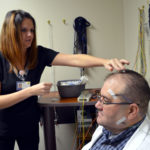
- -Messenger photo by Joe Sutter Kelly Berte, LPN, left, and Dr. Mark Berry show how a patient would be hooked up to brainwave monitoring equipment during a sleep study at the UnityPoint Sleep Center. If Berry were a patient, he would be wearing about 13 wires on his head, plus sensors on his chest, legs and arms before he went to bed.
-
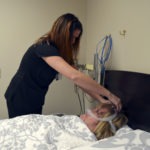
- -Messenger photo by Joe Sutter LPN Kelly Berte, left, and Dawn Byrne, neurodiagnostics/sleep disorder supervisor, demonstrate a CPAP machine at the UnityPoint Sleep Center. Patients spend the night here to have sleep disorders diagnosed.
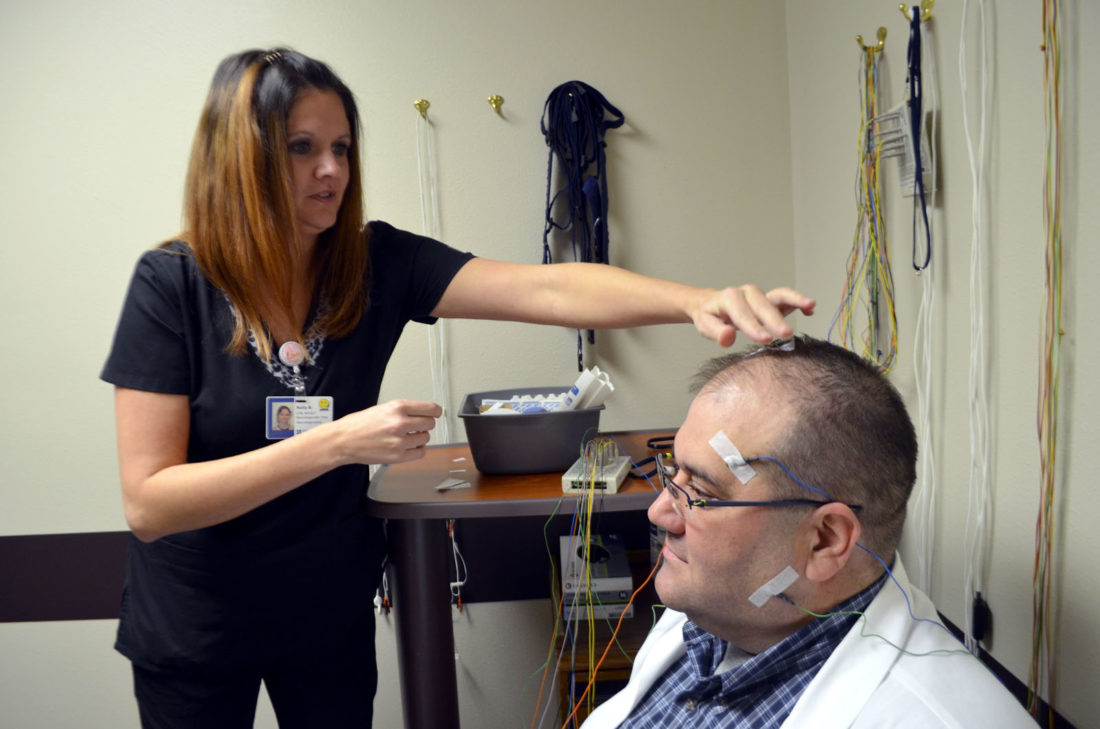
-Messenger photo by Joe Sutter Kelly Berte, LPN, left, and Dr. Mark Berry show how a patient would be hooked up to brainwave monitoring equipment during a sleep study at the UnityPoint Sleep Center. If Berry were a patient, he would be wearing about 13 wires on his head, plus sensors on his chest, legs and arms before he went to bed.
Getting a good night’s rest is hard enough, with busy schedules and long hours. But for some, an assortment of medical conditions can make it difficult or impossible to be well-rested for the day ahead. That’s where the UnityPoint Health — Fort Dodge Sleep Center can help.
The sleep lab at the hospital has been seeing patients for more than 20 years. But a new sleep lab on the same campus, located in the Physicians Building, only opened this year.
“Feb. 16 was our first patient,” said Kelly Berte, LPN.
Now that outpatient lab has been accredited by The Compliance Team, a nationally recognized health care accrediting body based in Spring House, Pennsylvania.
“It means we’ve shown competence in performing sleep studies, interpreting sleep studies, treating patients appropriately,” said Dr. James Meyer, one of two physicians working in the center.
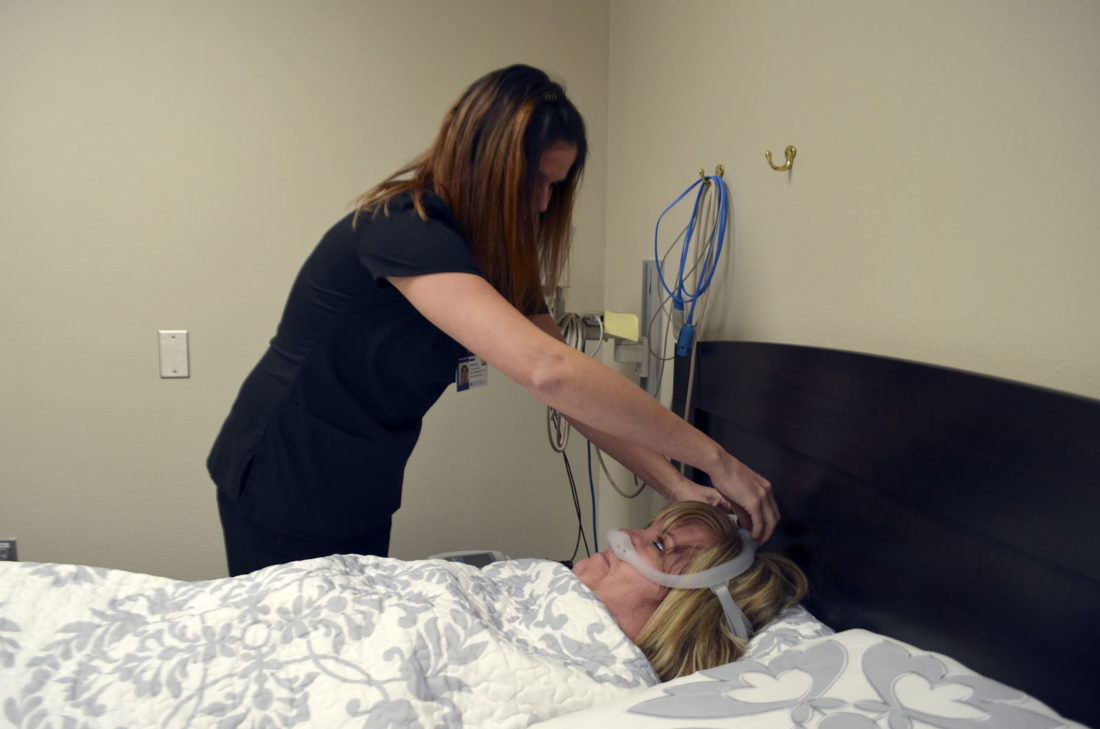
-Messenger photo by Joe Sutter LPN Kelly Berte, left, and Dawn Byrne, neurodiagnostics/sleep disorder supervisor, demonstrate a CPAP machine at the UnityPoint Sleep Center. Patients spend the night here to have sleep disorders diagnosed.
The Compliance Team certified that the center has demonstrated outstanding health care delivery practices and compliance to comprehensive accreditation quality standards.
The team awarded the center its “Exemplary Provider” Certificate of Accreditation for Sleep Care Management, which is valid for three years.
The Compliance Team requires participants score 90 percent or better to achieve accredited status. Fraud and abuse awareness safeguards and quality improvement plans have to be established, and on-going patient satisfaction surveys are required.
Meyer is a pulmonologist. He and Dr. Mark Berry, a cardiologist, are both board-certified in sleep medicine. While they see numerous types of sleep disorders at the clinic, the most common one is sleep apnea.
“That accounts for most of our patients,” Meyer said. “The most common symptoms we see are snoring and excessive daytime sleepiness, fatigue.”
Apnea is defined as 10 seconds without any air movement, Meyer said. People who stop breathing in the night can have their sleep disrupted without realizing it.
“Most people don’t wake up completely, but they go to a lighter stage of sleep so they can start breathing again,” Berry said.
“They’re not getting the restorative stages of sleep. That’s why they feel crummy during the day,” Meyer said. “They might be in bed for all that time, and appear they are sleeping, but they’re not getting the stages of sleep we require to feel well-rested.”
Dawn Byrne, neurodiagnostics/sleep disorder supervisor, has been with the program since it began.
“We’ve come so far,” Byrne said. “When I was starting, we did it on probably thousands of pieces of paper. It wasn’t digital back then.”
The machines recorded info on pieces of paper like an old polygraph, she said.
“Before, looking through them was epic,” Meyer said. “It’s a lot better now. Computers are good for a lot of things.”
The equipment is better, but the study is similar. Patients get an EKG and have brainwave activity, breathing, airflow, respiratory movement, limb movement, and oxygen levels monitored.
“Sleep apnea, 10 or 15 years ago was not nearly as well-studied as what it is now,” Meyer said. “We know a lot more about sleep disorders.”
Sleep disorders can actually lead to cardiac problems.
“The majority of side effects are heart-related. You see things like high blood pressure, abnormal heart rhythm, heart failure, cardiomyopathies, coronary disease, heart attacks,” Berry said. “It can be the primary cause, or it can be something exacerbates the problem.”
“It’s a chicken vs egg phenomena sometimes,” Meyers said. “We don’t know which came first, but we know treating sleep apnea will help those comorbid conditions and will help you live longer generally.”
The hospital sleep lab has four beds, while the outpatient lab has two. The outpatient lab sees eight patients a month on average, but that will be expanding as the need arises, Meyers said.
Other sleep disorders encountered at the center include REM behavior disorder — where people act out their dreams, sometimes violently — and narcolepsy, which may or may not occur with cataplexy (people just falling down asleep) as portrayed in popular media.
“Most of them don’t have that. They just have extreme fatigue,” Berry said. “And cataplexy can be little things, like they just drop their head.”
People also come in for insomnia. And at least some of that problem can be tracked back to how people behave before bed.
“A lot of our problems we see are actually sleep hygiene,” Meyer said. “You want to wind down before you go to bed. You want to watch stimulants you are taking. Make sure you have regular bedtime hours. Get exercise during the day.”
“You shouldn’t get in bed or watch TV, or get in bed and read,” Berry said. “You should get in bed and sleep.”
Reading on phones before bed can be a problem, and even keeping phones near the bed can cause problems.
“Some with their cellphones, they’re not necessarily on it, but they leave it on all night,” said Berte. “So they don’t think they’re waking up, but even a small email notification, a game notification, a text, each time their phone goes off it wakes them up.”
Byrne, Berte, Lyn Otto and Europe Theesfeld are all polysomnographic technologists in the department.
Local News

Merry and bright
Santa Cops were on the case again this year
In 2001, members of the Fort Dodge Police Association chose to sponsor the Santa Cops program as a way for law ...
Taking center stage with Sam Salvatore

A family barn

Countdown to Christmas
Pot found downtown caused concern
People were asked to stay away from a section of downtown Fort Dodge for a few hours Tuesday morning after a pot ...