
Van Dyke: Cover crops not a fad
Agronomist sees benefits for farmers — and soil and water quality
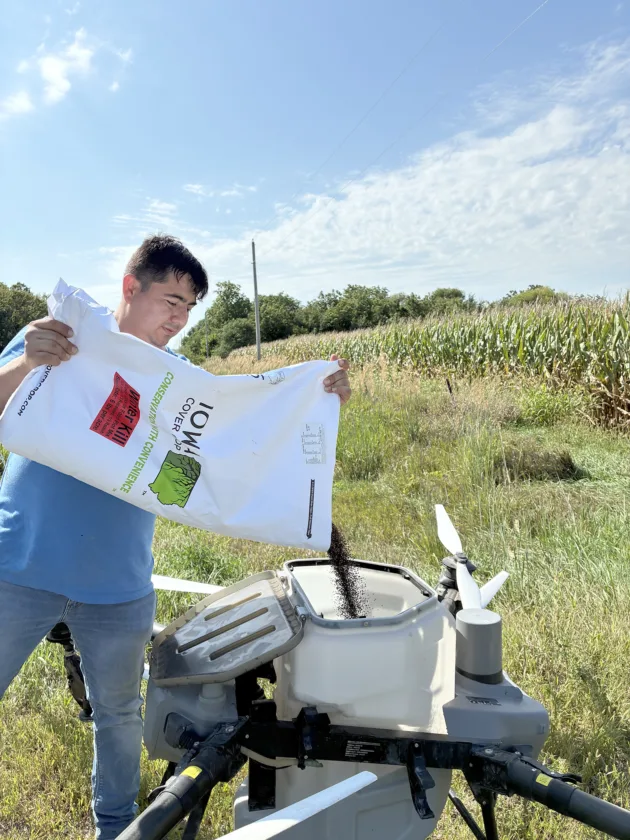
-Messenger photo by Lori Berglund <br> Mario Arredondo fills the hopper with seed as he operates a United Co-op drone seeding cover crops earlier this fall.
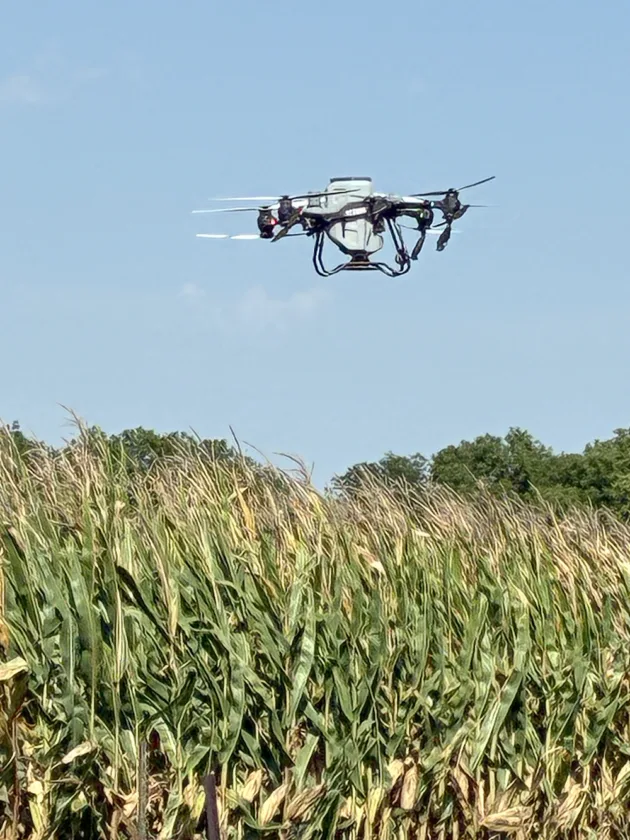
-Messenger photo by Lori Berglund <br> A drone from United Co-op hovers above a corn field near the Des Moines River as it seeds a cover crop earlier this fall.
-Messenger photo by Lori Berglund <br> Mario Arredondo fills the hopper with seed as he operates a United Co-op drone seeding cover crops earlier this fall.
-Messenger photo by Lori Berglund <br> A drone from United Co-op hovers above a corn field near the Des Moines River as it seeds a cover crop earlier this fall.
Trending
STRATFORD -- The airspace above the Des Moines River in southeast Webster County attracts numerous forms of aviation. Depending on the day of the week and the time of year, Iowa National Guard helicopters can be seen in twin formation high above the river valley. In the summertime, spray planes take to the sky, sweeping barely above the fields. And now, in increasing numbers, drones can be seen in multiple crop operations.
While the window is now closed for seeding cover crops, this technology is growing in popularity as a way to improve both soil health and water quality.
Landon Van Dyke, who recently joined United Co-op as agronomy manager in Webster City, is eager to talk to farmers and help them determine if cover crops can be right for their operation.
"I have been heavily promoting it this season, and really pushed hard for using the drone," Van Dyke said. "One of the principles for putting a cover crop out is to have a living root year-round, and to do that you need to get the seed out and growing before harvest, so using a drone is a good way to do that."
Van Dyke grew up on a farm near Pella and earned his bachelor's degree in agronomy from Iowa State University in 2016. He worked for a co-op in Poweshiek County before he joined United Co-op late this summer. While he worked in retail and a number of areas for that co-op, his focus was often on conservation agronomy. He looks forward to visiting with area farmers about any of their conservation and agronomy issues.
"I'm getting to know the growers here, the land, the geography of the area," he said. "My goal is to continue successfully serving the farmers. There's a lot of value in what the co-op can do for their operations."
Cover crops, he noted, are gaining interest for their ability to improve overall soil health, and thus benefit the farmer.
"We want to focus on how we can successfully raise a crop and do it in ways that are beneficial for a farmer," he said. "I think it's important to take care of the land, and to promote cover crops and other methods to help do that."
As the crops come out, fields that have been seeded to cover crops will be turning green again, making it a good time for farmers to consider their options for the next growing season.
While the rain set harvest back and frustrated many area farmers, it should have at least sped germination and early growth for cover crops. Like everything related to weather, there's always a trade-off, and farmers are accustomed to that. The fact that fall is usually a dry time of year can sometimes be a deterrent to many farmers considering cover crops.
"The weather can be a hurdle," Van Dyke said. "For farmers, sometimes they worry, 'What if it doesn't rain?' and nobody can predict that. My philosophy is, 'If you don't put it out, you won't get anything.' So, let's put it out and try to get something growing."
Van Dyke sees a two-pronged benefit to cover crops, both in terms of soil health and subsequent water quality, which is of increasing concern here in Iowa.
"It's developing the biology of the soil, and biology is what drives your yield," Van Dyke said. "It's not an easy thing, but shifting gears toward a more biologically-focused mindset in agronomy, that's where we're going to start seeing success in operations."
Cover crops can also be a crucial step in soil health to help improve water quality. As politicians and city-dwellers put more pressure on those who farm the land, Van Dyke encourages farmers to stay ahead of the curve and be proactive, rather than having to react after the fact.
"That's where I would say we need to be taking a proactive approach to that and lead," he said. "If we can do that, we can still be successful in the operation and benefit the public."
By farmers taking the lead themselves, change can come in ways that benefit the public and still protect the farmer's bottom line.
"It isn't just a fad," Van Dyke said of cover crops. "It's something that's been growing at an exponential rate and more farmers will be joining that. If we don't start being proactive, then we're going to be in a spot that we don't want to be in."
Van Dyke said he has enjoyed meeting the farmers and welcomes the opportunity to get to know them better as he seeks to serve their needs.