
SLOWING THE RADON WAVE
Humboldt’s Christensen, owner of the Iowa Radon Mitigation Co., fights to make homes safer one test — or system installation — at a time
Trending
When Jason Christensen walks into a home to conduct a radon inspection, he puts himself in the shoes of the individual or family he is serving.
"It comes down to helping people, first and foremost," said Christensen, who owns and operates the Iowa Radon Mitigation Co. "I take a lot of pride in being someone they can count on and trust. If what I do gives them both peace of mind and a safer home, that's what makes it the most meaningful.
"It's hard work, but it's very fulfilling."
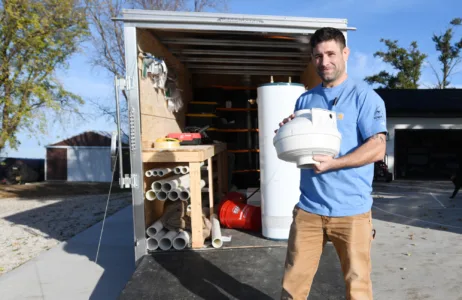
Christensen is one of the few licensed and credentialed radon specialists in the immediate area. The Humboldt resident is a member of the Hoag Plumbing and Heating team, but in his off hours and spare time, he professionally fights the odorless, colorless, radioactive gas that seeps into homes from decay of uranium in soil around the foundation.
According to recent studies, Iowa ranks first in the United States for highest average indoor radon levels, and also has the largest percentage of homes exceeding the Environmental Protection Agency's necessary action number. The statewide average for radon measurements in a typical Iowa home is 8.5 picocuries per liter; the national average is 1.3 pCi/L.
The EPA recommends the installation of a radon mitigation system if average indoor screening levels regularly measure above 4. Approximately 72 percent of Iowa homes are above that mark, mainly due to the amount of uranium in the bedrock and the levels of radon in the state's glacial deposits.
Why is this so concerning? Radon exposure ranks as the leading cause of lung cancer among nonsmokers in society today, and Iowa's numbers for cancer - specifically originating in the lungs - have been following a concerning trendline.
Christensen first became interested in radon detection and mitigation six years ago when he was working on his own home.
"We built a bedroom in the basement for our oldest son, and we knocked out a section of concrete to put in an egress window," Christensen said. "It had already been on my radar to get it checked anyway, so I called a local guy in Humboldt who knew all about it and he showed me what to look for and how to test."
Christensen installed his own mitigation system. After conversations with friends, family members, customers at work and people in the community, he began to realize there was a demand for testing and installation in the area.
"I always wanted to own my own business after I'd (obtained a) degree from Iowa Central," said Christensen, who graduated from Humboldt High School in 2009. "I thought this was something I could do that would make that possible while also educating and helping people who needed it.
"This has the potential to affect all of us, regardless of where we live, the age (of the dwelling) or what kind of home we have."
Christensen will test a property for radon levels - a process that typically takes a few days. There are also free in-home kits available through each county's public health department; the bags should be placed at the lowest living level and away from open air, drafts or sunlight if possible.
"I've seen people take measurements in all sorts of places," Christensen said. "We want to measure the lowest level of the home that is or could be occupied."
After three to seven days, Christensen checks his machine. If the homeowners are conducting the test themselves, they send the pouch in for analysis.
"If I'm conducting the test, I'll take two different independent readings - especially if the first comes back higher than 4 (pCi/L)," Christensen said. "If both tests come back with elevated numbers, we recommend installing a mitigation system, as well as addressing the areas that may be the root of the problem.
"The longer we test, the more accurate the result. An hour - or even a full day - isn't enough to give us the full picture."
Christensen noted that radon is able to enter a home through sump pumps, drains, cracks or spots in walls - particularly in basements. A mitigation system - formally known as an Active Soil Depressurization unit - includes a pipe, vent and fan that draws the radon from areas in and around the home, then pushes the gas outside.
Christensen said his ideal goal is a test showing one picocurie or less. The World Health Organization prefers 2.7 or lower. An outdoor average is 0.4-0.6 pCi/L.
He added each property's reading will be different - even in the same neighborhood.
"I've had people who wouldn't move into a home because of (high) radon levels," Christensen said. "But (testing, preparation and mitigation if necessary) makes for a safe environment. We are looking at reducing long-term, consistent exposure to decrease the risk of lung cancer."
All 99 counties offer free charcoal hang bags for testing. State funding is available to address financial needs related to the cost of installation, though Christensen pointed out assistance options vary by county.
The installation of a mitigation system widely varies in cost, depending on a number of factors related to both material and labor.
Christensen said the winter months are often the true litmus test for radon levels, because properties are closed up and sealed without any influence of outside air typically until spring.
"If you spend a lot of time in your basement - especially if it's used as a living (quarters) - it's really important to test," Christensen said. "It's a judgement call of course, but if, for instance, you have bedrooms for kids, I highly recommend you get it checked out."
Finished basements are a primary concern, but Christensen suggested testing households with unfinished basements, crawl spaces or even properties on cement slabs to be on the safe side due to the risks in Iowa. In the weeks to come, Christensen will also be checking schools in Humboldt, West Bend and Gilmore City.
Christensen's area with his Iowa Radon Mitigation Co, is "basically a one-hour radius around Humboldt."
"I want to make sure I'm able to do follow-ups and that I'm accessible to clients, so I try to stay within a 50- or 60-mile range from home," Christensen said, noting that he's regularly in Fort Dodge and has added customers in Webster City and Forest City recently.
"I treat every case seriously and like I'm testing my own home, because I went through this as a homeowner myself," Christensen said. "Nothing is more important than protecting your family. When I hear back from a mom or dad with kids and they say they feel better and safer and more comfortable in their own home after I've been there...that's about as good as it gets."
For more information, contact Christensen at 515-269-0147, or via email at iowaradonmitigationco@gmail.com. Christensen also recommends reading the citizen's guide to radon, located at www.epa.gov/sites/default/files/2016-12/documents/2016_a_citizens_guide_to_radon.pdf.