
From manicures to tattoos
Women-centered business space opens in FD
Trending
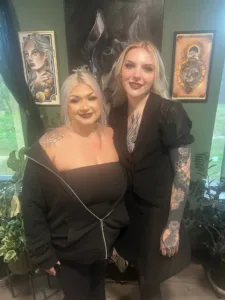
540 Hawkeye Ave. is much more than a street address in Fort Dodge. It's a women-centered, collaborative business space that is owned and operated by three female entrepreneurs - including two tattoo artists and a nail technician - all under 40-years old.
Located on the second floor of 540 Hawkeye Ave., the shared studio space currently houses three independent local businesses: Tattoos by Haley Studyvin, Nails by Shelby, and Gutter Rat Tattoos by Sara.
"The environment is a big part of what we offer here," the 24-year-old Studyvin said. "Promoting the name of the space, rather just our own independent services, draws attention to 540 Hawkeye's clean, comfortable, and creative atmosphere."
Each of the three businesses rent their space from Mark Campbell of Fort Dodge, who owns both the 540 Hawkeye Ave. building and the currently closed, Amigos Restaurant.
Campbell is a former Webster County supervisor, currently serving as the head of the Iowa Department of Administrative Services.
The first new occupant of the 540 Hawkeye Ave. business space was Sara Rosenburgh, the 36-year-old owner of Gutter Rat Tattoos, who set up shop in 2023. She was followed by Studyvin with her own tattoo business in June 2025. The following November, the 29-year-old Shelby Fowler brought her nail salon to the building.
Studyvin grew up in Harcourt, but moved to Fort Dodge in 2021. She has been tattooing for almost six years, beginning while in high school. She worked for various local tattoo parlors before establishing her own tattooing business last year.
Fowler is originally from Holstein and moved to Fort Dodge in 2019 to attend cosmetology school, focusing on nail work. She has been working as a nail technician for nearly six years, employed previously at larger nail salons in town.
Even though 540 Hawkeye Ave. is a fairly new addition to the local business scene, the space already has bragging rights. Tattoos by Haley Studyvin and Nails by Shelby, for example, received the 2025 Fort Dodge Messenger's Reader's Choice awards for the Best Tattoo Shop and Best Nail Shop, respectively.
"After we both won our awards from last year's Reader's Choice, we decided to promote ourselves a little bit more collectively, even though we function independently from one another and provide different services," Studyvin said.
Fowler agrees, noting that 540 Hawkeye Ave. is more than a location on a map; it has become an unofficial "coalition" and "whole space" for three autonomous businesses with a collective social media presence for promotional purposes.
When asked about their women-centric workplace environment, both Studyvin and Fowler said that it was an unplanned coincidence. They were linked by preexisting friendship networks and bonds, rather than simply their sex.
However, they readily admit that three independent women working together in the same social space provides a unique, positive atmosphere, benefiting both themselves and their clients.
"The majority of our foot traffic in here are women," Studyvin said. "I do tattoo, and a decent portion of my clients are men as well. But my male clients happen to enjoy the bubbly, energetic environment that we bring here."
Noting that the tattoo industry was historically male dominated and "very rugged," Studyvin observes that their workspace provides a different vibe.
"Having a more intimate, feminine, comfortable space does tend to relax a lot of my clients, both men and women," she said.
Fowler adds that her nail salon clients "absolutely love" the feminine atmosphere too. Nail salons, in contrast to tattoo parlors, however, are traditionally a female-dominated industry, she said.
In her past work experience, nail salons can sometimes become "a bit catty," she said.
"But I would say that 540 Hawkeye Ave. has probably been the best experience I could have ever asked for in my entire line of work," she said.
Based on their experience, Studyvin and Fowler observe that personal service workplaces tend to fall into one of two categories - either having a "competitive" or "collaborative" atmosphere.
"And I feel that what we've been able to create here, even though we work in different spectrums of the service industry, is based on that collaborative mindset," Studyvin said.
In contrast to many others working in their respective fields, both Studyvin and Fowler see themselves primarily as "artists" rather than simply as service workers or technicians.
Instead of identifying simply as a tattooer, for example, Studyvin sees herself as a tattoo artist. "I do put my artistry into everything that I do," she said. "I hand draw every piece that I put on skin, and I do not copy other people's work."
"I treat it very much as any artist approaching an art project, whether I'm putting art on skin or art on a canvas. I take very similar steps in preparation, including composition," she said.
Studyvin stresses the importance of designing tattoos that are proportional to the body, aesthetically pleasing to the eye, and structured appropriately for each individual client.
"That's a big part of tattooing for me - making sure that I'm creating a piece that is going to fit your body well, that is going to flow well with your anatomy, that is going to be organically balanced, that is going to have breathability where you can read it from across the room."
Similarly, Fowler emphasizes the artistic side of manicuring and other nail work, focusing on creating original designs that fit with an individual client's personal tastes and proclivities.
"Like Haley, I hand draw everything," Fowler said. "I don't use stickers. I don't use cheating methods. My personal technique is to just draw it on to the nail. And you have to have some kind of artistic ability behind the shaping, the filing, the application, and the designs."
Fowler notes that many people (especially women) want to express themselves through their nails. The color and size of nails are essential personal accessories.
"My clients like to portray their personalities through their nails," she said.
"I often paint nails in black and silver colors, and lots of funky kinds of chaotic designs," she adds. "Some girls like their nails long with all the bedazzles, rhinestones, charms, and the big designs. While other clients simply want 'plain nude nails' - without any color."
Both Studyvin and Fowler emphasize that both tattooing and nail design have been stigmatized at various points in the past. Such stigmas were related to the intersection of social class, race, gender, age, and other demographic factors, they explain.
"Tattoos were almost exclusively for men who were blue collar workers, veterans, convicts, or in alternative subcultures years ago," Studyvin said. "Men with fancy white collar jobs couldn't get tattoos that showed on their body because of the stigmas around them."
Fowler notes an opposite, middle class-based stigma that occurred with polished nails.
"There was the stigma that if a woman didn't have nice nails, it was because they're doing too much cooking, too much cleaning, too many things getting in the way," she said.
Racial stigmas have played a role too, given the fact that certain types of tattoos and nails (especially long painted nails) are more common among African Americans and other racial minorities than the white majority.
However, the negative stigmas for both body-based artforms has been reduced enormously over the past 50 years. Both Studyvin and Fowler observe there has been major evolution in American popular opinion concerning both tattoos and painted or long nails.
"There is a much broader acceptance to tattoos today than ever," Studyvin said. "I would say it's generational. It's not very often you're going to come across young adults that are going to have a huge issue with tattoos as a whole."
She notes that more people than ever are getting tattoos, even senior citizens. She attributes the rise in tattoo popularity to many factors, including positive, trendy depictions in popular culture and social media, along with improvements in tattoo technology.
"The tattoo artistry that can be applied to skin is vastly different than what was possible 30 years ago," she said. "Tattoos are now more intricate in nature. A lot of the tattoo work that I do is very detail oriented."
Fowler observes similar technological improvements in nail artistry and safety. Acrylic paint, for example, used to be very damaging to the natural nail, she said..
"But now there are products containing vitamins to help keep the natural nail as healthy as possible," she said.
When it comes to tattoos, one of the biggest changes has involved gender. Despite the hypermasculine roots of tattooing, there are now more women than men with tattoos in American society, studies show. There has also been a large increase in female tattooers.
Even though there are now more women working in the tattoo industry than ever before, however, tattooing can still be a male oriented, male dominated industry, especially in rural communities, Studyvin said.
"Unfortunately, I garner a lot of women clients who have their own horror stories of having been tattooed by men who spoke to them or touched them inappropriately, or didn't give them the care and respect that they deserve," she said. "I'm able to provide a comfortable and safe space for women to get tattooed."
Studyvin explains that tattooing is a very intimate, often painful experience that can place a person in a vulnerable or compromised position.
"Anytime you are making a permanent alteration to somebody else's body, and you are touching somebody else's bare skin, it makes or breaks what that experience feels like to you," she said. "When you are going through such an experience, it's important to feel as though you are in safe hands."
While Studyvin emphasizes that many male tattooers are very professional in their work and respectful of their women clients, she largely attributes the dramatic increase in women with tattoos to the growing number of female tattoo artists.
"The rise in female tattooers has probably led to the rise in women getting tattooed because there are more safe avenues to do so," she said. "If you are a young woman and looking to make such a drastic change to your body, it's easier to gravitate towards wanting to have that experience with a woman who is more likely to make you feel guided and safe."