
Gearing up to plant
With an eye on the Mideast, farmers grateful to have booked inputs early
-
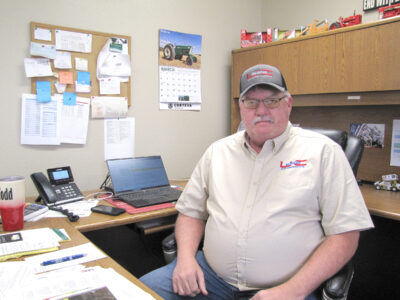
-
-Farm News photo by Lori Berglund
eson, agronomy manager at United Co-Op in Webster City, is looking forward to the start of the planting season and assisting farmers with their input needs.
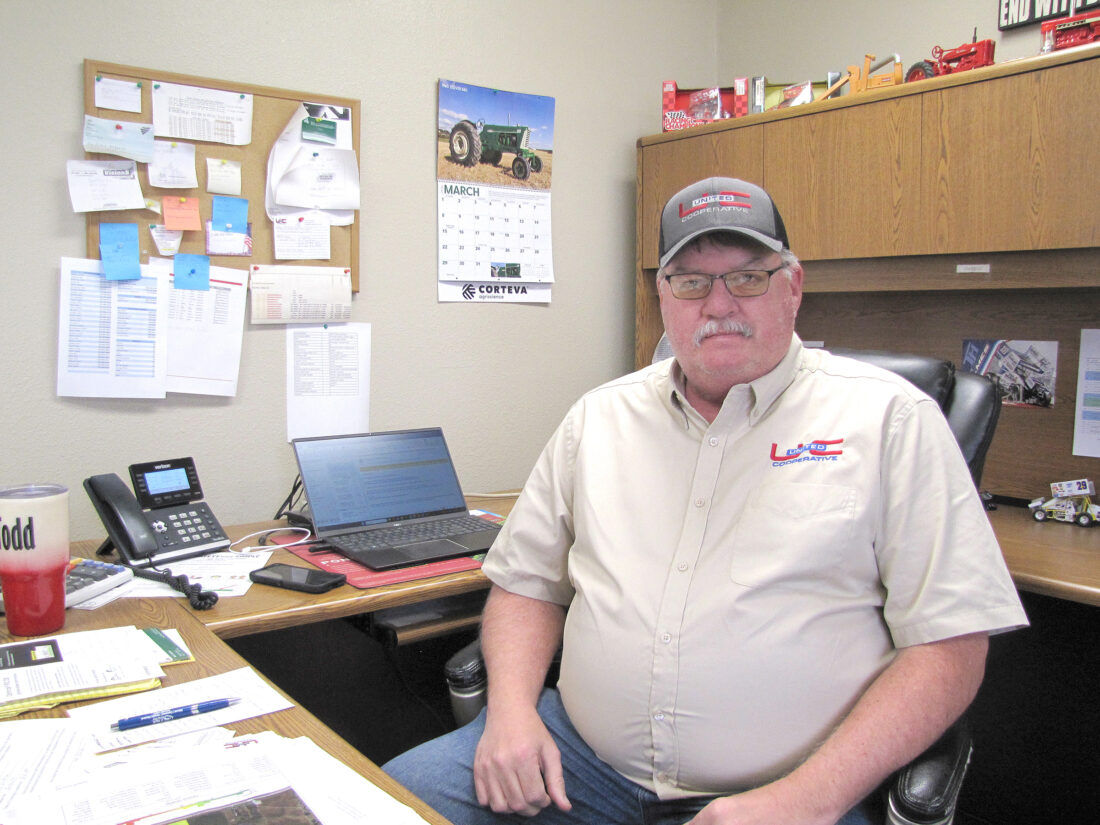
-Farm News photo by Lori Berglund
eson, agronomy manager at United Co-Op in Webster City, is looking forward to the start of the planting season and assisting farmers with their input needs.
Winter may still have some fury left, but Todd Christeson, agronomy manager at United Co-op in Webster City, is looking forward to serving customers when the soil warms and the tractors and planters hit the fields again.
After years when central Iowa has seen frequent drought conditions, the U.S. Drought Monitor has the area looking well refreshed for spring planting. As of mid-March, Hamilton, Webster and surrounding counties all appear in the “normal” rating for soil moisture. Several counties in northwest and southeast Iowa remain in a moderate drought, while counties buffering the swath through central Iowa are in moderate conditions.
Of course, as any farmer knows, all of that can change quickly. For Christeson, despite uncertainty in the world, he remains optimistic and eager to see the planters rolling soon.
“Our soil moisture seems pretty good right now; we don’t need any more,” he said. “If we can get the crop in the ground, and then let it start raining again, we’ll be in pretty good shape.”
But don’t get in too big of a hurry, with cold weather in the forecast for mid-March, soil temperatures in central Iowa were still hovering in the low 40s and upper 30s, according to the Iowa State University statewide soil temperature map.
The elephant in the room as farmers gather and talk about the upcoming planting season continues to be the conflict in the Mideast. Even the national media has taken notice of the impact the closure of the Strait of Hormuz may have on fertilizer and input prices for farmers nationwide.
The American Farm Bureau Federation has been voicing its own concerns and penned a letter to President Donald Trump on March 9. (Read the letter in full at fb.org.)
“Your leadership in advancing the One Big Beautiful Act and in providing $12 billion in emergency economic assistance has helped farmers enter 2026 on better economic footing. Yet we are still experiencing a generational decline in farm income driven by out-of-control inflation and dramatically declining crop prices. This is especially concerning when, just as American farmers begin to put seeds in the ground for spring planting, the prices for key inputs such as fertilizers and fuel increased rapidly following the closure of the Strait of Hormuz,” the letter began.
If there is good news to be had, it is that the vast majority of farmers traditionally book their input needs far ahead of planting season. Price increases coming from overseas will not have an immediate impact because farmers acted last fall to plan for the spring season.
Christeson estimated that at least 80 percent of farmers, and perhaps even more, took advantage of early booking, long before the current crisis erupted.
“Most of our stuff isn’t going up because of buying early,” Christeson said. “But if we had to buy it now, it’s really expensive.”
Like most Americans, he is hoping for a safe and swift resolution to the conflict overseas. If, as the Administration has said, the situation is resolved quickly, the long-term impacts may be minimal.
“Most everybody has their inputs and everything bought for this year,” Christeson explained. “So it’s more a question of what’s going to happen next fertilizer season. I think the question is how long it drags out over there. If they calm down, it can be back to business as normal. Right now, it’s very volatile.”
The conflict has served to focus attention on the global markets that fuel American agriculture.
“I didn’t realize until a week ago that Iran is the third-largest exporter of urea in the world,” Christeson.
A great deal of phosphorus put down on American fields also comes from overseas, while the vast majority of potassium and potash is imported from Canada, he said.
Some in the national media have speculated that the impact on inputs might prompt farmers to change up their planting plans, but Christeson doesn’t foresee that happening.
Changing from corn to soybeans has been one possibility cited in order to save on input costs, but with seed and inputs booked last fall, that is unlikely to happen.
“I think most people will keep with their regular crop rotations,” Christeson said. “I don’t think too many people would switch to beans because of the nitrogen.”
While corn-on-corn has become more popular in recent years, the agronomy manager did note that farmers may have already planned to change things up for their own reasons.
“Usually, if you have been corn on corn for several years, and you switch to beans, your bean crop is huge,” he said. “Usually, it can be between 80 to 90 bushels per acre, just because you change the crop.”
In addition to soil benefits, crop rotation also allows for different chemistry that will assist in combating resistance from weeds.
“Rotation gives you different chemistry for weeds,” he explained.
Even changing products or brands can allow for some resistance to build up on the part of weeds, he said. Rotating crops helps stay one step ahead of the weeds.
“With going corn to beans and beans to corn, you’re using different chemistry every year,” Christeson said, “so that kind of helps.”
Spring is on the way, and come what may with the weather or on the international scene, farmers will be hitting the fields soon.
Local Business
Gearing up to plant

Quality work, service the name of the game at Diamond Pro
Doster brings medical skills back to his hometown
When Michael Doster graduated from St. Edmond High School 16 years ago, he wasn’t planning on a career in ...
FROM FARM TO FASHION

FDIC Data: Iowa banks power economy with $92 billion in loans