Helping people at end of life
Hospice gives patients and families options
-

- -Messenger photo by Hans Madsen Paula J. Baber Hospice House clinical manager Joyce Bianchi holds a set of plaster hands cast from a patients hands in one of the rooms.
-
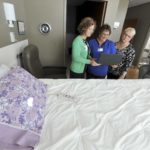
- -Messenger photo by Hans Madsen Paula J. Baber Hospice Home clinical manager Joyce Bianchi, left, along with RN Becky Crompton and clinical supervisor Becky Kalous look over a patient chart before their arrival.
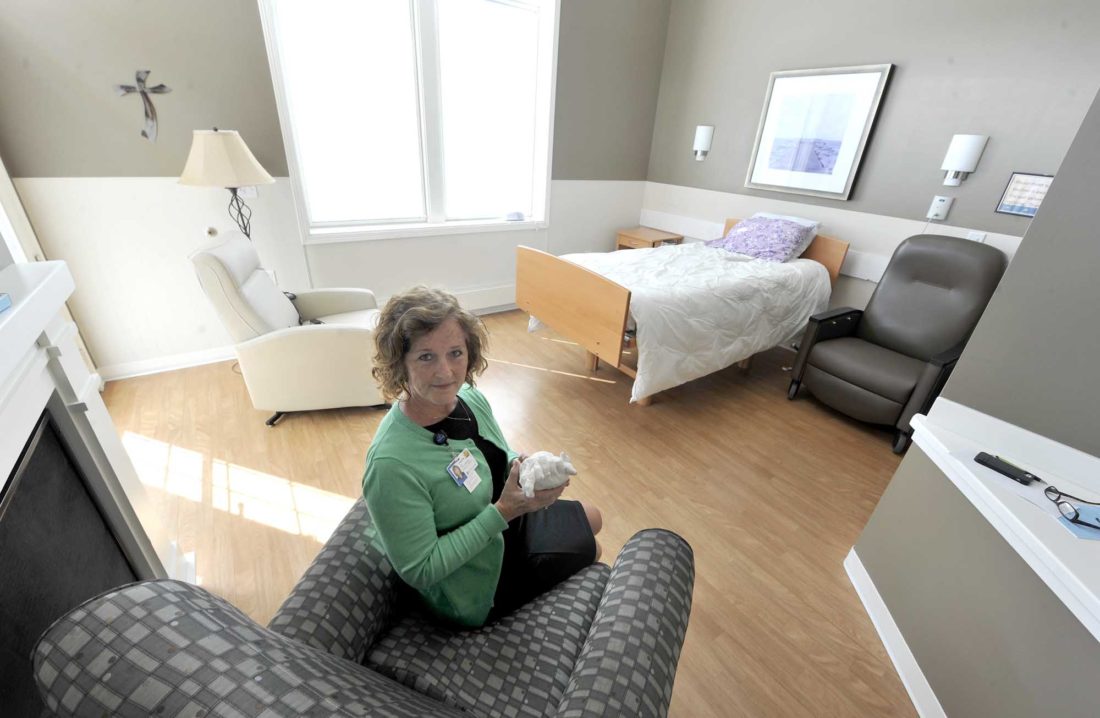
-Messenger photo by Hans Madsen Paula J. Baber Hospice House clinical manager Joyce Bianchi holds a set of plaster hands cast from a patients hands in one of the rooms.
Some deaths are sudden and unexpected. Often, however, a dying person and their family members have substantial advance warning that death will come soon. Helping patients and families through those difficult times is the specialized role played locally by UnityPoint at Home Hospice, which is part of the UnityPoint Health system.
“It is a special kind of health care that focuses on helping the patient and their family live each moment when they are facing a life-limiting illness or disease,” said Joyce Bianchi, UnityPoint Hospice clinical manager for the Fort Dodge area. “It’s about living. We focus on every day. It’s about honoring that patient’s goals of care.”
Hospice care is customized to the needs and wishes of each patient. It can be provided in an array of settings. Some people want to remain in their homes as long as possible. Hospice team members work with other care providers and family members to make that possible. If a person is in a nursing home, hospice supplements the care in that setting. If remaining at home either is not desired or no longer possible given the patient’s situation, a move to the Paula J. Baber facility, which is a hospice house, is an attractive option.
The hospice house makes it possible for a patient to be in an environment that while not their home is much like a home. It has accommodations for as many as eight patients.
“It’s the next best thing to home,” Bianchi said. “The environment is very calming. It is comfortable for families. There are actually places for the family to stay. It is more conducive to comfort. Each room has a private patient TV. Each room has a little room attached that is kind of a family room. There is a TV there and Internet. There is a family kitchen. Each room has access to a balcony. We can actually push the bed out onto the balcony where they can view the garden.”
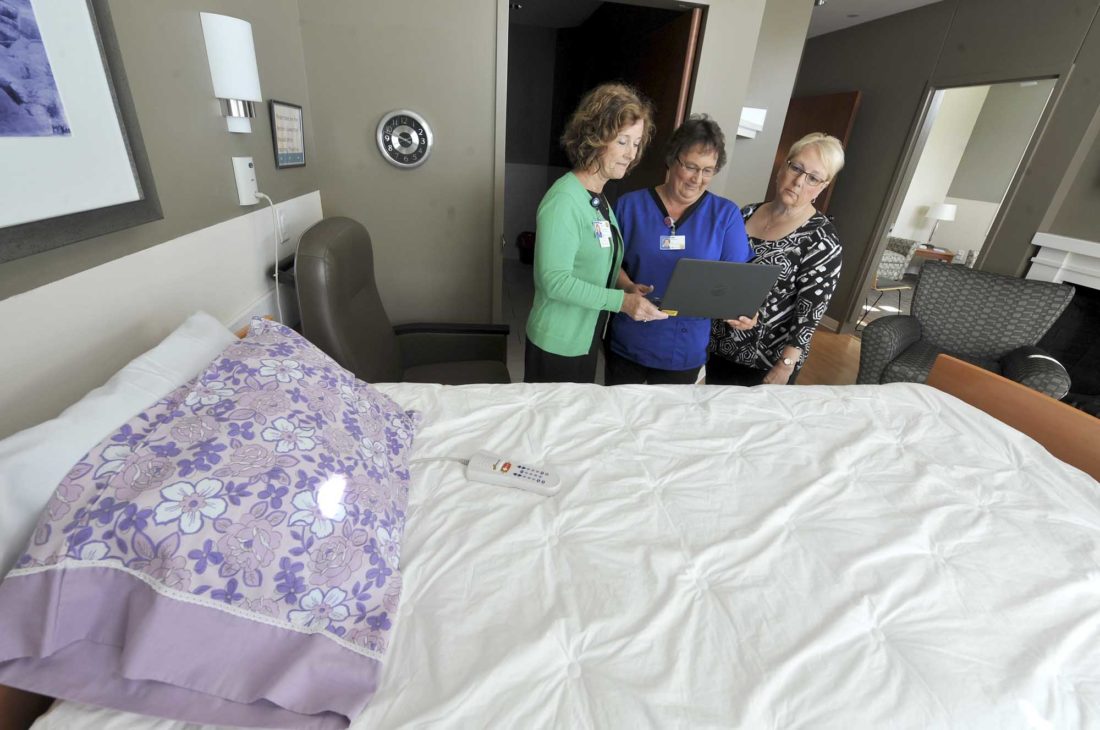
-Messenger photo by Hans Madsen Paula J. Baber Hospice Home clinical manager Joyce Bianchi, left, along with RN Becky Crompton and clinical supervisor Becky Kalous look over a patient chart before their arrival.
The goal quite simply is to make living one’s final days comfortable and nonthreatening.
How long someone remains at the hospice house varies greatly.
“We’ve had some patients for a matter of a few hours and we’ve had a few longer-term patients there for two to three months,” Bianchi said.
Whatever the setting, hospice care differs from the approach that would be followed for people who are expected to recover.
“When that patient and family decide that the goals are that they no longer want to seek aggressive treatment, then they are hospice appropriate,” Bianchi said. “Some of the benefits that we’ve seen with hospice services include real-time pain and symptom management. That is an expertise of our staff.”
Addressing crucial pain and symptom issues is just part of the story.
“All of our care is under the guidance of the physician or the provider,” Bianchi said. “We’ve got nurses. We’ve got social workers. We’ve got a chaplain. We’ve got music and massage and pet therapy. We’ve got home care aides that can help with personal care. And we’ve got volunteers that can help with many, many different tasks.”
Not all patients will need all the services hospice offers. Individualized care is at the heart of the hospice approach.
“They can kind of pick and choose according to that menu what services they would like to utilize,” Bianchi said.
Don’t wait too long
To be eligible for hospice care, the patient must generally have a disease or medical issue that means death is likely within the next six months. Some patients are senior citizens, others are much younger. Bianchi said, however, that many people have the misconception that hospice is only an option in the last few days of life. She stressed, that one consequence of that misinformation is that too many of the patients her team members assist enter the system much later than they should.
“What truly happens is we are getting our referrals so late in that disease process that we frequently will have a patient for a matter of hours to just a few days,” Bianchi said. “Medicare defines hospice as six months of life or less. But right now our median length of stay is 10 days. So, it is very difficult to provide the services for the patients and families to get the benefits of the services when we have them for such a short length of time.”
She strongly urged people to learn more about hospice so they can take full advantage of what the program can provide for themselves or family members.
“It’s never too early to learn about hospice services,” Bianchi said. “It helps make that transition easier. We frequently get called on just to give information.”
She said such inquiries are welcome. So too, is the opportunity to tell the hospice story to groups locally and throughout the region.
Expert, compassionate care
UnityPoint Hospice in the Fort Dodge region has a staff team that includes about 50 people, according to Bianchi. Currently the program is serving about 50 to 55 patients. She said most of those are in their own homes or care facilities with the split between those venues about 50-50. Three or four patients are in the hospice house at any given time.
Bianchi said the quality of the professionals who make up its care team is what sets it apart.
“We have a really compassionate team that focuses on giving the best care to every patient as if they were their family. We’re looking for compassion,” she said of the staff. “They have to be very creative. They are in all kinds of different situations in the homes and care facilities. They’ve got to be very confident in their nursing judgments and nursing skills.”
Bianchi said being a hospice team member becomes far more than a job for most people.
“I think it becomes a passion,” she said. “We have longevity in our staff. We have experience in our staff. I think it is a special kind of nursing because the physicians get to know them very well. When they get a call from a hospice nurse, they trust that nurse to say what needs to happen. I think there is a lot of confidence by providers in our hospice nurses because of their skill level.”
And the care hospice provides doesn’t end when the patient dies.
“We also do bereavement services,” Bianchi said. “We follow the loved ones of the patient for up to a year after death. We have a bereavement support group. It meets every month. If they are not in the support group, we do follow-up with email and phone calls and mailings too.”
Meet Joyce Bianchi
This year Bianchi celebrated being part of the UnityPoint team for a quarter century. She has been the hospice clinical manager for three years and has 20 years of home care and hospice experience.
Bianchi grew up in Fort Dodge and graduated from St. Edmond Catholic High School in 1980. She then went to Iowa Central Community College for the registered nurses program.
“Then after that I moved away to Ames for two years and worked at Mary Greeley on a medical-surgical floor there,” Bianchi said. “I returned to Fort Dodge and worked for Webster County Public Health for about 10 years as a home care-hospice nurse. From there I went to the hospital as a hospice-home care nurse. I did that for 10 years. Then I took a little break from hospice and I did some other kinds of nursing. I worked in same-day surgery for about seven years. Then I went to the Wound Center for three years. I helped get the palliative care program started. I did that for about three years before I returned to hospice.”
She said she finds working in the hospice world especially fulfilling.
“It is a very important time of life,” she said. “There is so much living yet to do even at the end of life. I like working with patients and families so that they can live quality days, so that their goals are met. We keep them comfortable. Just help them with their final goals.”
She said it is an honor to be allowed to be “involved in their care at this time of life.”
Bianchi has an important recommendation for the community.
“I think it is important that patients and families feel empowered to have conversations with their providers related to their serious illness and be able to verbalize their goals to the physician as far as how they want this disease to progress and what quality of life they want with this disease,” she said.