
The orphans of spring
When it comes to abandoned wildlife young, call the professionals
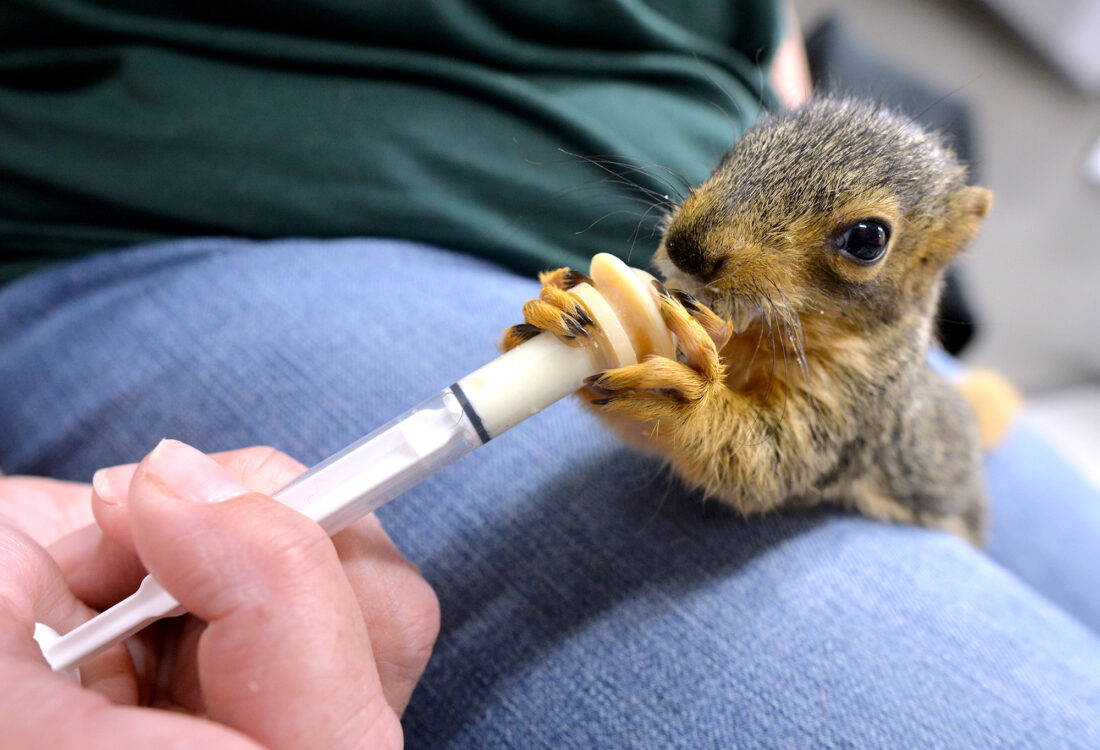
-Messenger photo by Hans Madsen <BR> "Longshot," a 7-week-old squirrel, gobbles up his breakfast Saturday morning during Coffee and Conservation at the Matt Cosgrove River's Edge Discovery Center. Valerie McNeeley, with 515 Wildlife Rehabilitation, does the honors.
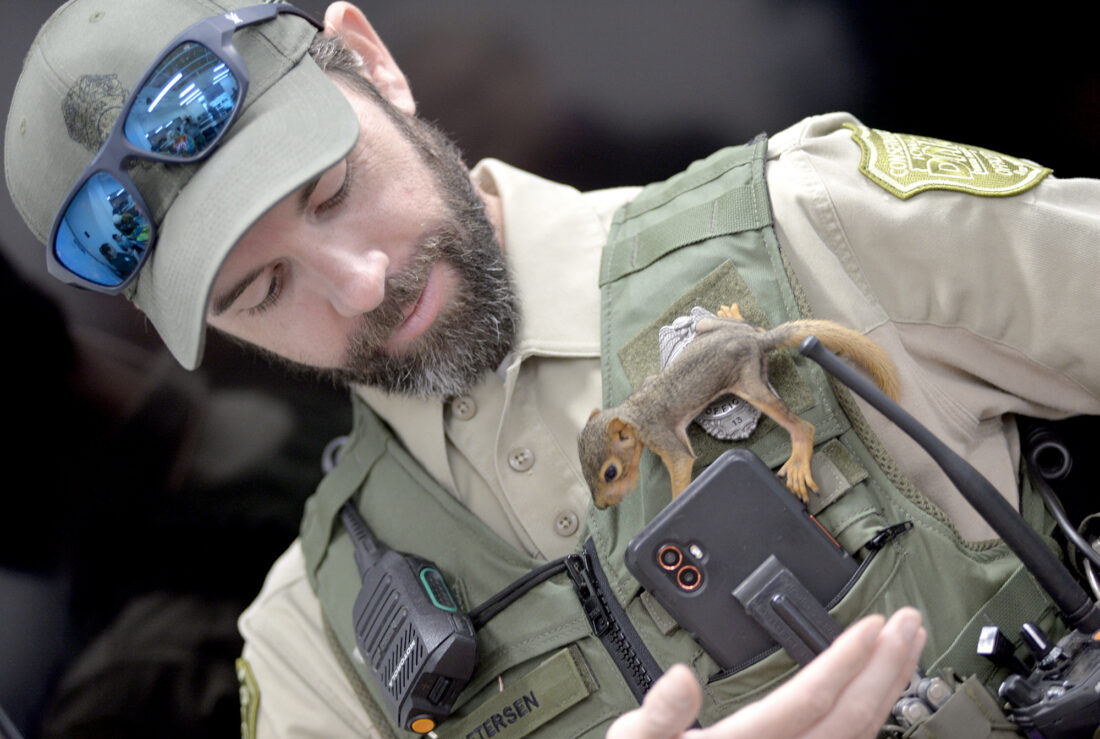
-Messenger photo by Hans Madsen <BR> Matthew Petersen, DNR conservation officer for Webster and Humboldt counties, spends a little time with one of the baby squirrels brought to Coffee and Conservation at the Matt Cosgrove River's Edge Discovery Center Saturday morning by Justin Goodno of 515 Wildlife Rehabilitation.
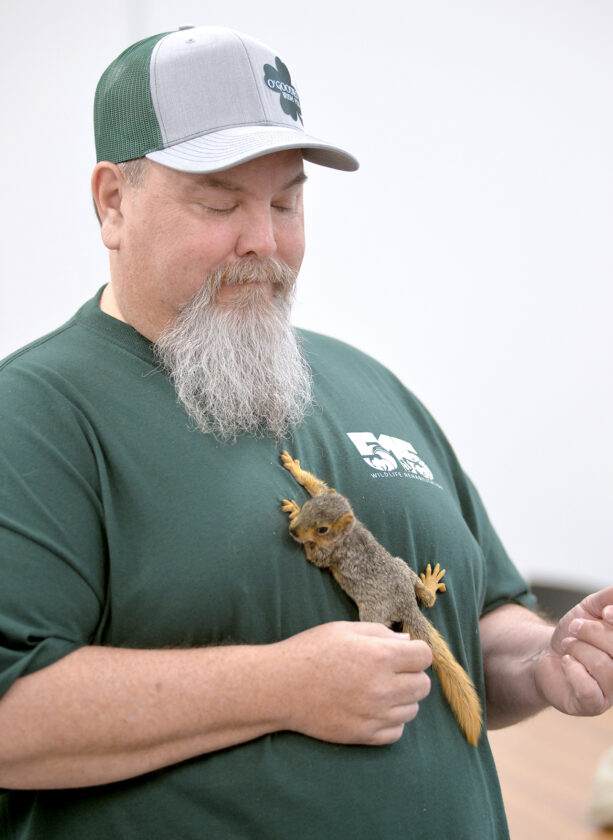
-Messenger photo by Hans Madsen <BR> Justin Goodno, who operates 515 Wildlife Rehabilitation, holds a baby squirrel he's currently taking care of before it is returned to the wild. Goodno spoke Saturday morning during Coffee and Conservation at the Matt Cosgrove River's Edge Discovery Center.
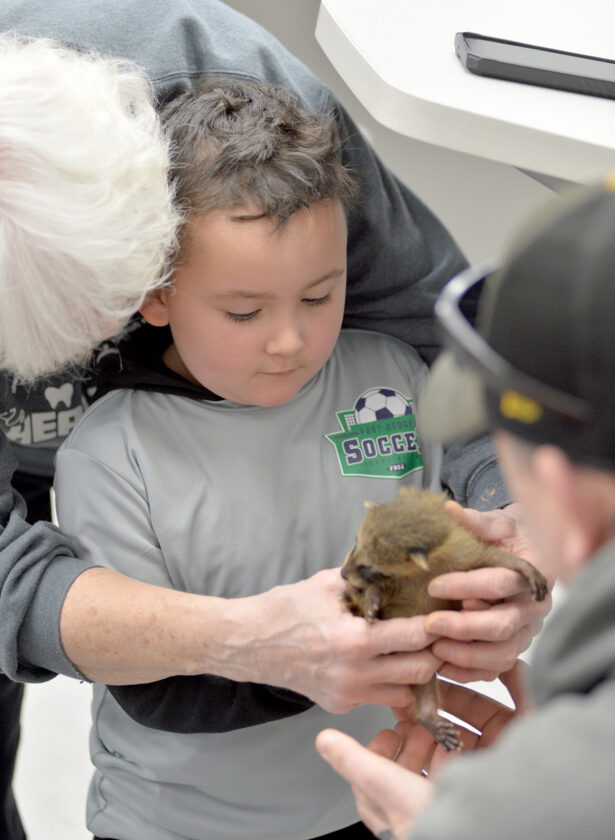
-Messenger photo by Hans Madsen <BR> Magnus Secor, 5, of Fort Dodge, along with his grandmother, Dr. Janet Secor, left, got to meet a baby raccoon Saturday morning during Coffee and Conservation at the Matt Cosgrove River's Edge Discovery Center.
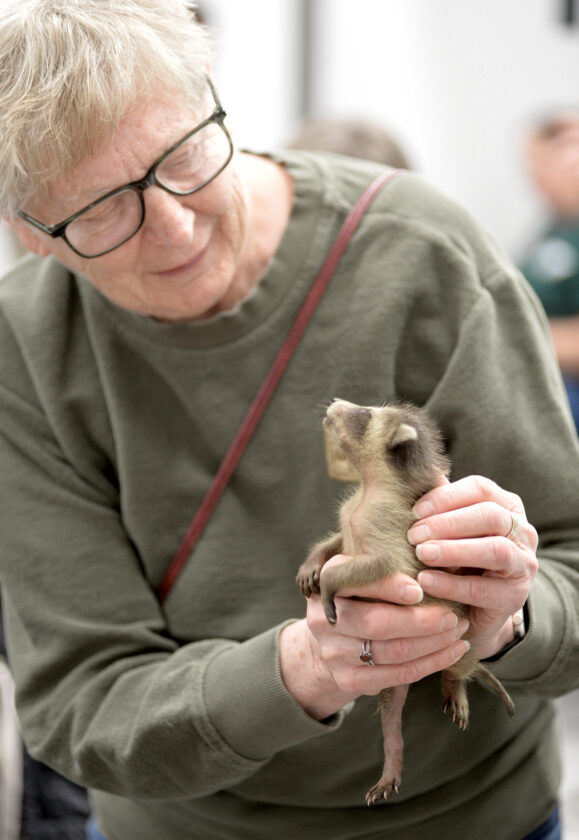
-Messenger photo by Hans Madsen <BR> Linda Lasher, of Fort Dodge, gets to meet a rather noisy baby raccoon Saturday morning during Coffee and Conservation at the Matt Cosgrove River's Edge Discovery Center.
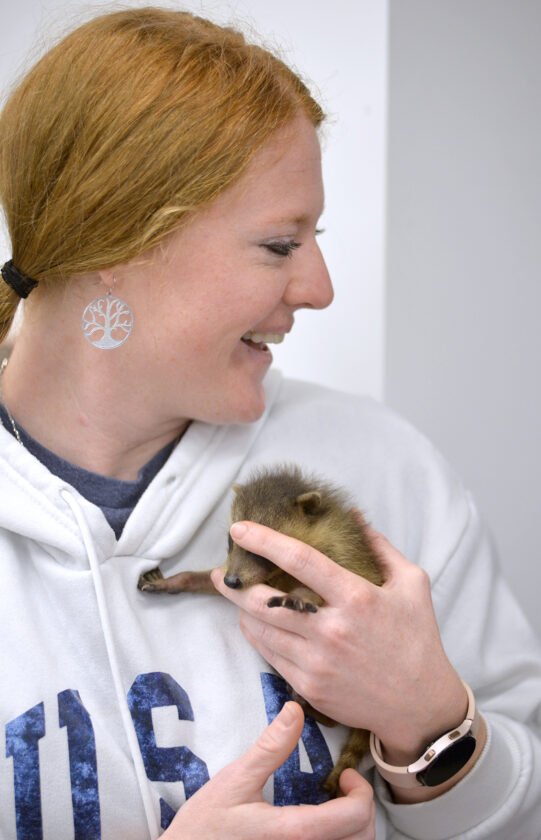
-Messenger photo by Hans Madsen <BR> Chuckie Heuser, of Eagle Grove, who apprentices with 515 Wildlife Rehabilitation, gets her finger turned into a chew toy for a baby raccoon during Coffee and Conservation at the Matt Cosgrove River's Edge Discovery Center Saturday afternoon.
-Messenger photo by Hans Madsen <BR> "Longshot," a 7-week-old squirrel, gobbles up his breakfast Saturday morning during Coffee and Conservation at the Matt Cosgrove River's Edge Discovery Center. Valerie McNeeley, with 515 Wildlife Rehabilitation, does the honors.
-Messenger photo by Hans Madsen <BR> Matthew Petersen, DNR conservation officer for Webster and Humboldt counties, spends a little time with one of the baby squirrels brought to Coffee and Conservation at the Matt Cosgrove River's Edge Discovery Center Saturday morning by Justin Goodno of 515 Wildlife Rehabilitation.
-Messenger photo by Hans Madsen <BR> Justin Goodno, who operates 515 Wildlife Rehabilitation, holds a baby squirrel he's currently taking care of before it is returned to the wild. Goodno spoke Saturday morning during Coffee and Conservation at the Matt Cosgrove River's Edge Discovery Center.
-Messenger photo by Hans Madsen <BR> Magnus Secor, 5, of Fort Dodge, along with his grandmother, Dr. Janet Secor, left, got to meet a baby raccoon Saturday morning during Coffee and Conservation at the Matt Cosgrove River's Edge Discovery Center.
-Messenger photo by Hans Madsen <BR> Linda Lasher, of Fort Dodge, gets to meet a rather noisy baby raccoon Saturday morning during Coffee and Conservation at the Matt Cosgrove River's Edge Discovery Center.
-Messenger photo by Hans Madsen <BR> Chuckie Heuser, of Eagle Grove, who apprentices with 515 Wildlife Rehabilitation, gets her finger turned into a chew toy for a baby raccoon during Coffee and Conservation at the Matt Cosgrove River's Edge Discovery Center Saturday afternoon.
Trending
'Tis the season.
All critters in the wild, great and small, are having babies.
Sometimes, they leave those babies, then people find them.
Then the trouble starts.
That's when Matthew Petersen, Iowa DNR conservation officer for Webster and Humboldt counties, gets involved.
"My phone has been ringing off the hook about wildlife babies," he said Saturday during Coffee and Conversation at the Matt Cosgrove River's Edge Discovery Center. "It's the season."
Most of the time, it's a normal situation. Deer and rabbits are among the species that leave their young during the day.
"Mom will leave then come back at night," he said. "Just like my mom did."
If there's any doubt, he prefers that people call him. He said they will come take a look and evaluate the situation.
If it is actually the loss of a parent animal, he said the last thing he wants people to do is try to rehabilitate the animal. It's not only illegal to keep wildlife without a permit, but very few people have the skills to be successful.
"We know your heart is in the right place," he said.
That's when those licensed to rehab wildlife, such as Justin Goodno, who operates the nonprofit 515 Wildlife Rehabilitation, come in.
He said the response is different for each species and every situation. No two are the same.
Goodno has gotten some memorable calls.
"We had an adult raccoon in the dressing room at Target," he said. "On St. Patrick's Day, we picked up three little baby raccoons from under the hood of a blue F250 at Fort Dodge Ford."
He gave the following general advice for various species.
Deer. "Leave them alone. Fawns especially, don't touch them, don't move it," he said.
Birds. "They get knocked out of the nest all the time," he said. "Leave them alone, even on the ground. In an emergency, you can move them up to where it's safe."
Squirrels. "The best thing to do is put them in a box. Mom will roll them up then carry them up the tree."
Opossum. "They're not scary; they won't attack," he said. "They prefer to drool, fall over and then play dead. If you see a dead one along the road, look to see if it's moving. They sometimes have babies that could still be moving. We've saved possums from the mother's pouch."
Reptiles. "Leave them alone. Just move them along," he said.
Rabbits. He said they're often found by the family dog who might find them a delicious treat. He said that keeping the dog away from the nest is the best idea. An upside down laundry basket with a hole cut for the mother rabbit to get in and out of is one option. The mother rabbit will come back several times a day to feed the babies. They usually do this early in the day and late in the afternoon. People might just simply never see the mom.
Coyotes and foxes have also ended up in his rehab.
"We had three coyotes last year and two the year before," Goodno said.
Is there any species he's yet to see?
"We haven't had a beaver or an otter," he said. "My bingo card is not blacked out yet."
Goodno brought some of his current critters with him, a group of squirrels and a group of raccoons.
Linda Lasher, of Fort Dodge, got to hold one of the raccoons.
"I love these little animals," Lasher said. "I had a set of ducklings in my yard. They just left one day."
Magnus Secor, 5, of Fort Dodge, got to hold a baby raccoon too.
He agreed it had scratchy nails and coarse fur.
To help support Goodno's rehabilitation efforts at 515 Wildlife Rehabilitation, he's available at https://www.venmo.com/u/WR515