
‘His folks were here. They weren’t going to move.’
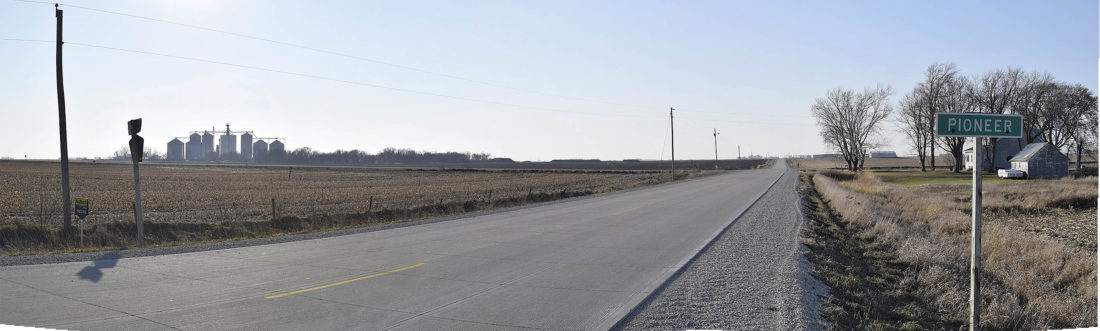
-Messenger photo illustration by Joe Sutter <br> The view from the county road: the town of Pioneer can be seen to the south, left in this image made of multiple photos. The tiny town remains an incorporated “city” as its population dwindles, but now the city clerk is making plans for the day when that will change.
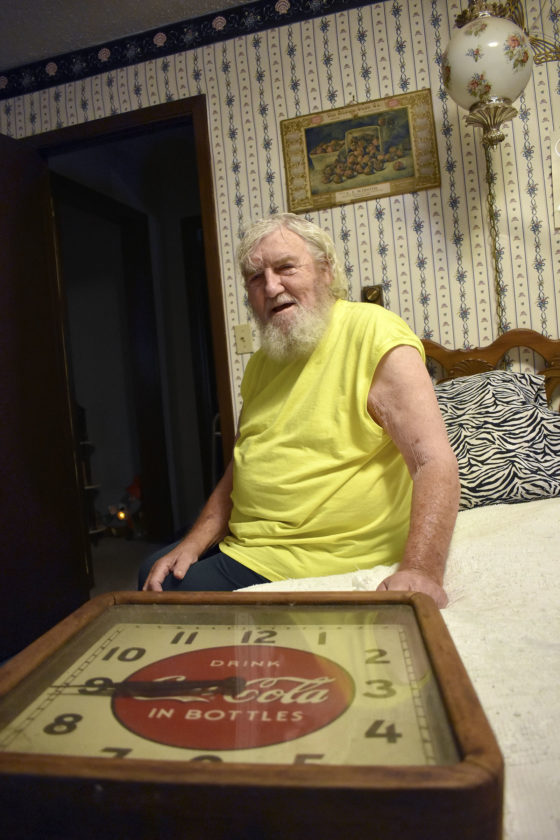
-Messenger photo by Joe Sutter <br> Mayor Ivan Henrichs poses with a clock he got out of the old Pioneer grocery store. The poster on the wall carries the lable of the E.E Webster hardware store, one of the earliest businesses established in Pioneer.
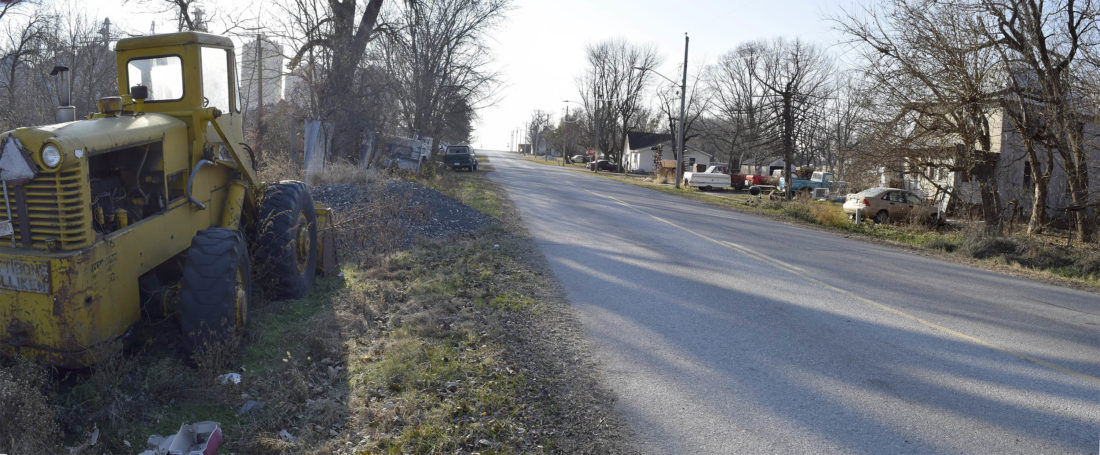
-Messenger photo illustration by Joe Sutter <Br> A salvage yard can be seen looking west into the town of Pioneer, in this image made from multiple photos. Aside from the elevator, the town consists of about three homes that are still occupied, City Clerk Janet Berte said.
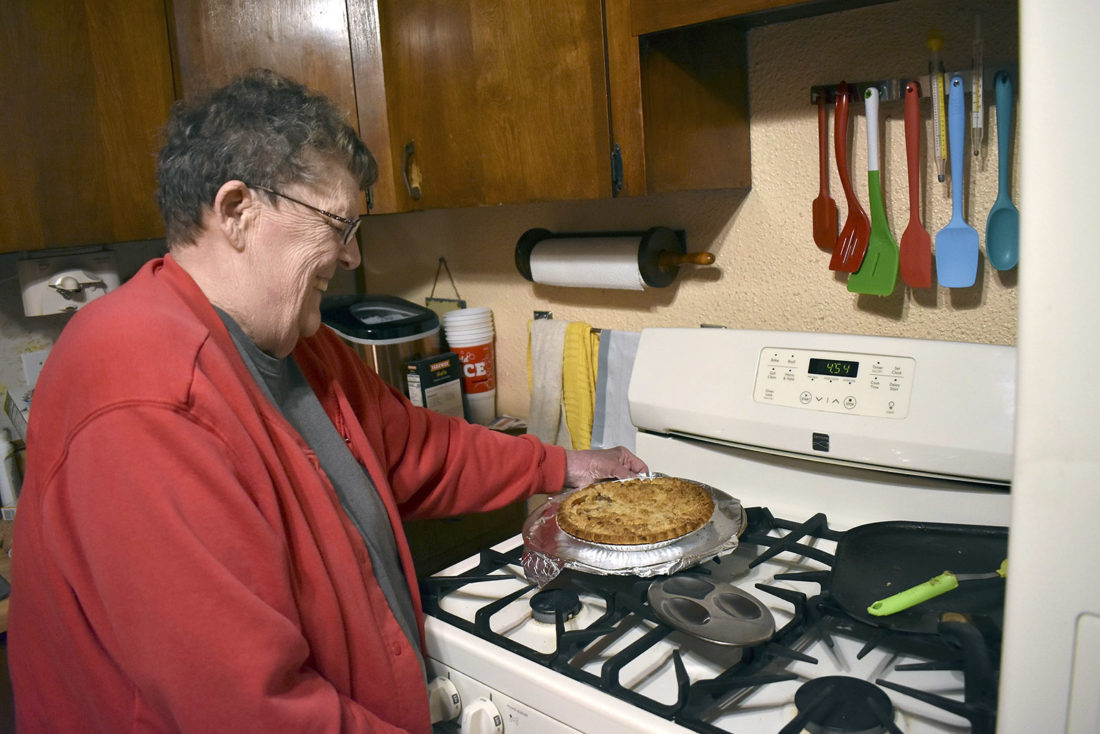
-Messenger photo by Joe Sutter <br> Jo Henrichs finishes baking a pie recently at her home in Pioneer. Jo and Ivan Henrichs have lived here for 52 years and are one of three families left in the little town.
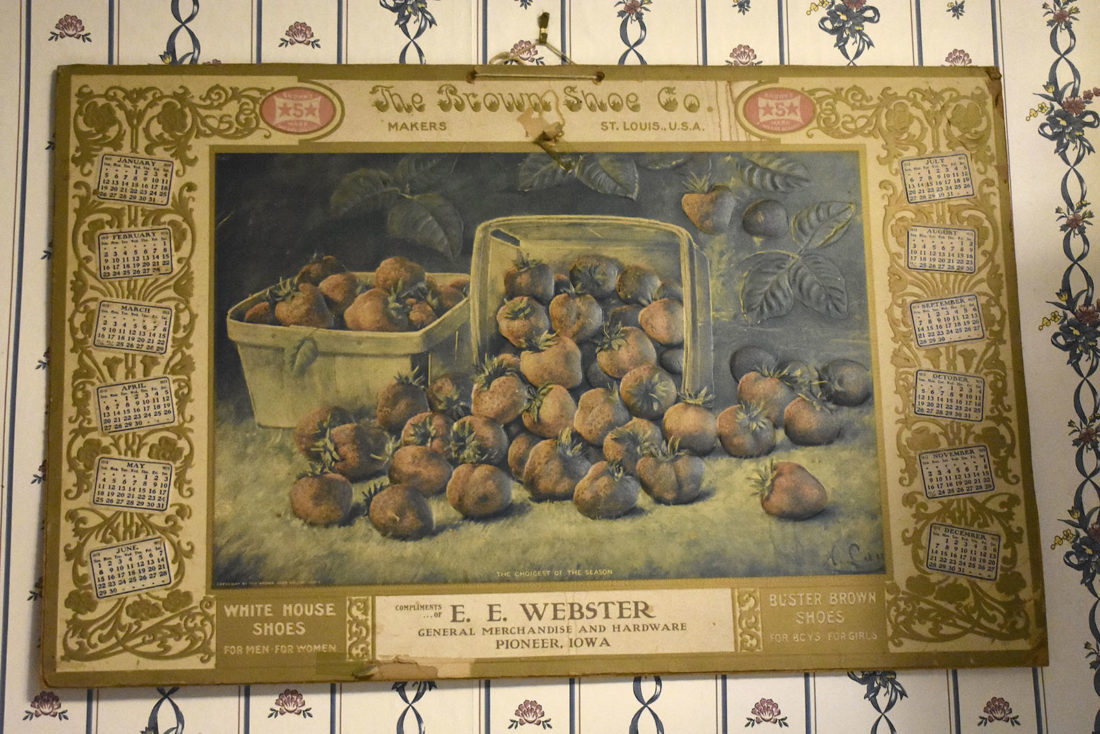
-Messenger photo by Joe Sutter <br> A poster from E.E. Webster's general store now hangs in the home of Pioneer Mayor Ivan Henrichs, who has lived in town all his life. The poster comes from around the turn of the century, and historic records note that the store burned to the ground and had to be rebuilt in 1928.
-Messenger photo illustration by Joe Sutter <br> The view from the county road: the town of Pioneer can be seen to the south, left in this image made of multiple photos. The tiny town remains an incorporated “city” as its population dwindles, but now the city clerk is making plans for the day when that will change.
-Messenger photo by Joe Sutter <br> Mayor Ivan Henrichs poses with a clock he got out of the old Pioneer grocery store. The poster on the wall carries the lable of the E.E Webster hardware store, one of the earliest businesses established in Pioneer.
-Messenger photo illustration by Joe Sutter <Br> A salvage yard can be seen looking west into the town of Pioneer, in this image made from multiple photos. Aside from the elevator, the town consists of about three homes that are still occupied, City Clerk Janet Berte said.
-Messenger photo by Joe Sutter <br> Jo Henrichs finishes baking a pie recently at her home in Pioneer. Jo and Ivan Henrichs have lived here for 52 years and are one of three families left in the little town.
-Messenger photo by Joe Sutter <br> A poster from E.E. Webster's general store now hangs in the home of Pioneer Mayor Ivan Henrichs, who has lived in town all his life. The poster comes from around the turn of the century, and historic records note that the store burned to the ground and had to be rebuilt in 1928.
Trending
PIONEER -- After Ivan Henrichs got married in 1966 and bought a house, he knew just where to find some pre-made components to make the old house bigger.
"We bought this house, and all that was here was this, and that, and the front porch," his wife, Jo Henrichs, said, pointing out the kitchen and living room. "He went out in the country and took a chain saw and cut the side of a house out, and the other side, brought them in on a hayrack, and set them up."
"It's kind of cobbled up, but we don't have any leaks or anything, so I guess it's done all right."
Across from the salvage yard Ivan Henrichs' family has owned his whole life, the Henrich home is one of three houses in Pioneer that still is inhabited. Ivan Henrichs was born 80 years ago and grew up just down the street -- his childhood house was where the metal grain bins of the elevator are now.
It's a sleepy little neighborhood today, with just a few homes, the junkyard, and the co-op. No other businesses.
But Ivan Henrichs remembers when it was more.
"I just turned 4 or 5 when the bank burned," he said. "They turned it into a tavern. We had a feed store, grocery store, a creamery, blacksmith shop, ice cream parlor, post office, a hotel, barber shop between the hotel and the tavern."
Ivan Henrichs has been mayor of the town for a number of years now, with Jo Henrichs serving on the city council.
"We used to have our meetings at the hotel, until somebody bought it out and trashed it. It's still standing, on Main Street, that big square building," Jo Henrichs said.
A brick building nearby was once Archer Feed, Ivan Henrichs said.
The grocery store was near that.
•
Years ago, after the grocery store closed, Ivan Henrichs bought it for $1 in order to tear it down. He still has in his house an antique Pepsi clock that once hung on the wall there.
"When I was a kid, I was 8 or 9 years old when they redid the grocery store, because it burned," Ivan Henrichs said. "So I was up there helping them, and that clock was hanging on the wall. So I stuck it in between the wall, and put a piece of plaster board over it. When I bought the grocery store back in the '90s, the first thing I did was dug that clock out."
Ivan Henrichs remembers when steam locomotives would come through town regularly. There was a water tower for them just across the tracks.
"I used to get in trouble going up there in the summertime, getting under that big spout and dumping the water," he said.
"I used to go up there when I was about 10 years old, go up there and jump on a steam engine and fill it up with water."
Ivan Henrichs also remembers working for the blacksmith when he was about 9, after school. He also worked with the junkyard since then.
He attended the little school in Pioneer.
"It was nice. There were three of us in eighth grade," Ivan Henrichs said. "They went to high school in Gilmore. I couldn't go because my mother got burned real bad."
"The school house is back in the junkyard now," Jo Henrich said.
"In the '60s we bought it," Ivan Henrichs said. "I bought it for $310."
The church that used to be at the east end of Pioneer has been moved to the Weigert homestead over near Palmer, Jo Henrichs said.
•
In spite of its small size, the town is in very good shape. It also has high-quality paved roads, thanks to some extra money the town received.
"The state of Iowa made a screw-up in the '80s," Ivan Henrichs said.
"It was in the '70s, I think," Jo Henrichs said.
"It was in the Fort Dodge paper, all about it," Ivan Henrichs said. "They assessed us for 3,500 some people, and we only had like 200, or less."
"We reported it and everything. ... They said it would take too much money to get it straightened out," he said. "So we blacktopped everything we could blacktop."
"Even the alleys," Jo Henrichs said.
The couple met in Gilmore City.
"I was a friend of this gal down here he used to go with. A neighbor of his," Jo Henrichs said. "We met in Gilmore, at a party or a ball game or something, I don't remember. ... We met in November, and we got married by March."
Over time, folks have moved away, mostly to get jobs, Jo Henrichs said.
"His folks were here, they weren't going to move," she said. "They didn't have anybody to watch over them."
•
One of the earliest names to come from Pioneer is Joseph Michael Anderson Jr., who built the first general store in town in 1890.
That's according to research compiled by Dona Powers Moline, whose work can be found at the Humboldt Public Library. Moline's grandmother, Sarah Ann Engle Powers, first settled in Pioneer in 1913.
The town is also attested to in the "History of Humboldt County," a book by the Historical Publishing Company.
"Pioneer is known for being a great grain center, as it now has large elevators for the accommodation of thousands of bushels of grain," the book states. "In the spring of 1890 J.M. Anderson opened a general merchandise store.
"In 1893 the Wisconsin Lumber company opened for business. M.M. Heptonstall, believing it a successful point for banking, opened the Farmers' Bank in 1898. J.F. Wittman & Co. have put up a pleasing solid store building in which they conduct a general merchandise business. They began business in 1899.
"Other stores have started and Pioneer has made a remarkable success during its brief career."
Heptonstall, the bank owner, was originally from New York, and also owned a general store in Pioneer.
Anderson was born in Oct. 24, 1856, and lived in Pennsylvania. He came to Humboldt County's Weaver Township before the town of Pioneer was laid out, according to the book. He also became the town's first postmaster in 1891.
In fact, there were a number of general stores, grocery stores, and coal businesses in town by 1930, according to Moline's research.
A general store and post office, owned by E.E. Webster, was destroyed on Feb. 29, 1928, by a fire. The call went out by rural phone lines, and the residents assembled with buckets and managed to save the nearby hotel, and the next store to the west.
Webster's store was located at the corner of Main Street and Wesley Avenue, Moline wrote.
A grocery store stood at the corner of Market and Main streets.
The last owners of the Pioneer Grocery Store were Melvin and Bessie Heiter, who bought it in 1958. The store closed in December of 1976 as business declined.
Melvin Heiter passed away in 2007, and Bessie Heiter in 2013.